
- Climate ambition and energy security are now inseparable in a world of geopolitical instability.
- India’s updated climate targets must translate into systems that secure growth, resilience, and autonomy.
- A science-led, centre-state, and market-enabled approach can anchor India’s next phase of climate leadership.
- The views in the commentary are that of the authors.
India is already brushing up against record electricity demand weeks before the peak of summer, with consumption nearing a record 256 gigawatts in April as an intense heatwave sweeps across large parts of the country. Temperatures in central and southern regions are climbing well into the mid-40s, pushing cooling demand and straining power systems earlier than usual. These accelerating extremes coincide with India’s unveiling of its updated Nationally Determined Contributions (NDCs) for 2035 at a moment of geopolitical uncertainty.
The opening months of 2026 have also underscored how fractured the global climate consensus has become. Some countries are wavering on climate commitments, even as 2025 closed with a grim roll-call of climate records, disasters, and missed targets worldwide.
With global tensions disrupting energy markets and exposing the fragility of fuel supply chains, one message is clear: climate ambition today is inseparable from energy security. India’s climate choices are now about securing growth, stability, and strategic autonomy, and they carry unusual weight going forward. India must now move decisively from targets to systems that protect its growth and credibility in the Global South. There are some steps that India can take on this pathway.
Embedding science and development at the core
First, public policy must be guided by the best available evidence. Across the world, scientists are increasingly questioned even as environmental decisions are taken as short-term fixes. Such choices, whether on air quality, energy, or climate policy, affect not just present welfare but future generations. The question is simple: what air, water, and climate do we leave for the next generation?
Sustainable development means meeting current needs without compromising future needs. The science is clear. Research by the Council on Energy, Environment and Water (CEEW) shows 57% of Indian districts, home to three-fourths of the population, now face high to very high heat risk. Monsoon rainfall has increased in 55% of Indian tehsils over the past decade. These shifts affect public health, productivity, agriculture, and the broader economy.
Second, embedding science in policy must begin in schools, with inclusion in curricula, and extend to professional courses and universities. India needs to fund research and build stronger academia-government linkages. More young people in universities need to work on policy-relevant issues, thereby building skills and better preparing them for future jobs.
At the same time, climate action must be firmly located within India’s domestic development agenda. Much of India’s climate push has been structured around the architecture of the Paris Agreement. But mitigation and adaptation are central to India’s next phase of growth. Global mitigation action needs to be accelerated to avert the dangerous impacts of climate change. India’s role is central to this action, given that it is one of the largest global emitters, even though its per capita emissions footprint is low.
At the same time, India’s vulnerability to the impacts of climate change is no secret. This poses both risks and opportunities for India’s next phase of growth. Climate action should not be driven only by international milestones. It must also be informed by a careful analysis of the growth potential it offers and the risks it poses to people, the economy, and ecosystems.
Ambitious targets send clear signals to markets and institutions. They define direction and pace. India’s net-zero target has already pushed policy and private-sector action. Many Indian states and companies have been motivated to explore, understand, and announce their own net-zero targets. Stronger short- and medium-term mitigation and adaptation goals could align even more closely with development priorities.
Our research shows that renewable energy expansion, cleaner industrial and transport fuels, early warning systems, and flood protection can deliver multiple benefits, such as more employment opportunities and resilient communities. Without such shifts, India risks being locked into a high-emissions, high-risk future.


Building institutions, markets and cities for transition
Adopting and implementing targets requires coordination across ministries, states, and local governments. States play a critical role in managing energy systems, land use, and resilience. While relevant national ministries and state departments already work on various aspects of the climate issue, regular coordination for integrated planning and better implementation among these is a must. A formal centre-state climate council could elevate climate action to mission mode, align priorities, and accelerate implementation.
Environmental challenges are also not merely constraints to manage; they are opportunities to innovate. India Inc. must become a partner in building a climate-resilient economy. Energy efficiency, clean production, and circular economy approaches offer competitive advantages. Robust monitoring and evaluation systems, alongside market-based mechanisms and clean-production incentives, can strengthen compliance and ambition.
India must also rethink how it builds its cities. Nearly a third of India’s population lives in urban areas, and the share will rise. Many future cities are yet to be built. Not all small and medium cities need to turn into noisy, congested, and polluted centres. Investments in public transport, safe walking and cycling, and electric mobility infrastructure could reduce emissions while improving liveability. Strong building codes, energy-efficient designs, and alternative materials could lower embodied energy, emissions, and electricity demand for lighting and cooling. Pursuing actions linked to the LiFE (Lifestyle for the Environment) initiative, including smaller houses, higher AC temperature set-points, lower travel demand, higher share of shared mobility, and higher material recycling, could reduce India’s 2070 emissions footprint by 14%. Ensuring safe, affordable, and resilient housing, energy, and infrastructure for vulnerable populations is central to equitable development. Livable cities are climate-ready cities.
At the same time, India needs to continue building the narrative around clean energy. India needs energy for growth, but it must increasingly come from non-polluting sources. While India is already setting a global example for clean energy investment, with 80% of total investment in India’s power sector in 2024 going to renewable energy, discussions often fixate on grid reliability, transmission bottlenecks, and land constraints. These challenges are real, but they should not define the narrative. The focus must now shift to solutions: scaling storage technologies, strengthening grid management, and accelerating system integration. The discovered tariffs for firm and dispatchable renewable energy are already lower than those for new coal-based thermal power projects in India. The transition is economically rational as well as environmentally necessary.

Securing resilience through risk mapping and natural capital
Scientific evidence suggests the world may soon cross the 1.5°C threshold. For India, this implies substantial adaptation burdens. A long-term national strategy must assess climate risks at granular scales to inform land-use planning, infrastructure investment, and settlement design. Protecting both existing and planned assets requires granular climate risk mapping embedded within national and state adaptation strategies. Emerging tools such as CEEW’s Climate Resilience Analytics and Visualisation Intelligence System (CRAVIS), which integrates decades of climate intelligence with forward-looking projections, can help translate such data into actionable planning across sectors and geographies.
Equally, protecting and restoring natural resources is central to resilience. Forests, mangroves, rivers, waterbodies, hills, and urban green spaces underpin both India’s biodiversity and economic security. For example, while several states have achieved success with afforestation efforts, enforcement remains uneven. Biodiversity conservation must be integrated into planning and design guidelines, supported by strong regulations and incentives. Protecting natural capital is foundational to resilience.
Finally, commitments must be matched by transparent action. Decision-making processes should encourage dialogue and openness to scrutiny. Climate-related data must be accessible and reliable. For existing policies and targets across sectors, India needs transparent reporting on action, effectiveness, and evidence, including failures and trade-offs. Did a policy achieve its intended outcomes? What benefits did it deliver? Did it create trade-offs, and how were these resolved? Large public programmes such as the Swachh Bharat Mission demonstrate the value of structured monitoring and evaluation. Climate policy deserves similar rigour.
The climate crisis remains one of the defining environmental challenges of our time, but it is also an opportunity to showcase bold vision and leadership. Ambitious domestic action would send a powerful signal: that India’s growth story is inseparable from its climate responsibility.
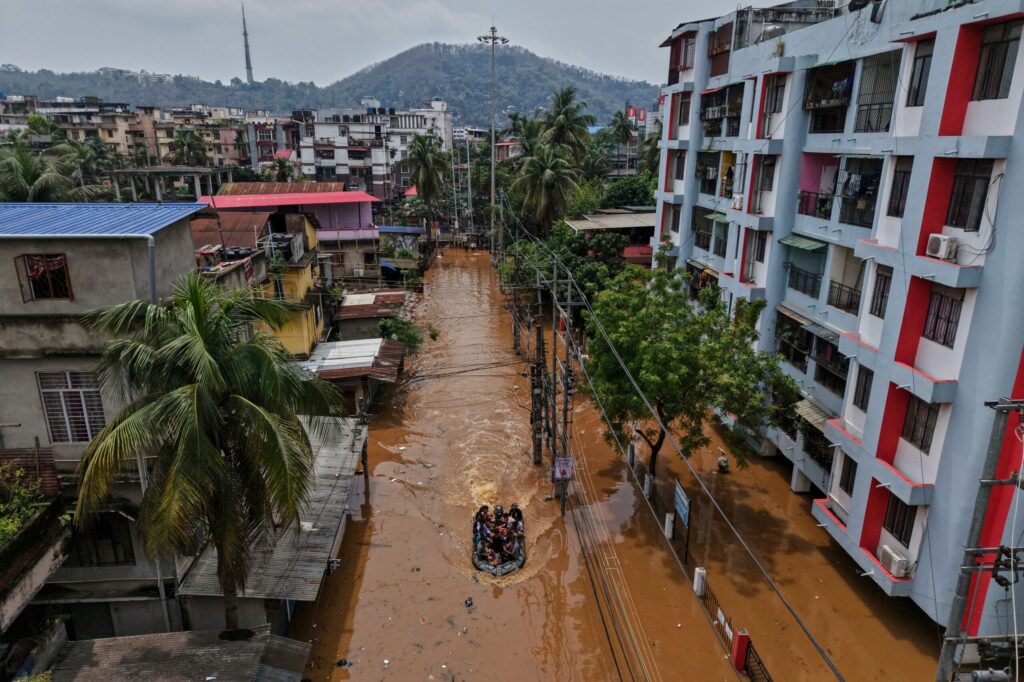
Banner image: State Disaster Response Force personnel head to rescue affected people after heavy rainfall in Guwahati in April 2026. (AP Photo/Anupam Nath)
Minal Pathak is an Associate Professor at Ahmedabad University, and Vaibhav Chaturvedi is a Senior Fellow at the Council on Energy, Environment and Water (CEEW) and an Adjunct Professor in the Strategic Management Area at XLRI Jamshedpur.

