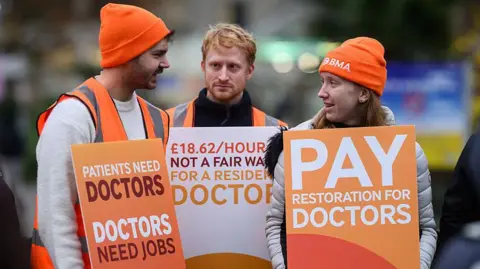
 Getty Images
A five-day strike by resident doctors in England will start as planned on Wednesday 17 December, after they rejected the latest offer from the government.
The British Medical Association (BMA) said 83% of its members had voted to continue with the walkout after ministers said they would not increase doctors’ pay.
It will be the 14th strike since the long-running dispute began in March 2023, and follows an earlier five-day walkout in mid-November.
Who are resident doctors?
Resident doctors are qualified doctors who have completed a medical degree.
They make up nearly half of all doctors in England, and work across the NHS including in A&E and GP surgeries.
After their initial degree and the mandatory two years of post-graduate foundation training, many choose to specialise in a particular area of medicine or surgery.
They used to be known as junior doctors, but in September 2024 the government agreed to change the name of their role to better reflect their expertise.
Full training can take a long time, so although some resident doctors may have only recently finished medical school, others could have more than a decade of practical experience and be responsible for most aspects of care.
How much do resident doctors earn?
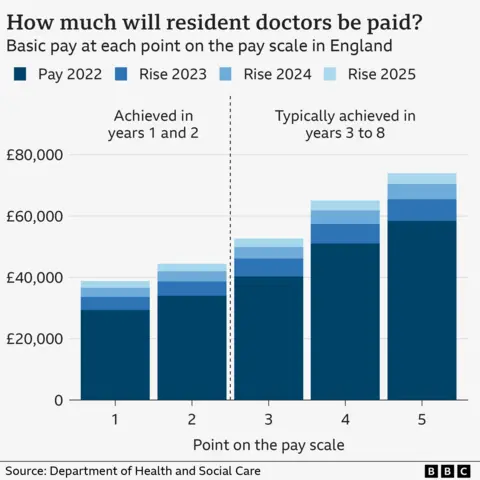
During their first foundation year after finishing their medical degree, resident doctors in England earn a basic salary of £38,831. In their second year, this rises to £44,439.
Medics are often expected to work night shifts, weekends and longer hours, for which they receive extra payments.
After eight years or more, resident doctor salaries can progress to around £73,000.
In 2023 and 2024, they received pay rises totalling 22%, and in 2025 got an additional 5.4%.

What are the resident doctors’ pay demands?
The BMA has called a series of strikes in England over pay and working conditions since 2023.
It argues that resident doctors’ pay is 20% lower in real terms than it was in 2008, even after the 2025 increase.
The government uses the Consumer Prices Index (CPI) measure of inflation to calculate public sector pay increases.
However, the BMA says many resident doctors have large student loans and that interest on these is calculated using a different inflation measure called RPI, which is higher.
Using the CPI measure, the government says resident doctors’ current pay is fair.
But analysis from the Nuffield Trust think tank suggests pay has fallen 5% since 2008 if CPI is used, compared with nearly 20% with RPI.
What have the government and the BMA said about the dispute?
Health Secretary Wes Streeting says resident doctors have received the largest pay rises of any public sector employees over the last three years, totalling nearly 30%. He insists the government will not offer any further increases.
Instead, the the government’s latest offer promised to accelerate the expansion of specialist training posts, which resident doctors move into in their third year of training.
In 2025, there were more than 30,000 applicants for 10,000 of these jobs – some from abroad.
The government said it would increase the number of posts by 4,000 by 2028 – with the first 1,000 available from 2026.
The deal also included emergency legislation that would let the NHS prioritise doctors who have studied and worked in the UK when filling these posts, and restated an earlier offer to cover the cost of some other expenses, such as exam fees.
Responding to the offer, BMA resident doctors committee chairman Dr Jack Fletcher said “it does nothing to restore pay for doctors, which remains well within the government’s power”.
In an online poll carried out days before the strike was due to begin, 83% of respondents said they wanted to continue with the strike. The turnout was 65%.
Prime Minister Sir Keir Starmer said he was “gutted” by the result, describing it as “irresponsible” given the rising pressures faced by the NHS with soaring flu cases.
The BMA’s current mandate for industrial action runs out in early January, but it has started asking its members whether they want to extend the dispute.
What happens if I’m ill during the strike?
The strike in England is due to last from 0700 GMT on Wednesday, 17 December until 0700 on Monday, 22 December.
The NHS is already under huge pressure this winter, with rising flu cases and other winter infections doing the rounds.
It’s also a busy time for hospitals as they discharge as many patients as possible so they can be at home for Christmas.
In previous strikes, the NHS urged patients to come forward for care as usual.
That means anyone with a life-threatening emergency should call 999 and attend the emergency department if needed.
For urgent, non-life-threatening issues, the advice is to use the NHS 111 website or to call the helpline. GP surgeries will be open as normal.
During previous industrial action, hospitals were told they should only cancel routine appointments in exceptional circumstances.
But at such a busy time of year for hospitals and GP surgeries, appointments and operations are likely to be disrupted for thousands of patients.
Scotland, Wales and Northern Ireland are not affected by this planned walk-out.
What pay rises have other public sector staff had?
In May 2025, the government announced pay rises for a number of public sector workers, including:
- 4.5% for members of the UK armed forces, with 3.75% for senior military staff
- 4% for other doctors, dentists, and teachers in England, as well as prison officers in England and Wales
- 3.6% for some NHS staff in England, including nurses and midwives
- 3.25% for civil servants
However, because a medical degree can take five or six years to complete – longer than most other degree courses – the BMA argues resident doctors’ pay should reflect the fact that they may have more student debt than other graduates.
Resident doctors also have little control on where and when they are asked to work, and say that the need to do placements in different parts of the country can be expensive.