
Times Insider explains who we are and what we do and delivers behind-the-scenes insights into how our journalism comes together.
People contain multitudes, goes the saying. It’s trotted out to explain why someone does things that are contradictory. Most often, Walt Whitman is credited with coining it, in “Song of Myself.”
The line is useful whenever I ask myself one of the more glaring questions surrounding an essay I wrote for the Well desk about my cancer diagnosis and surgery: Why is someone like me, so private and introverted, sharing intimate details of my health with New York Times readers?
Beyond the wisdom of poets, I don’t have a ready answer. I was diagnosed on Memorial Day last year (the palindromic date 5/26/25, in case I ever wanted to forget!), and a month later I had surgery to remove the tumor. Weeks after, when I was trying to distract myself from nausea that could quickly cascade, I grabbed the notebook on my night stand and started writing.
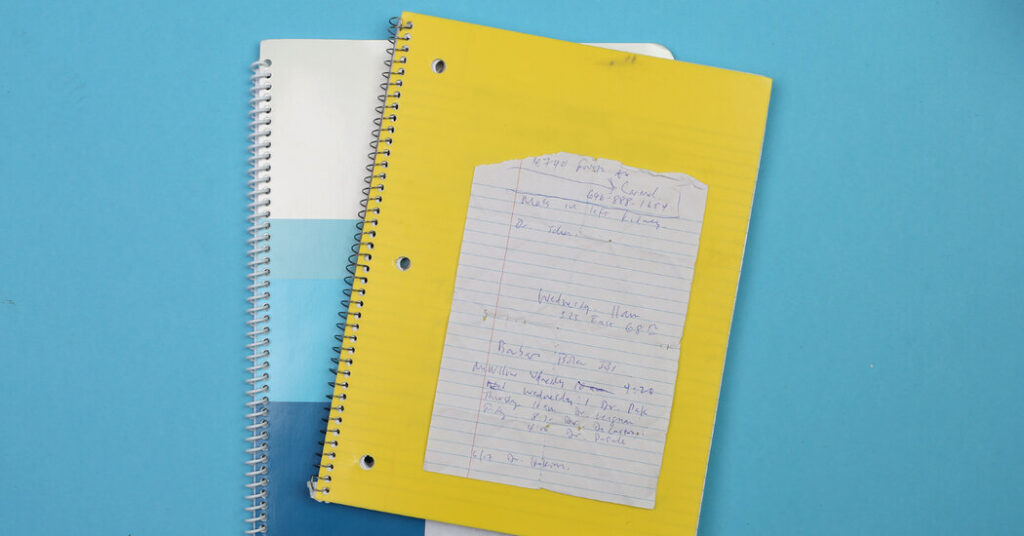
The notebook was there to record what drugs I took and when, so I wouldn’t forget or repeat a dose. That day, though, I used it more like a diary, of my body turning on me.
I work on the Culture desk at The Times, and I also worked on Styles and on the early Live teams, covering the pandemic. It has been a kaleidoscopic tour through the newsroom and an invaluable journalism education. I’ve learned how to write some headlines in 15 seconds; others in 15 days.
The Live teams bring readers breaking news, sometimes minute by minute. We followed President Trump leaving Walter Reed hospital after being treated for Covid in October 2020 and then dramatically ripping off his face mask at the White House. I was editing, too, when we got word of the new vaccines’ astonishing success rates.
These were singular moments in what is now history. My diagnosis and treatment are the opposite, yet overlap, too: singular, but only to me and a very small number of other people. On that otherwise sunny day in May, the call from the radiologist was not unlike breaking news, though it broke in a very different way.
And in many ways, I “covered” it, to myself, using journalism tenets — rigor, determination, terseness and a cool distance.
Until I couldn’t. Scribbling in the notebook was a moment when any distance between me and my disease collapsed. But, as torturous as the pain could be, I wanted to document this phase of my life. I considered keeping all the throwaway bracelets they gave me at the hospital whenever I had an appointment, but then decided they would look like a sophomoric art project, with none of the humor of a $6 million banana at Sotheby’s.
Weeks later, when I read what I had written, there was just a page and a half. (I’d have guessed at least 10 in my fever-dream memory.) The medication schedules and their own sad truths still dominated. There was something poignant, though: the creaky shapes of the words, as if I had lost some fine motor skills or suddenly aged decades.
My wife tells me our dog wouldn’t leave my side as I slept, or tried to, another fact lost to me in my post-surgical haze. This fits with my mythmaking about dogs. They know things, just by the way you look at them. (Also, I had explained to her before my hospital stay that I would be away for a few days, but I’m not totally sure she remembered.)
When I learned of my diagnosis, I told very few people. One of them, a friend at The Times, said it must be awful to be walking around with this while everyone else was just going about their jobs.
I’m not sure she used the word “this” intentionally. She didn’t say “this secret,” or “this knowledge,” words that could have both positive and negative meanings. So much of our language has lost its ability to shock, but “cancer” is a word that can still paralyze.
She was right. It was terrible to be stranded with “this.” The alternative, though — spilling it to hordes of people — seemed even worse.
So, back to the original question: Why do it? Two and a half months after my surgery, I pitched my story to an editor on the Well desk, which publishes a lot of health articles. When I told her I felt ambivalent about revealing something so intimate, she said she thought it would help readers in pain not feel so alone. She was prescient: One reader wrote movingly, “This sounds hokey, but I feel seen.”
Despite my burying much of this deep in my mind, I still have some vivid memories, including the drive to the hospital that June morning. By then, I had told everyone I’d needed to, and what was left wasn’t any more talk of diagnoses, outcomes and odds. This, a random stretch of roadway on the Queensboro Bridge, was where the abstract ended and the tangible began.
My surgeon came by in the prep room. He asked if I was ready. I stammered “yes” even though it was a lie. He touched my shoulder and said he would see me soon.
I was in his endlessly skilled hands now, their mixture of gentleness and force. Soon a nurse escorted me to the operating room. There, my memory starts to fray, and then goes blank as the doctors readied the anesthesia. The work of lifesaving had begun.