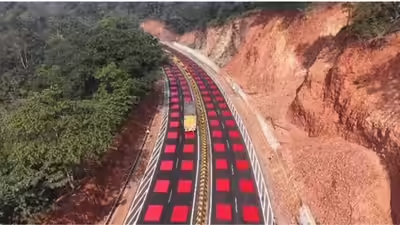
The Ministry of Road Transport and Highways (MoRTH), which oversees the National Highways Authority of India (NHAI), is implementing safety-focused designs that also safeguard ecosystems as the country’s highway network continues to grow. The latest highway stretch in question is the one in Madhya Pradesh that has been able to do just that, and balance both animal protection and traffic safety.The initiative covers an 11.96 km stretch, including a 2.0 km ghat section through the Veerangana Durgavati Tiger Reserve (formerly Nauradehi Sanctuary). This is an ecologically fragile zone with frequent wildlife movement, making safety provisions essential for both animals and motorists. India’s first ‘table-top red marking’ national highwayA major highlight is the country’s first table-top red marking on a National Highway. Inspired by international examples such as Dubai’s Sheikh Zayed Road, NHAI applied a 5 mm thermoplastic red coating on the danger zone’s carriageway. Drivers are warned by the red surface that they are about to approach a speed-controlled and wildlife-sensitive area. Because of the delicate tactile input provided by the slightly elevated roughness, drivers are naturally prompted to slow down without experiencing discomfort or hard braking.The safety of the forest stretch is enhanced by the white shoulder lines along the margins, which further direct cars and keep them from wandering onto unpaved areas.
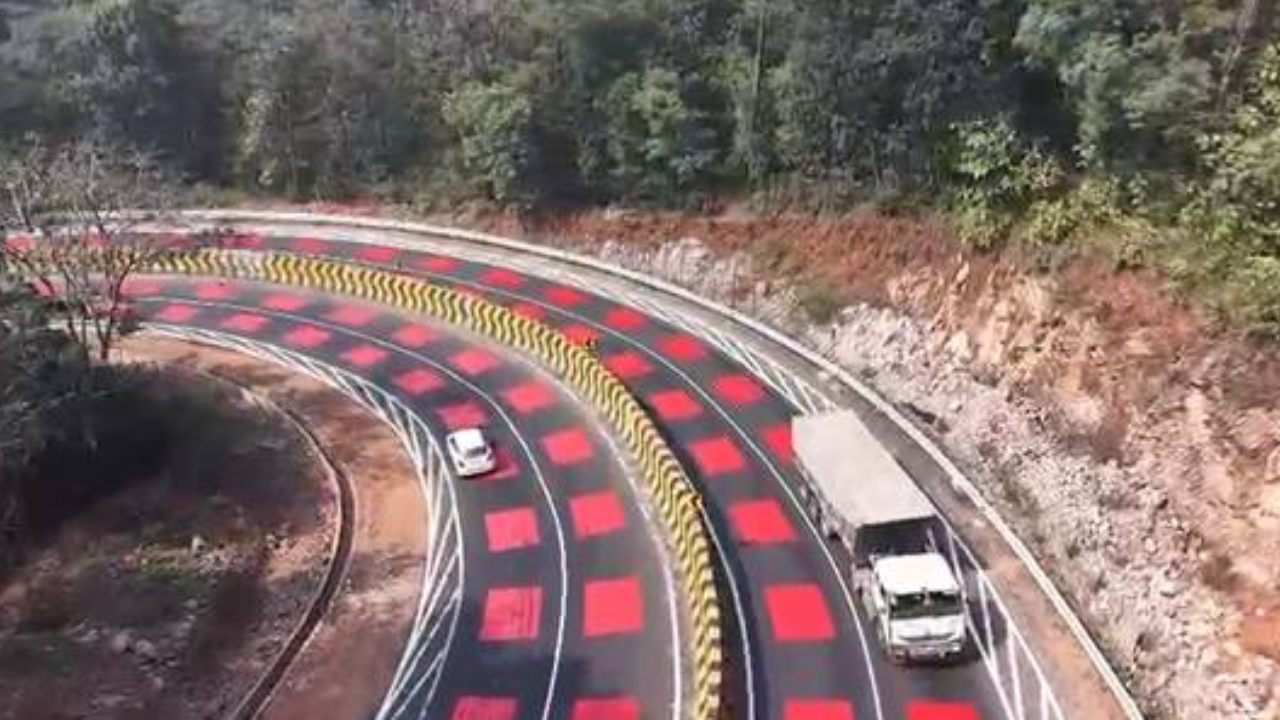
Minimal ecological disturbanceThis surface treatment leaves a minimal environmental footprint. It requires no alteration of the existing road structure or drainage and does not interfere with wildlife movement. It produces much less noise than rumble strips, reducing forest disturbance, and can be easily removed or modified in the future.Read more: What happened when a wildlife photographer woke up with a curled up cheetah beside him Wildlife protection featuresSpeed management is part of a broader safety plan. NHAI has built 25 animal underpasses along the 11.96 km route, placed strategically where animals frequently cross. These underpasses align with natural ground and drainage lines, to encourage safe wildlife passage.Chain-link fencing runs continuously along both sides of the road, except in deep cuts, to prevent direct entry of animals onto the carriageway. Cameras installed on minor bridges, which double as crossing points, help authorities monitor wildlife activity.Read more: 5 destinations that became popular unexpectedlyThe lights at bridges, junctions and culverts are operated by the solar method which makes night driving very friendly to our environment. Even on the risky 2 km ghat stretch, the fencing with underpasses make it impossible for animals to cross directly across roads, protecting people as well as wildlife. This experiment underscores that engineering, ecology and safety can all co-exist. NHAI has managed to, by successfully marrying the global standards of design and local ecological knowledge, do precisely that and create a safer, wildlife-sensitive corridor that will continue to see vehicular movement but shift into gear conservation efforts as well.