This report is from this week’s CNBC’s The China Connection newsletter, which brings you insights and analysis on what’s driving the world’s second-largest economy. You can subscribe here.
The big story
Latest data from China showed a key gauge on consumption falling to its weakest level in nearly three years. But it does not capture the full story.
American membership warehouse clubs are telling something more nuanced: they are finding success in drawing consumers who are willing to pay a hefty membership fee in exchange for premium goods at reasonable prices. On top of that, those stores provide no-frill “treasure-hunt” shopping experiences to sweeten the deal.
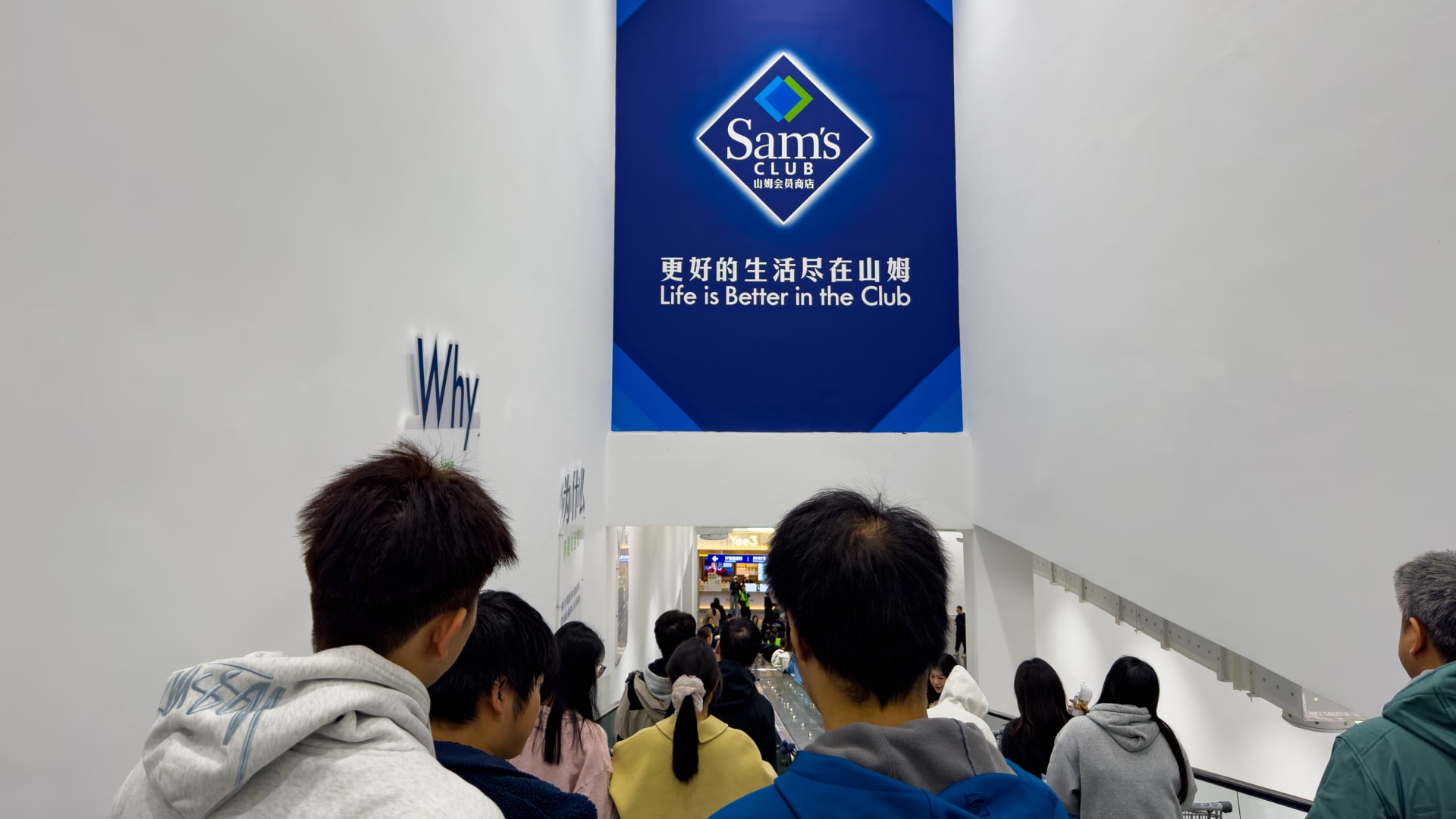
Sam’s Club, the membership-based warehouse retail arm of Walmart, opened its new store in Beijing last month, followed by another one in Shanghai on Tuesday. They drew large crowds, snarling traffic for hours and keeping consumers in long queues.
Walmart plans to open 10 new Sam’s Club outlets in China this year — its fastest expansion ever — and is on track to reach this target, with its 10th store opening in Guangzhou next week.
YANGZHOU, CHINA – NOVEMBER 12, 2025 – Citizens shop at the first Sam’s Club in Yangzhou, Jiangsu Province, China on November 12, 2025.
Cfoto | Future Publishing | Getty Images
Such warehouse stores have long been known as places to buy large quantities of household staples at cheaper prices.
Even though it’s less typical in China, where grocery habits have historically skewed toward high-frequency, smaller-basket shopping, this retail model is starting to find its customers.
“Here they do buy it because of the value and niche products,” said Cameron Johnson, Shanghai-based senior partner at consulting firm Tidal Wave Solutions. He said residents in his compound often ask in group chats whether others want to split oversized packs.
Sam’s Club has leaned into that proposition: a shopping experience and product lineup distinct from conventional supermarkets and online retailers, paired with annual membership fees ranging from 260 yuan to 680 yuan ($37-$97). Shoppers get modest discounts — but the bigger draw is access to curated merchandise that they can’t find elsewhere.
“It’s a membership model that consumers pay the membership fee upfront, and as a result, they get a full set of services,” said Weiwen Han, a Hong Kong-based partner at Bain & Company.
Walmart’s success
Walmart entered China in 1996 with its first hypermarket and Sam’s Club warehouse chain in Shenzhen.
But the hypermarket format — which combines a supermarket and department store — has lost momentum as digital retail took off. Sprawling online marketplaces, such as Alibaba and JD.com, with their aggressive discounts and convenience, have squeezed out traditional grocers and foreign players such as France-based Carrefour.
Walmart has closed almost 150 hypermarkets in China since 2020, with just 279 stores operational as of July, down from 412 in 2020.
But Sam’s Club has proven an enduring strength for the company. The chain has turned warehouses into both shopping destinations and e-commerce delivery hubs, while filling shelves with products consumers can’t easily comparison-shop elsewhere, including exclusive items under its house brand Member’s Mark and Marketside.
Beyond online grocery ordering and delivery, the clubs offer an offline experience where shoppers can browse and “treasure hunt” — something local e-commerce players struggle to replicate, Han said.
The bet is paying off. Sam’s Club has become one of the China’s fastest-growing foreign retailers, with 56 outlets nationwide, compared to Costco’s seven stores in the country. The market also helped fuel Walmart’s strongest net sales growth globally. In the third quarter, Walmart’s net sales in China surged 21.9% year on year to $6.1 billion, exceeding the broader Walmart International segment’s average growth rate of 10.8%.
‘Let’s go to Disney’
That blend of curated products and digital convenience helps explain why the model has gained traction with affluent shoppers — and why one store visit can translate into multiple online orders.
Many shoppers won’t return often in person. They’ll make one trip to browse, then rely on the mobile app for five to 10 deliveries from the same store, said Curtis Alan Ferguson, former president of Coca-Cola Greater China and Korea and now managing partner at Ventech China, a venture capital firm focused on consumer startups.
For some, the appeal is the outing itself — a well-designed, predictable version of discovery shopping. “It’s more of a … ‘let’s go to Disney’ here,” Ferguson said.
Aside from the physical shopping experience, Walmart says speed is part of the stickiness. “Our team in China delivers extremely fast, with nearly 80% of digital orders delivered within one hour,” Doug McMillon, Walmart’s CEO, said on the company’s third-quarter earnings call.
Ferguson said suppliers also like working with Sam’s Club because the volumes can justify unique packaging or sizes. “People bend over backwards to give [Sam’s Club] the quality they desire,” he said. “If you have … Sam’s or Costco pulling your brand … that gives you some other cachet.”
Hard to copy — even with local muscle
Few local rivals have managed to seriously challenge Sam’s Club and Costco in membership retail — and not for lack of trying.
Alibaba’s Freshippo, the Chinese tech giant’s grocery business, shuttered its last members-only store in August.
However, regional chain Pangdonglai, which started in Xuchang, a city in the heartland of Henan, is widely viewed as a standout success.
Pangdonglai’s appeal is that it operates on a “people-first philosophy” where emotional value and trust matter more than scale, said Olivia Plotnick, founder of Shanghai-based marketing agency Wai Social.
But the Henan store has struggled to scale beyond its home base. Its distinctive culture and high operational standards can be difficult to replicate — and to defend — in larger, more competitive cities, said Plotnick.
“Consumers with real demand for premium value are still willing to pay, but those seeking rational, low-price essentials are shifting toward discount formats,” Plotnick said.
As China’s consumer slump drags on, the warehouse clubs that offer quality goods at reasonable prices, and provide a store experience that online competitors can’t easily rival, are emerging as rare bright spots in the sector.
Top TV picks on CNBC

Zerlina Zeng, head of Asia credit strategy at CreditSights, discussed the reason behind the strong performance of offshore Chinese yuan-denominated bonds.

Alex Stamos, Corridor chief product officer and former Facebook chief security officer, joined “The Exchange” to discuss the future of AI regulation and why China is leading the pack for open-weight AI models.
Need to know
Chinese chipmaker MetaX spikes nearly 700% in debut. The company began trading in Shanghai on Wednesday and saw it shares jump from 104.66 yuan ($14.86) to 829 yuan. MetaX Integrated Circuits develops semiconductors for AI applications.
China’s economic slowdown deepened in November. Consumption, investment and industrial output growth fell short of expectation and worsened from previous readings.
Government jobs draw flocks of China’s youths. As many as 3.7 million applicants are vying for one of the 38,100 entry-level government roles that start next year. The slump in private sector jobs is drawing people to the civil service.
Quote of the week
In the markets
Chinese markets traded higher Wednesday. Hong Kong’s Hang Seng index rose 0.82%, and the mainland CSI 300 advanced 1.83% after Chinese chipmaker MetaX Integrated Circuits soared almost 700% in its market debut.
The Hang Seng Index is up nearly 26% year to date, while the CSI 300 has risen 16.39% across the same period of time.
The offshore yuan last traded at 7.0421 against the dollar.

The performance of the Shanghai Composite over the past year.
Coming up
Dec. 20: 1- and 5-year loan prime rate
Dec. 22-27: 19th session of the National People’s Congress Standing Committee