
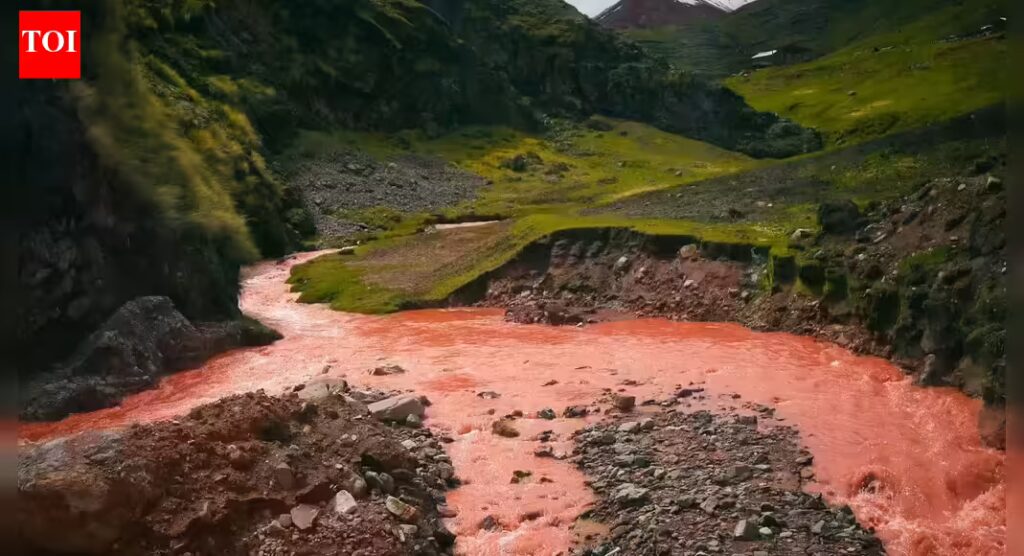
Every year, the southwest monsoon event changes India’s river systems. The changes include turning one of India’s rivers red. The effect is associated with increased rainfall. The changing colours of India’s rivers are closely linked with the monsoon. The monsoon is associated with changes in India’s climate. The changes in India’s rivers are linked with well-understood processes involving India’s climate. Explaining why India’s river changes to red during the monsoon season helps us understand how India’s natural processes relate to changes in climate.
How monsoon rains increase river flow and stir up sediment
The first obvious factor affecting the change in river colour is the sudden rise in water discharge witnessed during the monsoon season. Rainfall rates escalate considerably between the months of June and September, which results in numerous streams and river tributaries emptying into the river. Consequently, river speed and agitation increase significantly, causing the water to be able to suspend a considerable amount of material compared to the previous season.Studies on the sediment load characteristics of the Himalayan rivers, like the comprehensive research done by Subramanian and Ramanathan, clearly establish that the monsoon discharge has the capacity to carry as much as a few hundred million tons of sediment every year. In particular, during this phase, the suspended load is mostly made up of fine sediment like silt and clay, which is able to stay suspended for a large part of the spectrum due to the constant turbulence. Unlike the clear water, this material tends to scatter light in a way that makes the stream appear murky, turning increasingly reddish brown based on the concentration.
What role iron-rich sediments play in turning the river red
This red colour, evident during the monsoon season, is very strongly associated with the geographical features of the river basin. A considerable part of eastern and northeastern India is composed of land wherein iron oxide is in high concentration in decomposed rock formations and laterites. These soils get coloured red and brown due to high iron oxide content, especially when they come in contact with tropical conditions.The heavy rainfall loosens up these layers of iron-rich material and causes them to flow downslope into streams and rivers. Suspended, even small concentrations of iron-coated particles will strongly influence water colour. In contrast to coarse sand, fine lateritic material remains suspended for long periods of time. Further, because several tributaries drain their material simultaneously, their effect is evident over extended stretches of the river, sustaining the red colouration of the seasons without obvious cause.
What increases soil erosion when monsoon rains peak?
Natural erosion increases abruptly with monsoon rains, although the magnitude of solid material transport is also dependent upon the conditions of the land surface. Before monsoon rains, a major part of the basin has dry spells, which make the soil loose. Then, with the onset of heavy rains, the soil gets displaced much more effectively than with gentle rains.Additionally, human land use systems modify this process. Agricultural land ready for cultivation, embankments, settlements, and transport routes that are not paved all contribute to making the soil less stable. Under these conditions, soil erosion is exacerbated because the vegetation cover is likely to be inadequate for protecting the soil from being flushed by the excess water. The soil under these conditions flows freely into the drainage channels, hence increasing sediment input into the river. It does not amount to abnormal sediment degradation.
Why the river stays red long after heavy rain has fallen
After entering the river, the sediments become dependent on the intensity of the flow as well as the characteristics of the river channels. Since during monsoon, the intensity of the flow hinders the settling of fine sediments, they are suspended throughout the entire cross-section of the river. This phenomenon accounts for the distribution of the red hue throughout the length of the river, sometimes reaching the deltaic regions as well.Although precipitation may decrease in the local area, the input from upstream sources may be high enough to maintain high concentrations of sediment in the water for several weeks. The width of the river further down also works to retard sedimentation, since a wider river means that the energies of the water are dispersed over a wider area, which does not act to calm the water’s turbulence. Consequently, the transition of the colours is smooth rather than immediate, occurring only when the water levels are low enough for sediment to settle on flood plains and the bottom of the river.
Why the river turns red every year but not always the same way
The reddening of the river due to the monsoons is a phenomenon which occurs every season. Every year, the level of rainfall and the geographical distribution of the rainfall influence the final effect of the river reddening. The more the rainfall in the form of monsoons, the redder the river looks. The less the rainfall or the weaker the monsoons, the less reddening occurs. On a more extended timescale, this kind of sediment movement is crucial for the creation of flood plains and the regeneration of soil nutrients and deltaic formations. So the red water observed during the monsoons is actually an indication of this natural process that is taking place. It is actually the indication that the river is working at this time in a natural cycle because of the earth materials moving over the land and the climatic conditions.Also Read | Could global warming paradoxically freeze the planet: How tiny ocean organisms could flip Earth’s climate