
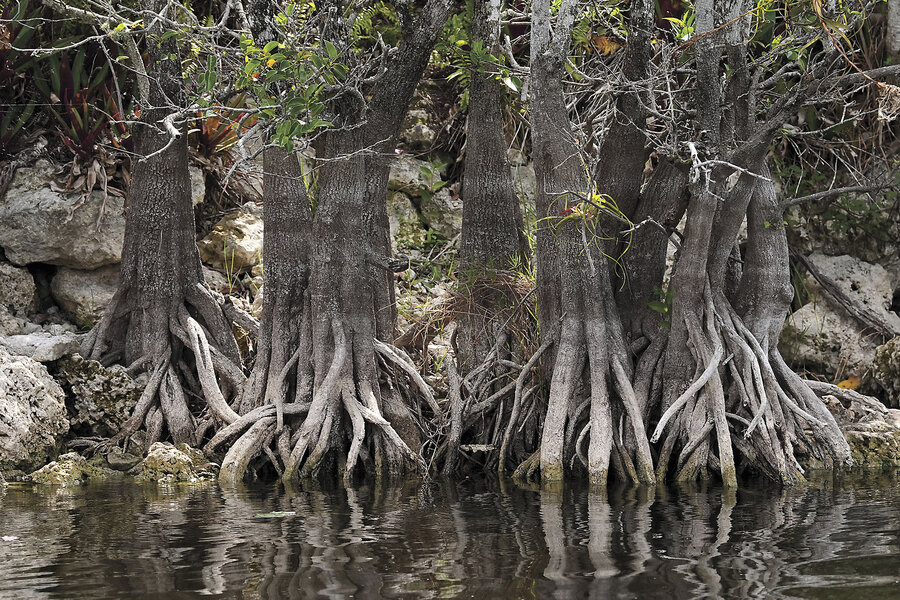
Barbara Blonder has been a bit worried about her parents’ house, which sits near a Cypress swamp outside St. Augustine, Florida.
In a normal year, the saturated wetlands would protect her mom and dad from the threat of wildfires, says Ms. Blonder, vice mayor of the centuries-old historic city on Florida’s eastern coast.
But like numerous states across the nation, Florida is in the midst of a severe drought spanning the entire state, and that has fueled a large number of wildfires unusually early in this year’s season of heaviest wildfire risk.
Why We Wrote This
Winter conditions usually tamp down wildfire risk. But across the U.S., drought and heat have set the table for hungry fires. Some states prone to wildfires are beginning to embrace controlled burns that give fires less fuel when they do start.
“If a fire gets going in there, the potential for an ember to reach their house and land on the roof is entirely possible,” says Ms. Blonder, who is also a professor of natural sciences at the city’s Flagler College.
Years ago, she was a certified “burn boss” in Florida’s nationally recognized wildfire prevention efforts, which include prescribed burns to remove the underlying fuel of what could turn into a massive blaze. “I can remember 15 years ago the Okefenokee Swamp [in Georgia] burned, and a lot of it got into what we call a ‘duff or muck fire’ – a fire in what is normally fully saturated soils, but now it’s all dried out and it burns easily.”
In Florida, wildfire conditions peak in April, May, and June, but already there have been a series of significant fires in Florida. In the south, a wildfire in Big Cypress National Preserve burned tens of thousands of acres, sending smoke across highways and into nearby communities. Fires have flared in Central and North Florida, including in the Ocala National Forest and along the Gulf Coast, as dry vegetation and persistent winds fueled rapid spread, an unusually active pattern for this early in the year, according to federal reports and the Florida Forest Service.
The conditions driving Florida’s increase in the number and size of wildfires have also been driving others across the United States, across a wider range of regions than is typical, alarming wildfire experts of a difficult year ahead.
Last year, conflagrations in greater Los Angeles revealed the extremes of wildfire risks in a region where such fires are notorious. Through April 14, however, more than 1.7 million acres have burned across the United States – more than double the 10-year average for the same period, according to the National Interagency Fire Center.
In the West, a historic snow drought and an intense, far-reaching heat dome over the western and central United States have contributed to the severe start to the 2026 wildfire season, experts say.
Nebraska has emerged as one of the most striking examples of this year’s early wildfire surge in the Great Plains. In March, a cluster of wind-driven fires burned more than 800,000 acres across the state, churning through dry underbrush and grassland under powerful gusts, according to state incident reports.
The Morrill Fire became the largest wildfire in modern Nebraska history, consuming more than 640,000 acres, according to state officials.
Similar fires have flared across states like Oklahoma, Texas, and Colorado, even as winter conditions would typically limit fire spread. The scale and timing of these fires have drawn national attention not just because of their size, but for the number of them, and how quickly many have spread.
“We’ve seen a lot more winter activity – dry winters with high winds or lightning storms – and we see this increased wildfire risk at times of the year when you may not associate high wildfire risk,” says Chris Seaman, a services director at Rayburn Electric Cooperative in Texas, whose job includes monitoring 265 miles of transmission lines for signs of wildfire east of the Dallas-Fort Worth area. “That’s kind of changed our dynamic. … [W]e’re always monitoring. We treat it as year-round now.”
Drought and high winds have been the immediate causes of the number of wildfires across the United States. But the country’s forest policies also have a lot to do with a growing problem, says Josh Cook, a former regional administrator of the U.S. Environmental Protection Agency in the second Trump administration.
“A lot of this is a man-made disaster,” says Mr. Cook, who’s spent decades working on forestry and land management policy in California. Over the past few decades, the U.S. Forest Service adopted what became its foundational principle: Extinguish every wildfire, as fast as possible, wherever it starts.
That philosophy, he says, spread from federal agencies into state land managers and eventually into the broader cultural assumption that trees are good and fire is bad.
“That has permeated our management practices in Los Angeles, in Nebraska, in Colorado, Oregon, and Washington. Not just forested states, but almost everywhere,” he says. “We learned to love trees and we loved them to death.”
The consequences, he argues, extend beyond wildfires. Dense, unmanaged forests don’t just burn, they drink. The Yuba County Water Agency in Northern California now pays for forest fuel reduction work in its watershed, he notes, because thinning trees produces a measurable increase in downstream water flow.
Mr. Cook has also spent over 25 years working alongside the Mooretown Rancheria, a Concow-Maidu tribe whose aboriginal homeland lies in Northern California. The tribe lost their land after settlers seeking gold and then timber flocked there in the 19th century, but then worked to get it back. What they found when they returned was a forest that had been overgrown, dense, choked with fuel, and burning with increasing regularity and ferocity.
“They are focused on forest fuels reduction,” Cook says. “This is where the last generation worked in the forest when the forest didn’t burn down every year.”
Still, as the Monitor reported last October, California and other states are beginning to embrace the kind of “controlled burns” that Indigenous peoples long used to fight wildfire with fire, even though unease and suspicion still surround the practice, which is relatively new for people in the western U.S.
Florida, in fact, has been recognized as a national model in fighting wildfires, especially with its decades-long embrace of prescribed burns to remove the dry vegetation that fuels wildfires. The state conducts more controlled fires annually than any other, and maintains one of the most extensive wildfire mitigation systems in the country.
The practice itself has deep roots in Florida, Ms. Blonder notes, stretching back through Indigenous land management traditions and into the habits of early settlers. “It just makes more sense to put the money to fight wildfires in the front end – prevention, not just reaction,” she says.
In some cases, Ms. Blonder says, the tools to fight the increase in wildfires are older than the nation itself, whether carried forward by the prescribed burn traditions of American Indigenous tribes or preserved in Florida’s right-to-burn law – and the 2 million acres the Florida Forest Service burns intentionally every year.
The knowledge of how to live with fire, she says, has always been there, even as wildfires continue to cause more damage. “We’re living the future,” Ms. Blonder says. “It’s come. And it isn’t going to get better anytime soon.”