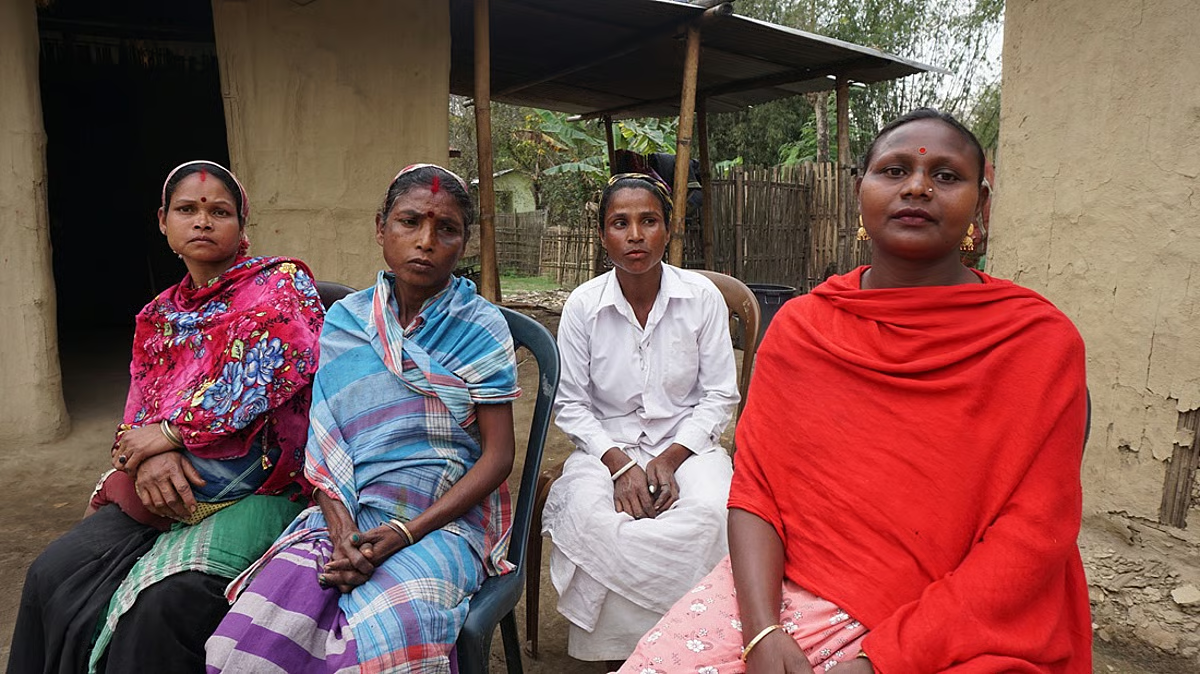
Junmoni Gogoi, a resident of Bagchung block in Assam’s Jorhat district, remains guarded in front of the camera. A daily wage earner, Gogoi is a beneficiary of the state government’s scheme for marginalised women under which four million women were paid Rs 9,000 each, less than a month before the state goes to polls. As a poll pitch, the Bharatiya Janata Party-led coalition government claims that this is the largest ever direct benefit transfer (DBT) in the history of Northeast India’s most populous state.
Much like Gogoi, several women beneficiaries were reluctant to talk about these schemes targeting women voters, fearing that they may not get the next instalment once the BJP-led coalition comes back to power. “What happens if someone finds me talking to a reporter on camera,” Gogoi asks when asked what she thought of the government scheme called Orunodoi. “They keep tabs on everyone. I attended all the block level meetings. I feel that is why I got Rs 9,000,” Gogoi says.
Her neighbour, Champa Gogoi, a resident of Baghmaria village under the Bagchung block, however says that she has never qualified for the Orunodoi scheme, ever since its announcement in 2020, ahead of the previous elections. “I never bothered to attend these meetings at the block level. I am raising two children and I have a small grocery shop, and servicing two loans. I am from the BPL category, same as my neighbour. When I asked a local block level official, they said I will get the benefits if BJP forms the government. These schemes should come to us irrespective of our political choices,” Champa Gogoi told Down to Earth (DTE). “None of these women have received these benefits. So, we have decided to boycott this election,” Gogoi says.
On March 10, women in Assam were called to 2,500 meetings across 35 districts where BJP leaders and the party’s regional coalition partners disbursed Rs 9,000 each — Rs 1,250 per month from January to April and Rs 4,000 as bonus for the annual Bihu festival in April. Announced in 2020 ahead of the 2021 Assam Assembly polls amidst COVID-19 lockdowns, it is believed that these schemes brought back BJP to power with Himanta Biswa Sarma becoming Assam’s chief minister. The state government started the Orunodoi direct benefit transfer scheme with Rs 830 per month which has been revised to Rs 1,250 per month in its third iteration. The Rs 1,250 dole consisted of Rs 400 for procuring medicines, Rs 200 for 50 per cent subsidy on four kilogrammes of pulses, Rs 80 for 50 percent subsidy on four kilogrammes of sugar, Rs 150 for purchasing fruits and vegetables, Rs 170 for essential goods, and Rs 200 for LPG.
Half the sky
Besides Orunodoi, in the last five years, Sarma launched the Mahila Udyamita Abhiyan which promises to empower women entrepreneurs, schemes for girl child protection, health insurance for women, DBT for COVID-19 widows and for tree plantation. These schemes have been launched across the state on a pilot basis with a possibility of being scaled up if incumbent Sarma is elected back to power. However, he himself has been repeatedly insisting that these schemes are not election freebies. Contrary to Sarma’s claims, BJP quickly emulated this model of 2021 Assam Assembly polls and launched similar schemes to win elections in Maharashtra, Madhya Pradesh and Bihar. Sarma himself said 90 per cent of targeted women beneficiaries and their families were covered ahead of the polls while 10 per cent will have to wait till BJP forms a government in the state after the 2026 elections.
Across various mediums, the BJP-led coalition quickly transformed each of the fund disbursal meetings into an elaborate PR exercise targeting women voters across the state. Social media, video streaming websites and direct messaging services have been crowded with testimonials of marginalised women praising Sarma for the schemes. Assam’s cities, towns, pit stops across the highway are littered with hoardings, banners, wall paintings and posters loudly claiming that BJP stands for women empowerment with an oft repeated Assamese phrase, ‘Mohila Xobolikoron’.