
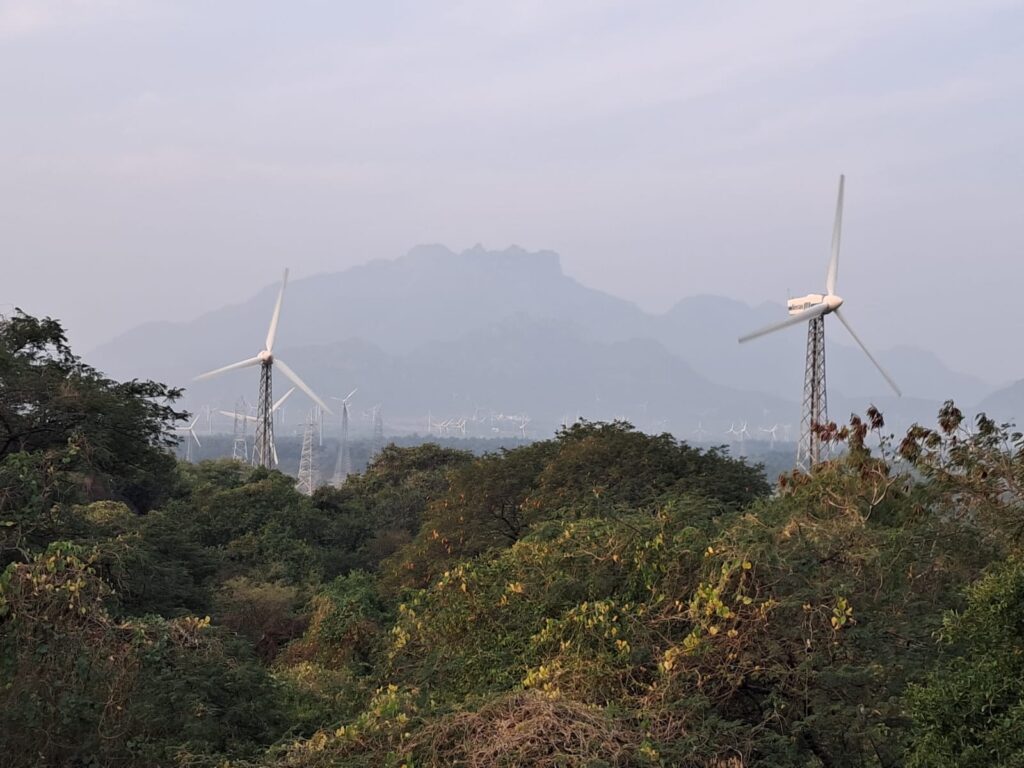
- Wind turbines pose threats to bat species in India and around the world, as bats collide with turbine blades and die. Migratory bat species face a higher risk of collision.
- To understand bat mortality, researchers conduct carcass studies which are very challenging as Indian wind farms operate at a massive scale. Differences in bat sizes and wet season carcass searches also make the process difficult.
- There are also legal challenges such as the lack of protection for many bat species categorised as ‘vermin’ and no Environmental Impact Assessment mandates for green energy projects.
- As India continues to invest in wind energy, this has to come with a better understanding of its impact on biodiversity, especially bats, experts say.
As India’s renewable energy market diversifies, wind farms have emerged as an underexplored threat to bats. Globally, millions of bats die every year when they collide into wind turbines as they fly.
Currently, bat species across the world face significant threats such as habitat loss from deforestation and agriculture, persecution, hunting, urbanisation, energy production, and climate change, according to a 2025 Fact Sheet by the Convention on the Conservation of Migratory Species and Wild Animals (CMS). Yet conversations about biodiversity threats rarely acknowledge that climate solutions, such as renewable energy infrastructure, can themselves pose risks to biodiversity.
The latest State of Indian Bats report also brings attention to wind turbines as one of the threats affecting bat species.
However, there are data gaps in three major areas, bat researcher Rohit Chakravarty says. “One, what species are the most affected. Two, to what extent the mortality is and three, whether there are any seasonal patterns in the mortality across species,” he explains.
With about 135 bat species, India is home to roughly 10% of the global bat diversity. Of these, around sixteen are found only in India. According to Bat Conservation International, of the 122 species from India assessed by the IUCN, “only 23% have stable populations, with the rest decreasing.”
Why bats could be colliding with turbines
While there is evidence of bats colliding with wind turbines, the reasons for it remain unclear.
“It could be because they are drawn to go check out something different. There is also some evidence that it may be some of the lighting that we use at wind turbines that might attract bats into a facility,” says Winifred Frick, chief scientist at Bat Conservation International (BCI).
Chakravarty says that insects might also draw bats to a wind farm. Turbines can attract flying insects at rotor height, and bats following prey could collide while foraging. “The surrounding habitat plays a larger role. Bats could collide while pursuing this food abundance, not turbines themselves,” he adds.
He also points out that for echolocating animals, turbines are harder to detect. “It’s similar to how bats collide with fans, not because they can’t detect them, but because the rapid rotation confuses them,” Chakravarty explains.
Studies have found that bats are the most at risk of collisions with wind turbines during the autumn season, an important migratory and mating period for bats. “But the different reasons why this period is such a high risk are still hypothesised,” says Frick.
Researchers in India have found bat carcasses in and around wind energy farms. For instance, a 2025 study found eight carcasses of an unidentified bat species at wind farms in the Thar desert. Chakravarty and colleagues have conducted studies in Satara, Maharashtra, and recently completed one season of sampling in Kanyakumari. “While we haven’t found many carcasses, we’ve identified collisions that are killing three bat species: the greater yellow house bat, the lesser yellow house bat, and the fulvus fruit bat,” he says. The common pattern is that these species fly at mid- to high altitudes, which puts them at risk of collision, he adds.
Regarding bat distributions in India, Chakravarty notes that southern India faces a greater risk. “The Kanniyakumari district particularly stands out as it has good bat species diversity, which is why we’re conducting our current study there. The landscape is highly heterogeneous with diverse habitats. Additionally, temples, houses, and other structures throughout the area serve as bat roosts,” he explains. By contrast, Rajasthan and Gujarat are drier savannah ecosystems with lower bat activity and fewer species, he adds.


Why migratory bats are more vulnerable
One of the major knowledge gaps around bats is the lack of understanding of their migratory pathways, says Frick. “Bat migration routes are comparatively not as well understood as bird flyways,” she says.
The bat fatality rates from wind turbines are high enough to cause “rapid declines in populations and increase the risk of extinction for some migratory species,” a 2019 study led by Frick noted.
An interim report released after the recent 15th Meeting of the Conference of the Parties (COP15) to the CMS revealed that almost half of all CMS-listed migratory species are declining.
Bat migration can be long-distance movements within a country as well as across countries. However, because bats are usually nocturnal and hard to track, migratory movements of most species remain poorly documented, according to the Fact Sheet by CMS. Experts have stressed that identifying migratory pathways as well as how seasons impact their movement is important for global bat conservation.
Bats are at risk during low wind speed nights in the migratory period, Frick says. She also reveals that in Europe, her colleagues have found that placing turbines in woodland areas or forests can displace bats and be harmful not just to migratory bats but also to forest-dwelling bats.
However, India lacks sufficient data on bat migration, Chakravarty says. “We don’t anticipate large-scale migration, but certain species need attention,” he elaborates.
Tomb bats and mouse-tailed bats occur in both temperate and subtropical or tropical regions. In the north, during winter, mouse-tailed bats hibernate, but the tomb bat’s behaviour is unclear. “Tomb bats are likely to undertake short-distance migration, perhaps 300 to 400 kilometres. If they follow specific routes now occupied by turbines, winter becomes a critical monitoring period,” he explains.
“Additionally, India lacks infrastructure such as Motus, the U.S. system which uses antenna networks to detect migrating tagged birds and bats. Without this, cost-effective migration studies are not possible,” Rajesh Puttaswamaiah, citizen scientist and trustee, Bat Conservation India Trust (BCIT) says.
Studies have also revealed that tree-roosting bats, which are usually long-distance migrants, seem to face more risk from wind turbines. Hoary bats are the largest proportion of bats killed at wind turbines in North America, with over 30% of all fatality records. One of the bats that continues to face high risk is Lasiurus cinereus, which shows seasonal migratory behaviour with high activity in late summer and early fall. Experts have predicted the extinction of the L. cinereus population within 40 years if projected wind energy expansion doesn’t include operational protections.
To better understand how migratory bats are impacted by wind turbines across India, winter carcass searches should focus on Rajasthan and Gujarat, where tomb bat density is higher, “We don’t expect to see migration in southern India because the temperatures don’t change much across seasons, unlike northern India, where winters are harsher. In the southern region, temperatures are more stable,” Chakravarty explains.

Challenges in understanding bat mortality
In recent years, as more data suggest an increasing risk of bats colliding with wind turbines, researchers have looked into ways to balance the push toward renewable energy with its impact on biodiversity. However, this has met with quite a few hurdles.
Sreejith Jayakumar, who is part of the bat conservation project at Nature Conservation Foundation and is mentored by Chakravarty, talks about the difficulty of searching wind energy facilities for bat carcasses. In 2024, he was part of the team that searched for bat carcasses in Satara, Maharashtra. He and his colleague selected a representative sample of turbines and searched for carcasses around each turbine using the standard global method of road and pad searches. The search focused on the turbine base and access road. During the study duration, they found one bat carcass.
This doesn’t necessarily mean that no bats were harmed, but it points toward the difficulty that researchers face during these searches. “Indian wind farms operate at a massive scale. For instance, the farm we looked at in Satara has nearly 1,000 turbines, and we were only two people. If we had systematically searched all turbines, we’d likely have a much clearer picture of actual mortality rates,” he says.
Jayakumar also adds that ideally, monitoring should begin from the moment a wind farm is established. “In India, this level of systematic monitoring isn’t happening,” he says.
Bat sizes can also make searches difficult. Chakravarty points out that some bat species, such as Pipistrelles, are tiny, weighing only five to six grams. “Even if killed by a turbine, their carcasses are extremely difficult to find in the field. This makes detection challenging for these species,” he says.
Another challenge that researchers face in carcass searches is that while it’s easier to find carcasses during the dry season in savanna ecosystems, during the wet season, grass growth makes finding tiny bats (5 to 40 grams) extremely difficult, Chakravarty explains.
In some wind energy facilities, such as in Kanniyakumari specifically, old turbines exist, and these are situated next to houses, farms, cliffs, or water bodies, which drastically reduces the search area.

Jayakumar recalls that during his field visits in Muppandal, Tamil Nadu, he came across a big well, in the centre of the wind farm, in which thousands of Fulvous fruit bats were roosting. “So there are high chances of mortality for this species, which has not been recorded yet,” he says. This further shows that bats’ roosting sites might exist very close to wind farms.
According to Bhattacharya, one of the biggest challenges is the lack of call libraries for Indian bat species. Bat calls can be recorded, but without comparing them to existing repertoires, one can’t identify the species, he says. “Currently, only one library exists in India, which is Rohit Chakravarty’s. We need larger, comprehensive libraries because bat calls vary seasonally, by mating as well as foraging behaviour. A complete library must capture this variation,” he says.
Without considerable scientific evidence, it is very difficult to convince stakeholders about implementing mitigation strategies and solutions, Bhattacharya further explains.
Legal challenges
The bat species in India, which are likely to die in the collisions with wind turbines, as identified by researchers, are not protected by law. Only two species in India have the highest legal protection by being categorised under Schedule I of the Wildlife Protection Act, 1972 – the Wroughton’s free-tailed bat (Otomops wroughtonii) and Salim Ali’s fruit bat (Latidens salimalii). Most of the remaining fruit bats are categorised as ‘vermin’ under Schedule V of the Wildlife Protection Act, 1972.
There are no specific regulations that focus on bats, says Saumabha Bhattacharya, ESG consultant at Environment Resources Management. “However, general protections apply: no development projects can occur within protected areas such as sanctuaries, wildlife reserves, national parks, or eco-sensitive zones. These protections extend to all wildlife, including bats and birds. But bat-specific regulations remain absent,” he explains.
Moreover, there’s an important nuance: the Indian government does not mandate Environmental Impact Assessments (EIAs) for green energy projects; they’re exempt from it. However, major banks such as the Asian Development Bank, which finance wind farms, are mandating EIAs as lending conditions, Chakravarty says.
A significant issue is that bats receive minimal attention compared to other species, Jayakumar says. “While extensive bird research occurs at wind farms, bats are often overlooked,” he says.

Possible solutions
Currently, one of the most effective ways to reduce bat collisions with wind turbines is curtailment, Frick says. Curtailment is the reduction of electricity output from wind turbines, which is done by shutting down turbines through feathering blades or braking. There’s also algorithmically informed curtailment, which uses wind speed, season, and other weather parameters to predict when bat activity will be highest and curtail during those periods.
While there is substantial research abroad on curtailment strategies, their effectiveness in India is uncertain. However, some strategies are promising, Chakravarty says. “For example, increasing cut-in (the minimum wind velocity required for a wind turbine to start turning and generate usable electricity) speed could work. However, the challenge is implementation,” he explains.
Testing these strategies requires energy company cooperation. “Experiments need turbines within the same wind farm operating at different cut-in speeds, then comparing the resulting mortality. Without industry partnership, we can’t conduct this research,” he says.
Researchers have also looked into acoustic deterrents, such as broadcasting ultrasonic noise, which have received attention, but Frick says that the evidence shows they are “generally ineffective and can actually attract some bat species.”
Wildlife Acoustics, a technology company focusing on bioacoustics has come up with the SMART system, wherein turbines shut down only when bats are present. “The goal is to maximise energy production while minimising bat risk. Acoustically triggered curtailment appears to be a very promising pathway to achieve both,” Frick says.
But Puttaswamaiah points out that the solutions must start before installing turbines by conducting baseline surveys to identify bat species present, locate large roosts, and assess whether they contain endemic, critically endangered, or crucial species.
“This assessment should inform turbine deployment decisions, including height, capacity, placement,” he says.
“The baseline that applies in Rajasthan won’t apply in Tamil Nadu. Activity baselines must be measured individually across different areas,” Chakravathy adds.

He also points out that companies are only invested in pre-construction surveys, which aren’t very useful. “Any area could be a decent bat habitat. Additionally, there’s the baseline problem: what threshold triggers a no-build decision? Is it a certain number of species detected? We lack standardised baselines for what constitutes significant bat activity. Without it, we can’t set defensible thresholds.” Ongoing periodic assessments and post-construction monitoring over many years are also needed, say experts.
In recent years, there has been a change in perspective, Puttaswamaiah notes. “International banks financing projects are increasingly recognising bat assessment as an important factor,” he says.
Bhattacharya echoes this and says lender-driven projects with strong ESG performance have their own safeguards. “For example, major lenders like the World Bank implement protective mechanisms and specific screening criteria. They assess whether project locations are ecologically important for bats, identify large roosting cave sites, and evaluate potential impacts accordingly,” he elaborates.
However, often financing projects reference guidelines from South Africa, Canada, and the U.S., standards designed for those regions, not India, Puttaswamaiah points out. “Following foreign protocols blindly is inappropriate for Indian conditions and the species found here,” he says.
This correspondent reached out to the Indian Wind Turbine Manufacturers Association (IWTMA) for their comments but did not receive a response at the time of publication.
As India continues to invest in wind energy, this has to come with a better understanding of its impact on biodiversity, especially bats. “Wind energy is really important today, but there is a pressing need to ensure that it is done in a way that doesn’t cause biodiversity harm,” Frick emphasises.
Banner image: Wind turbines at Muppandal, Tamil Nadu. Researchers came across a big well in the midst of the site where thousands of fulvous fruit bats were roosting. Image by Rohit Chakravarty.

