
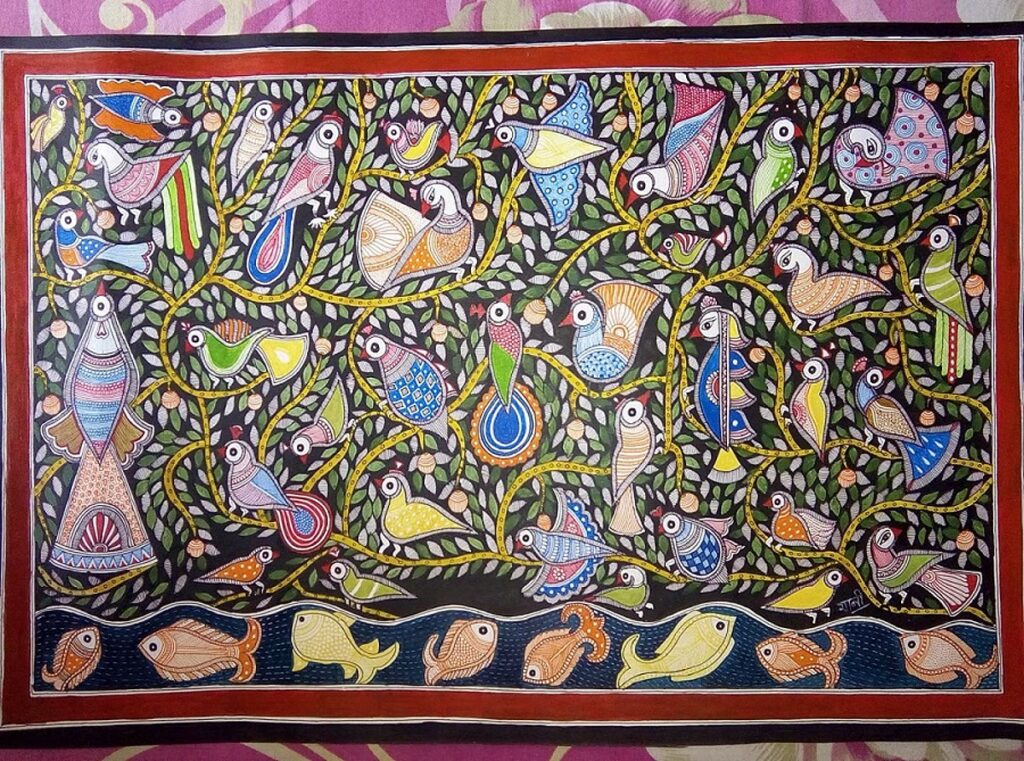
The classrooms, dusty and sunlit, buzzed with laughter and chatter. Most students were young Muslim girls: Sajiya Bushra, Saleha Sheikh, Sarwari Begum, Rahmati Khatoon. Girls whose mothers had once been told that the walls were not theirs to paint. Girls who had never been part of ritual yet now held the brush.
To Avinash, it was a revelation. To me, even from afar, it felt like watching a river change its course, quietly, insistently, claiming its floodplain. Hands once taught to obey boundaries now traced entirely new contours of possibility.
Where earlier generations painted with turmeric and indigo on mud walls, today’s practitioners navigate concrete, synthetic pigments, migration, and shifting monsoons. Yet, as these pressures grow, women’s cooperatives and craft centres quietly insist we will remember. Children learn to grind leaves and flowers into pigments; women teach each other motifs as much as they teach survival; the courtyard becomes a classroom, a studio, a shrine. And all the while, the brush insists on continuity.
A grammar for our times
The inclusion of Dalit, Mallah, Dusadh, and Muslim women is not a gesture, not a token, not a box to be checked in some report. It is an upheaval, a social shift, a quiet defiance. A girl in a headscarf draws the sun alongside the moon. A girl who once thought her fingers too lowly to touch pigment now traces vines, fish, and lotus across the wall.
The art does not belong to caste, creed, or inheritance. It belongs to those who pick up the brush. And in that belonging, Mithila is remade, a green grammar of earth and water, of labour and love, of memory and possibility.
Mithila’s visual vocabulary, dense with vines, birds, suns, and fish, offers a philosophy. It asserts that the divine, the human, and the natural are interconnected. It teaches that the environment is not an external object to be managed, but a relationship to be lived.
At a time when artisanal incomes fluctuate sharply and market linkages are increasingly dominated by middlemen, the grammar of Mithila painting reminds us of something countercultural: abundance. Its refusal to leave blank spaces, its insistence on fullness, reflects a worldview in which life persists even in scarcity.
To write about Mithila today is to recognise that when a wall painting disappears, more than art vanishes. A way of knowing the world disappears with it. Every line holds a memory of earth, river, and season, a reminder that the soil remembers, even when we forget.
In that memory lies the enduring green grammar of Mithila, where soil, water, and the hands that shape them continue to speak.