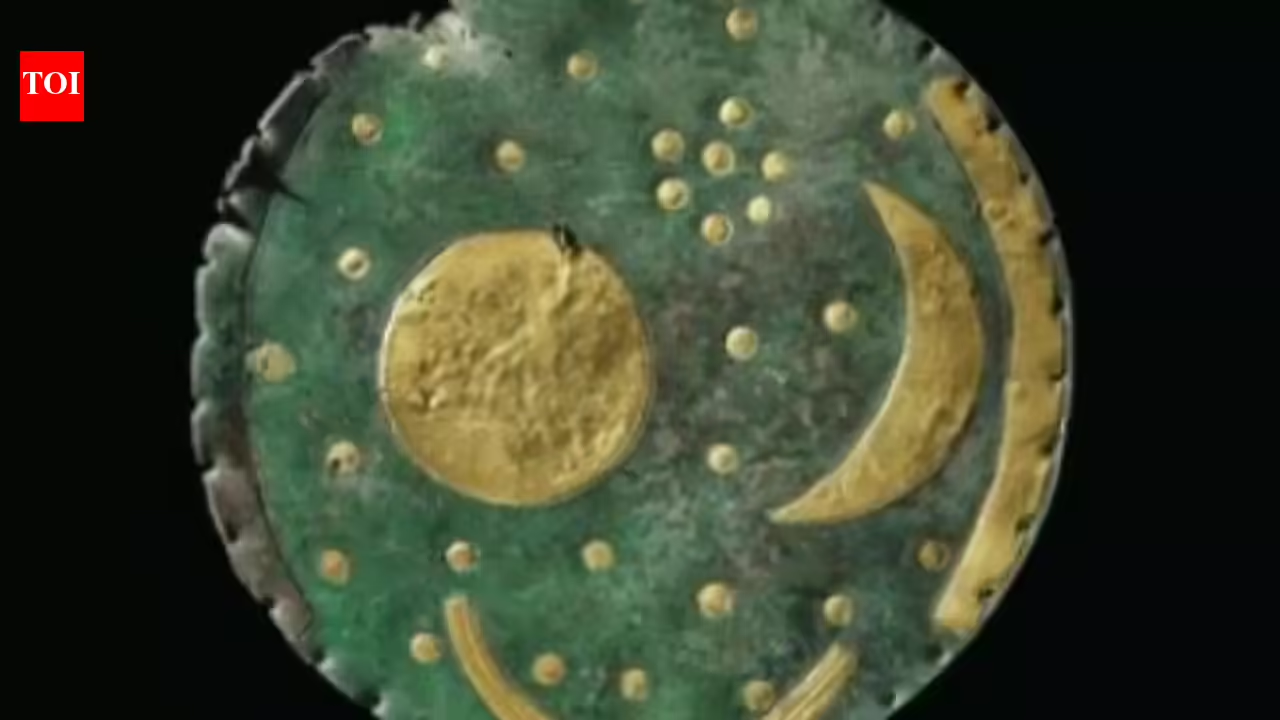
Some discoveries make you stop and stare. The Nebra Sky Disc is one of them. Unearthed in Germany, this 3,800-year-old bronze disc seems simple at first glance. A bronze circle. Gold inlays. Stars and moons. But experts say it could be the world’s oldest “astronomy app.” People back in the Bronze Age might have used it to read the sky, track seasons, maybe even plan rituals. It’s mind-blowing to think that nearly 4,000 years ago, humans were looking at the stars in ways that resemble our modern obsession with apps and tech.The disc itself is small. Yet, it packs a huge story. It hints at early Europeans’ understanding of the cosmos, long before written astronomy. Archaeologists are still teasing apart its mysteries. Every mark seems to have a purpose. Some stars might represent the Pleiades cluster. Others hint at solstices.
Nebra Sky Disc found on Mittelberg Hill reveals ancient star map
The disc was discovered on Mittelberg Hill, near Nebra in Saxony-Anhalt, Germany, in 1999. Treasure hunters reportedly dug it up illegally. Alongside swords, axes, and bracelets. Police recovered it. Archaeologists swooped in. Carbon dating suggests it was made between 1800 and 1600 B.C. It seems the disc wasn’t just lying around. Its placement, near a hill and open sky, might have mattered. Maybe it was used outside. Experts speculate it was part practical tool, part spiritual object. Made of bronze, inlaid with gold, the disc shows a crescent moon, a full moon or sun, and 32 stars. Seven of these stars appear to mimic the Pleiades. Some researchers think it acted as a celestial calendar. Tracking solstices. Guiding farmers on when to sow and harvest.The craftsmanship is striking. Tiny gold pieces, carefully placed. Not random. People back then clearly understood what they were doing. It’s easy to assume ancient people didn’t think like us. But this disc suggests otherwise. They observed, calculated, and recorded.
How the Nebra Sky disc changed over time
Studies show the disc evolved over time. Initially, the moon and stars were the main focus. Then gold arcs were added, which experts think mark horizons at the summer and winter solstices. A third golden arc appeared later, perhaps a solar boat. One more phase added holes around the edge, maybe for mounting it during ceremonies.It seems every generation added something new. A cosmic tool that grew with knowledge. You can almost imagine ancient people holding it up, aligning it with the sun and stars. Feeling the power in understanding the sky. The disc wasn’t just practical. It likely symbolised power. Maybe owned by a chieftain or priest. Understanding the heavens gave authority. And using precious metals made it look important. Not just decorative. Sacred, perhaps.Alignment with nearby mountains adds to the intrigue. When set just right, the arcs line up with sunsets at solstices. Imagine Bronze Age people watching this happen, year after year. Tracking the sun, the stars, life itself.The Nebra Sky Disc connects science, myth, and human curiosity. Nearly 4,000 years later, it still inspires awe. Not just a piece of metal. A window into minds that looked up at the sky and wondered. That might be the first “app” humans ever made. Ancient tech, in its purest, starlit form.