Wormholes are one of science fiction’s favourite cheats. Need characters to cross impossible distances? Skip years of travel? Break reality without saying “magic”? Introduce a wormhole.By Season 5 of Stranger Things, the show finally joins a long cinematic tradition. Up to Episode 8, it reframes the Upside Down not as a spooky parallel world but as something closer to a wormhole or bridge through spacetime. To understand why that idea keeps turning up in movies and television, it helps to separate the real science from the storytelling convenience.Let’s start with the basics.
What is a wormhole, in simple scientific terms?
In real physics, a wormhole is a theoretical solution to Einstein’s general theory of relativity. The equations allow spacetime to bend and curve. In some mathematical solutions, that bending forms a tunnel connecting two distant points.The simplest way to imagine it is this:If spacetime is like a sheet, a wormhole is what happens when you fold the sheet and poke a hole straight through, instead of travelling across the surface.Physicists sometimes call this an Einstein–Rosen bridge. Importantly, this idea exists on paper, inside equations. No wormhole has ever been observed. No experiment has detected one. And most models suggest they would collapse instantly.So wormholes are theoretically allowed, but physically unproven.
Why real wormholes probably wouldn’t work like movies
There are three big problems with wormholes in real science.First, stability. Most theoretical wormholes snap shut before anything can pass through them.Second, energy. Keeping a wormhole open would require something called exotic matter or negative energy, which has never been observed in nature.Third, safety. Even if a wormhole existed, the gravitational forces involved would likely destroy anything entering it.This is where science fiction steps in and politely ignores all three.
Why Hollywood loves wormholes
Wormholes solve narrative problems that plague science fiction.They allow:
- Faster-than-light travel without breaking Einstein’s speed limit directly
- Instant movement across galaxies
- Connections between worlds, timelines, or realities
- Grand spectacle without long explanations
- That’s why they appear again and again, across genres.
Famous wormholes in movies and TV
One of the most scientifically careful depictions appears in Interstellar. The film shows a wormhole near Saturn that allows astronauts to reach another galaxy. The visual design was even based on real equations supplied by physicist Kip Thorne. That said, the wormhole’s stability and usability are still speculative.In Contact, based on Carl Sagan’s novel, a machine creates a wormhole-like passage that lets the protagonist travel vast cosmic distances in seconds. The film explicitly references theoretical physics, while admitting that the technology itself is far beyond us.The Marvel universe uses wormholes constantly, often calling them portals or jump points. In Thor and later MCU films, the Bifrost functions like a wormhole, connecting distant realms instantly. The science is decorative rather than explanatory.In Event Horizon, a spaceship uses an artificial wormhole drive. The result is not exploration but horror, as the ship effectively punches through spacetime with catastrophic consequences. The physics is fictional, but the idea of spacetime rupture is central.Television science fiction leans heavily on the same idea. Star Trek frequently uses wormholes as plot devices, most famously the Bajoran Wormhole in Deep Space Nine, which serves as both a strategic asset and a near-mystical phenomenon.
Where Stranger Things fits into this tradition
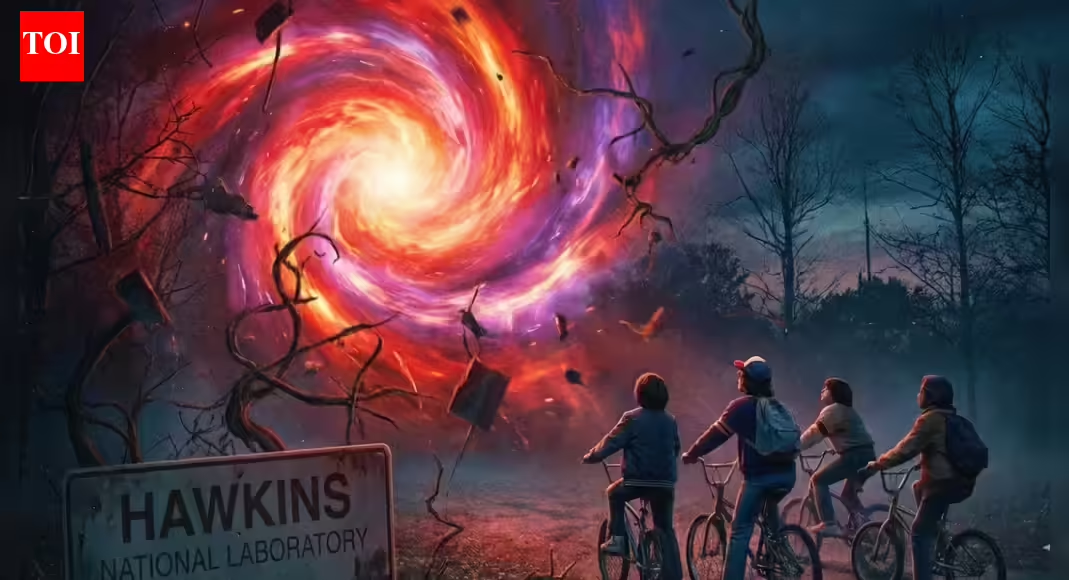
Season 5 places Stranger Things squarely in this lineage. The Upside Down is no longer treated as a stable alternate universe. Instead, it behaves like the inside of a spacetime bridge. It looks familiar because it is connected to Hawkins. It feels wrong because it is not a complete world.This is classic wormhole logic.Rather than creating a new universe with its own rules, the show suggests Hawkins damaged spacetime itself. The Upside Down becomes the scar left behind by that damage.That idea has more in common with Interstellar and Event Horizon than with traditional parallel-universe stories.
Wormholes and time
Season 5 also hints at wormholes connecting not just places, but times. This idea exists in speculative physics. Some theoretical wormhole solutions could, in principle, link different moments in time.However, this opens paradoxes and contradictions that physicists have no solution for. In real science, this remains firmly in the realm of thought experiments.As with most films, Stranger Things uses the suggestion of time distortion without committing to the consequences.So what’s real, and what’s fiction?Real science contributes the vocabulary:
- Spacetime as something that can bend
- Mathematical wormhole solutions
- The idea of bridges connecting distant regions
- Fiction supplies everything else:
- Stable, traversable wormholes
- Monster-filled dimensions
- Psychic beings exploiting spacetime damage
The science is not wrong so much as incomplete and dramatically exaggerated.
Why the wormhole idea keeps working
Wormholes endure because they feel scientific without being restrictive. They sound grounded, even when used fantastically. Audiences recognise the word. They trust it enough to suspend disbelief.Stranger Things Season 5 uses wormholes the same way Hollywood always has. Not as a lesson in physics, but as a way to say something bigger.That reality can be bent.That damage can spread.And that once you punch holes in the universe often enough, it eventually punches back.