
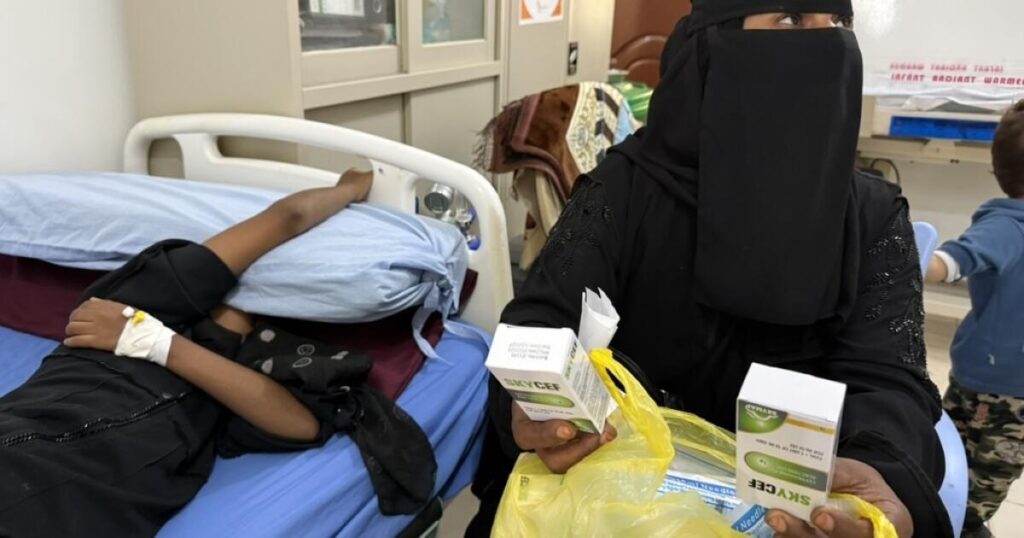
AL KAWD, Yemen — In the cramped examination room of this tiny village clinic, Rania Moussa lay on her side and covered her eyes with a pillow, her slight, childlike-frame belying the fact she is 13 years old. It had been days since she had taken an injection of the powerful antibiotics she needs to manage her condition, a type of anemia.
But the clinic, which used to give them for free, now had none to offer; and aid cuts since the U.S. froze assistance last year meant it was unlikely to get them anytime soon. Without the medication, Rania’s mother said, her daughter couldn’t do anything.
“She can’t walk; she can barely move. I had to carry her here. We could get the shots before, but now none of the clinics have them, so I have to buy them from pharmacies,” said Jamilah Omar, Rania’s mother. “We can barely afford food, let alone medications.”
Somehow, Omar scraped together money for the antibiotics, which the clinic staff administered.
In the year since the evisceration of U.S. Agency for International Development at the hands of Elon Musk and his so-called Department of Government Efficiency, or DOGE, discussions on its shuttering can devolve into political point-scoring, with advocates and opponents of the Trump administration shouting over each other about the savings made or lack thereof.
Remnants of signage for the U.S. Agency for International Development on the facade of the Ronald Reagan Building and International Trade Center in Washington, D.C., on Dec. 29, 2025.
(Brendan Smialowski / AFP via Getty Images)
But it’s here, in places like the dust-swept grouping of cinder-block houses and dilapidated buildings that make up Al Kawd, where the real-world impact of those cuts can be most clearly felt.
“You feel helpless,” said Areeda Fadhli, the 53-year-old medical assistant managing the clinic, as she shifted the pillow away to look at Rania’s face.
“Imagine your son, your daughter, fading in front of you,” she said. “How do you think that feels?”
Fadhli pointed to some boxes of basic medical supplies squirreled away in a corner.
“It’s the last shipment and it came more than nine months ago,” she said. “We’re trying to stretch them as much as possible.”
The contractions in Yemen reflect a wider ravaging of foreign assistance worldwide. In 2025, the U.S. pledged $3.4 billion in global aid, a fraction of the $14.1 billion funded under President Biden. That includes funds from USAID and other U.S. entities.
And that amount is getting only smaller: Late last year, the Trump administration announced in 2026 it would provide $2 billion to U.N. programs in 17 countries, while pointedly excluding Afghanistan and Yemen.


Rabii Nasr, a nurse, cleans a child’s wound at a hospital in Yemen’s Abyan province. Her injury did not require stitches, which was fortunate because the hospital had run out of stitches and surgical thread.
(Nabih Bulos/Los Angeles Times)
Other wealthy nations are following suit, with Germany more than halving its humanitarian budget for 2026 compared with last year. France is planning to reduce development assistance by nearly 40%, and the U.K. is shrinking aid expenditures from 0.5% to 0.3% of its gross national income by 2027.
The Trump administration offered different justifications for cutting foreign assistance. President Trump alleged there were “billions and billions of dollars in waste, fraud and abuse” while DOGE officials boasted about the cost savings. Secretary of State Marco Rubio said USAID did not serve, and in some cases harmed, the “core national interests of the United States.”
Administration officials brought no evidence of corruption and cited examples of waste that proved to be inaccurate, such as Trump’s assertion that $100 million was spent on condoms to the militant group Hamas in Gaza.
In any case, observers say the funds earmarked for foreign development assistance in the Biden era amounted to less than 1% of the federal budget.
Last year, the U.S. slashed funding for Yemen from USAID and other sources from $768 million — amounting to half of the country’s humanitarian response budget in 2024 — to $42.5 million. The result, the U.N. says, is that 453 health facilities have faced partial or imminent closure across the country, including hospitals, primary health centers and mobile clinics.
The Lancet, the esteemed British medical journal, published a study in July that estimated the cuts to USAID could result in 14 million otherwise preventable deaths worldwide by 2030. The estimates were based in part on the lifesaving effects of USAID’s past work on food security, HIV treatment, medical care and other services.
The cuts already deeply hit Yemen, a country that is no stranger to tragedy. A calamitous civil war — which began in 2014 when Iran-backed Houthi rebels seized the capital and spurred a furious assault from a Saudi-led coalition — made Yemen in years past the site of the world’s worst humanitarian catastrophes.
Though Yemen has since been surpassed in devastation by other conflict spots, 19.5 million people — slightly less than half of the population — needed humanitarian assistance in 2025, with the majority of them food insecure, the U.N. says.
This year, with political upheaval persisting throughout the country, the expectation is that number will increase to 21 million; it’s a situation made more difficult by the Trump administration’s 2025 designation of the Houthis as a foreign terrorist organization.


A soldier walks by the U.S. Embassy in Sanaa, Yemen, on Wednesday.
(Osamah Abdulrahman / Associated Press)
The designation, humanitarians say, in effect outlaws aid deliveries to areas under Houthi control, where 70% of the population resides. At the same time, the Houthis have detained 73 U.N. staff members and confiscated vehicles and telecommunications equipment, leaving the U.N. unable to operate.
“You have the perturbations of the conflict and increased humanitarian needs at the same time as a challenging funding environment constrained the delivery environment,” said Julien Harneis, the U.N.’s resident coordinator in Yemen. “So all the conditions are coming together for a very difficult year.”
For aid organizations in Yemen that relied on U.S. largesse, the aim has shifted to preserving whatever remains of their operations.
An aid worker who spoke on condition of anonymity for fear of jeopardizing remaining assistance flows said the organization he worked for had shut down one of its two offices, fired 250 out of 300 employees and suspended support to dozens of health centers. The organization’s portfolio had shrunk from roughly $32 million to $2 million.
“Yes, we have other donors from Europe and Canada, but it doesn’t equal even 5% of what the Americans would give,” he said.
Some organizations have tried tailoring proposals to fit Washington’s regional priorities, including countering Iran and Al Qaeda, or by excluding terms that under the Trump administration have in effect become verboten.
“Anything focusing on gender, feminism, or LGBT protection: A statement with any of those concepts wouldn’t get sign-off,” he said.
To get a sense of what a difference a year makes, last January, before the aid cuts, Fadhli was about to extend the operations of the Al Kawd clinic from 12-hour shifts to 24.
Three doctors — an OB-GYN specialist and two general practitioners — already made the daily 52-mile journey from Aden, the main city in Yemen’s south, to Al Kawd to treat about 300 patients every day. Medical assistants, chosen from local village women, received $100 a month and training sessions to work in the clinic and help serve the community’s needs.
The clinic had enough basic medications for three months, and there was funding to procure specialized medicine for patients with complicated illnesses.
“People come here because they have no money, but before we could offer them solutions to their problems,” said Dr. Umayma Jamil, the 37-year-old OB-GYN specialist who is the last remaining physician in the clinic. She comes only once a week, paid for by whatever funds the clinic can cobble together.
Now, Jamil said, she will give a diagnosis, prescribe medicine and then see the patient return with the same complaint.
“I ask them, ’Did you get medicine?’ And they say they can’t because there’s no money,” Jamil said.
“It’s natural to be frustrated, but I don’t know what to do. It’s not in my hands.”
The effects of such a drastic scaling down of aid aren’t restricted to smaller facilities; they extend even to major medical institutions such as Al-Razi, the main hospital in Abyan province, serving more than 30,000 people every year.
Children are dying, and more children will die later this year
— Julien Harneis, U.N. resident coordinator in Yemen
Dr. Muhsen Abdullah, the surgeon who heads the emergency room, spoke with a weary tone of a ward without surgical thread or stitches, and anesthesiologists forced to ask patients to purchase their own anesthetic.
“Surgical perishables, antibiotics, even iodine and rubbing alcohol — all this the patient has to buy from the outside before they come in for surgery. It’s ridiculous,” he said, adding that some patients postponed procedures because they couldn’t afford postoperative treatment.
Around him were additional signs of disrepair: an X-ray examination board without a functioning backlight, and a dust-covered ultraviolet sterilization machine that hadn’t worked in months.
With humanitarian groups operating under extremely tight budgets, there’s little they can do when epidemics hit — assuming they can detect them in the first place, because much of that information relied on health centers reporting outbreaks.
“Now we have no reports. Zero,” the aid worker said. For example, he said, cholera cases in Yemen would appear to be fewer than last year, although suspected numbers are far larger.
“How can they tell you anyway? There are no kits to test.”
In Al Kawd, Fadhli and Jamil have already detected a few cases of cholera in the village. It’s a terrifying prospect, they said, because the disease transmitted by infected water killed a few dozen people — most of them children — last year. But with no money for quarantine or medications, there isn’t much they can do, so they expect the outbreak to get worse.
That’s in line with predictions from Harneis, the U.N. resident coordinator, who said aid groups in Yemen were anticipating an increase in epidemics “which we won’t be able to control, and an increase in mortality and morbidity, particularly affecting young children.”
“Children are dying, and more children will die later this year,” he said. And once such outbreaks hit, there’s no guarantee they’ll stay within the confines of Yemen, he added. “Epidemics don’t stop at the border.”
This month, the U.S. completed its withdrawal from the World Health Organization, a decision, the group said, that made “both the United States and the world less safe.”
Many in the aid community acknowledge USAID wasn’t perfect and understand complaints that it could be used to promote ideas the Trump administration denounces as “woke.”
But they nevertheless lament the rollback of their work. One person likened it to America’s abrupt withdrawal from Afghanistan and leaving the field open for the Taliban to destroy all of USAID’s projects.
“OK, you could say USAID was unsustainable, but there’s an argument to be made you shouldn’t close the tap completely,” said the aid worker, adding his employer has been operating in Yemen since 1994.
“With this move, you’ve destroyed the work of decades.”