Doing good gets you killed in Sudan. It was why Amira did not tell her mother when she joined a volunteer group that felt like the only thing stopping her country sliding deeper into dystopia.
Each morningshe secretly crossed the shifting frontline of Sudan’s North Kordofan state. Amira was entering territory held by the Rapid Support Forces (RSF), paramilitaries who have committed countless war crimes, including genocide, during the country’s cataclysmic war.
“I’d never tell anybody, especially my mother, where I was going,” she says. “You have to sneak in and hope you make it back.”
Amira’s days were spent counselling women and children who had been raped. When darkness fell, she crept back to land controlled by Sudan’s army.
Both sides viewed her with suspicion. “I was constantly interrogated. Every day I would be subjected to questioning. When I’d go to the markets, they’d ask us where I got the money.”
It is against this backdrop of fear and mistrust that Sudan, home to the world’s worst humanitarian crisis, has conjured up one of the year’s most heartening narratives.
Across the vast country, a gigantic grassroots network of ordinary Sudanese people, the Emergency Response Rooms (ERRs), is providing life-saving food and medical care to millions of fellow citizens. It is this group that Amira dared not tell her mother she had joined.
People in the mutual aid network can become an immediate target for both the RSF and the country’s military, believed to have killed up to 400,000 people between them since the war erupted in April 2023.
Hardly any of the thousands of volunteers have told friends or family of their work with the ERRs in case they, too, became targets by association.
Despite the dangers, the ERR network has grown so large that it has in effect replaced the country’s collapsed state.
The network’s ability to care for communities has united a Sudan split in half by the fighting, transcending ethnic and regional schisms. The ERRs have become so popular that analysts suggest it is fundamental to any postwar future for Sudan – a rejection of the men with guns who have forced more than 12 million to flee their homes.
The ERRs were nominated for this year’s Nobel peace prize, and there was genuine surprise among many humanitarians when they did not triumph.
Not that the volunteers minded. “We only want to help,” says one, Jamal.
But providing help is increasingly fraught. Volunteers are hunted down; many are apprehended and detained. Some disappear; others are tortured, or executed. More than least 145 of them are believed to have been killed.
How many have been arrested or disappeared is unclear: vast swathes of Sudan have no connectivity, meaning there is no way to document war crimes.
Another volunteer, Alsanosi Adam, from central Sudan, tells the Guardian: “You risk anything from intimidation to death. From torture to being killed – and anything in between.”
Like many others, Adam has lost close friends who were persecuted for simply helping the ERRs. “A friend from South Kordofan was detained, imprisoned and tortured. He eventually died because of the torture he received in prison.”
About 100 volunteers are detained in Shala prison in El Fasher, the city recently seized by the RSF amid a wave of atrocities.
Samir says: “If you’re a humanitarian in Sudan now, it is very dangerous. Neutrality, being impartial, is dangerous. Each side thinks you should swear allegiance to them.” He adds that volunteers are routinely beaten after being accused of “political affiliation” by the RSF.
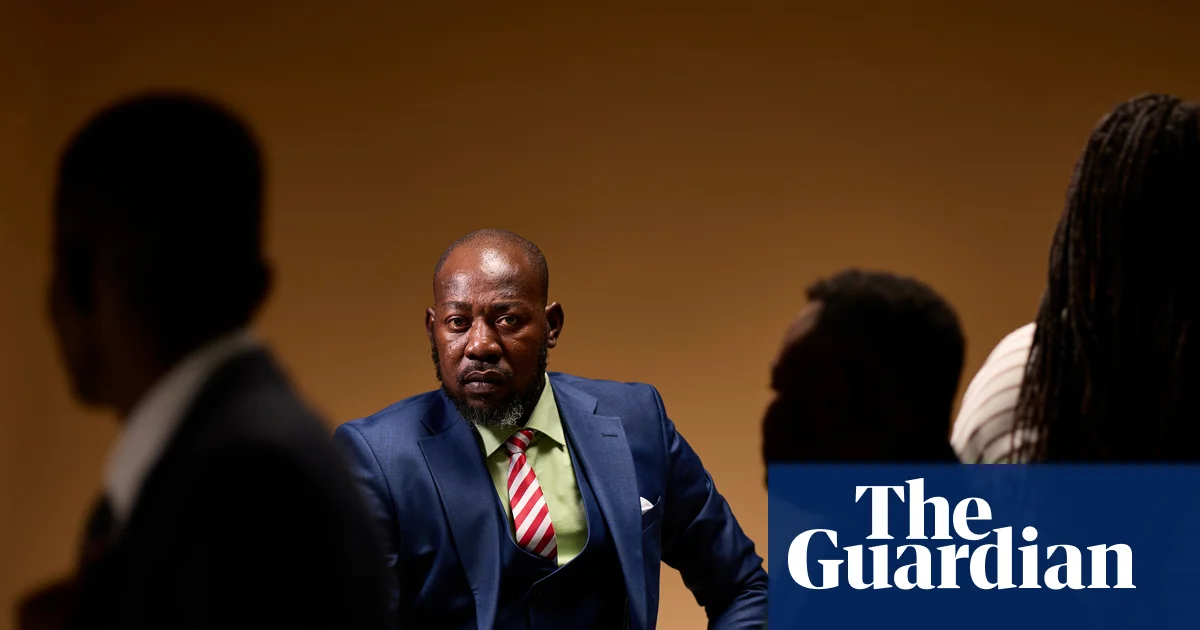
As he speaks, Amira, Alsanosi and Jamal nod in unison. They are sitting in the London offices of the Guardian – 3,000 miles from those who might want them dead – yet their fear is palpable.
They arrived in the UK under a veil of secrecy, a trip arranged by the Foreign, Commonwealth and Development Office to show solidarity with Sudan’s humanitarian volunteers.
During the trip they briefed the foreign secretary, Yvette Cooper, who later told parliament of the “incredibly brave Sudanese volunteers” she met.
A Foreign Office spokesperson says: “Emergency Response Rooms are risking everything to deliver life-saving aid where no one else can reach – their service to humanity is extraordinary.”
The secrecy of the trip underscores the perils they face. Only Adam agreed to be pictured.
Faced with such risks, it might be assumed that volunteer numbers are sluggish. Yet even as the violence spreads, they increase daily.
To date 26,000 volunteers have stepped forward to provide support in a country where 21.2 million people are experiencing high levels of acute food insecurity and seven million face famine. Most are young and 40% are women, despite the risk of sexual violence.
Amira accepts that she faces a heightened risk of being attacked but says that when she learned that rape survivors were receiving no support she had to act. “There was a need to do something. They had nothing.”
Those with nothing in Sudan can be counted in the millions. Traditional aid-distribution systems have disintegrated as the war has worsened. International humanitarian agencies struggle to reach many areas, leaving local ERR groups as the only solution.
Volunteers are active in 96 of 118 districts across Sudan. More than 29 million Sudanese people – more than half the population – have received meals or help from ERRs.
But their effectiveness has amplified the dangers volunteers face. Both the RSF and the military appear increasingly envious of the trust in communities accrued by the ERRs.
“They know we have a direct link and much influence within our communities,” says Samir. “Therefore, they are slightly fearful of our activities.”
Jamal says such distrust can quickly tip into violence. He was distributing food to starving civilians in South Kordofan when he was arrested, then tortured. “I was beaten and confined to a very small room which wasn’t well ventilated at all. They were accusing me of collaborating with outside forces,” he says.
Yet while the community’s support can heighten the threat, more often it serves as a life-saver. Jamal thinks he would still be detained – or dead – if local residents had not rallied to protest over his arrest.
“Most of the protection we get actually emanates from the community itself. When I was arrested, it was the massive community mobilisation that ensured my release.”
Despite such support and despite propping up much of the country, the future of the ERRs is far from guaranteed. Funding is tight – they operate at a deficit of 77%, forcing them to scale down critical life-saving support.
They have received less than 1% of all international aid funding for Sudan despite being able to deliver aid at a fraction of the cost of UN agencies.
After American aid was frozen this year, that derisory amount was reduced even more. Hundreds of their community soup kitchens were forced to close.
At the time of writing, the ERRs have enough money to operate several months into next year. “It’s not enough,” says Jamal.
But the cash they do have goes far. “Money is targeted to areas considered most at need. They specify the location and then ask for the funds – it’s direct,” explains Samir.
Adam confirms that, during their visit to the UK, Cooper has pledged to give them direct funding.
The Foreign Office spokesperson says the UK is “proud to support their vital work” and has provided £146m in aid to Sudan, including money for groups supporting the ERRs.
Another Nobel nomination in 2026 feels probable, though Jamal says that such global acknowledgment is not about the acclaim, but personal safety.
“For me, the Nobel prize is a protection measure. Winning it would contribute to the volunteers gaining more protection,” he says.
Amira ultimately decided she could not wait for the Norwegian Nobel Committee to afford her extra security. After a year of furtive trips across the frontline, she told her family.
“I started being more open with my mother about what I was really doing. To my relief, she was 100% supportive,” Amira says. “She could not be more proud.”