
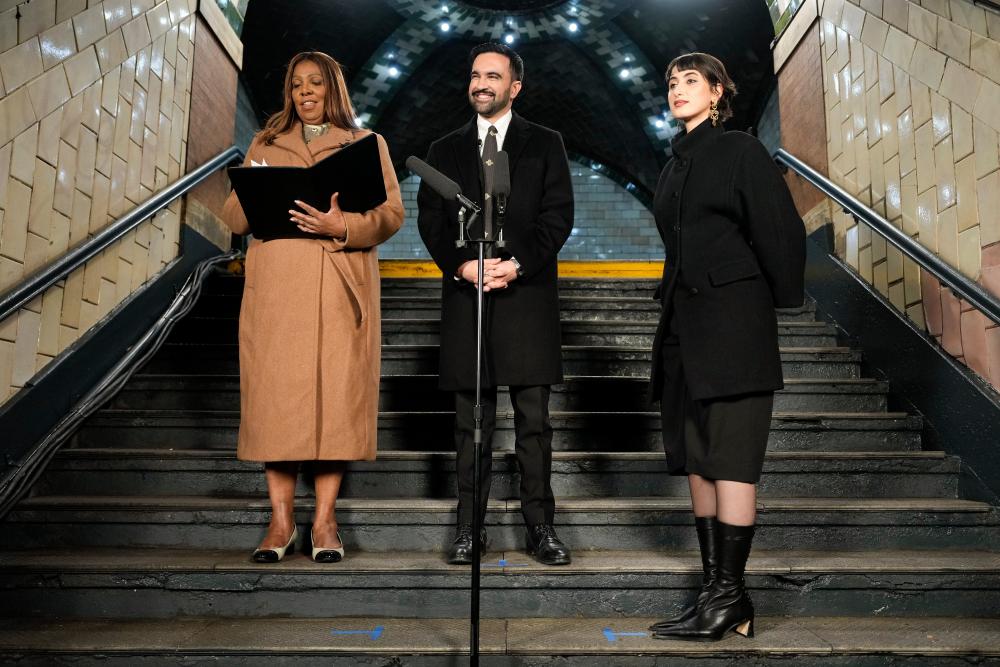
Zohran Mamdani was sworn in as mayor of New York City soon after midnight in a private ceremony in an abandoned beaux arts subway station – a prelude to daylong celebrations set to include a second, public swearing-in and a block party outside city hall.
Mamdani, 34, was sworn into office by the New York attorney general, Letitia James, surrounded by wife, Rama Duwaji, members of his immediate family, including Mira Nair, his mother and a film-maker, and his father, Mahmood Mamdani, a professor of African studies at Columbia University.
“This is truly the honor and the privilege of a lifetime,” Mamdani said.
The ceremony was also attended by the outgoing mayor, Eric Adams, who had held off from a commitment to attending but later said he’d “like to be there to show the smooth, peaceful transition of power”.
Related: Working Families bet on 2026 as the right time for a third US party after a wave of wins
To honor his Muslim faith, Mamdani was sworn in using a Qur’an, Islam’s holiest book, becoming the first mayor in New York City to do so.
Also attending were a diverse cast of New Yorkers Mamdani selected for an inaugural committee, including actor John Turturro, playwright Cole Escola and writer Colson Whitehead, as well as advocates, small business owners and campaign workers who the incoming mayor’s office says have “provided perspective, guidance and cultural sensibility” for the ceremony.
The midnight ceremony will be followed a 1pm public event at which the new mayor will be introduced by political ally and Bronx Democratic congresswoman Alexandria Ocasio-Cortez and sworn in by Vermont senator Bernie Sanders.
Mamdani’s office has said the choice to be sworn in at the old city hall subway station reflected his “commitment to the working people who keep our city running every day”.
“When Old City Hall Station first opened in 1904 – one of New York’s 28 original subway stations – it was a physical monument to a city that dared to be both beautiful and build great things that would transform working people’s lives,” Mamdani said in a statement.
“That ambition need not be a memory confined only to our past.”
The day’s events are a culmination of a remarkable rise to power in the US’s most populous city, both for a political unknown and for the Democratic Socialist party that Mamdani, elected as a Democrat, represents.
The first signs of Mamdani’s electoral potential came earlier in the year, ahead of a primary vote that saw him knock out former governor Andrew Cuomo, who later ran as an independent candidate. Adams, then under the scrutiny of federal prosecutors, chose not to seek the Democratic nomination.
In April, Mamdani was trailing Cuomo 36% to 64%. Those numbers shifted after Mamdani’s savvy political campaign took off on social media; his robust grassroots efforts appeared to energize first-time voters struggling with the high cost of living in the post-pandemic city.
A campaign spokesperson said Mamdani’s success owed to him “being everywhere all of the time”, with more than 10,000 volunteers knocking on more than 100,000 doors, and by pushing out a platform of affordability, rent freezes, free metro transport and city-run grocery stores – as well as the creation of a department of community safety to invest in citywide mental health programs.
Democrat campaign veteran Hank Sheinkopf said that Mamdani “represents the city of the future – a more Asian city, a more Muslim city, and what could be a more leftwing city”.
In November, the then state assemblyman won the election with 50.78% of the vote, defeating Republican activist Curtis Sliwa and Cuomo. In his victory speech, Mamdani spoke of his commitment to working New Yorkers who did not normally have access to the levers of power.
“Let the words we’ve spoken together, the dreams we’ve dreamt together, become the agenda we deliver together,” he said. “New York, this power, it’s yours. This city belongs to you.”