- A new study finds that the hard-ground swamp deer translocated to Satpura Tiger Reserve have grown from 98 to 172 individuals.
- The deer, moved from Kanha Tiger Reserve to reduce extinction risk from a single population, are breeding successfully and adapting to Satpura’s grassland habitats.
- Researchers say habitat restoration, a predator-proof acclimatisation enclosure and long-term monitoring helped the reintroduction succeed, offering a model for conserving other threatened herbivores.
A population of hard-ground swamp deer translocated from Kanha Tiger Reserve to Satpura Tiger Reserve, both in Madhya Pradesh, is growing steadily and breeding successfully, according to a new study. The subspecies, once widespread across central India, now survives in just one region, making efforts to establish a second population critical in reducing extinction risk.
The hard-ground swamp deer (Rucervus duvaucelii branderi) was once found widely across India, but today survives naturally only in the Kanha. According to the IUCN Red List, the hard-ground swamp deer is categorised as vulnerable and is listed under Schedule I of the Indian Wildlife (Protection) Act, 1972. The subspecies declined historically due to habitat alteration, fragmentation of grasslands and hunting. With a single population of roughly 1,100 animals, the species remains vulnerable to disease outbreaks or other threats.
“Confining the entire subspecies to Kanha effectively created a single point of failure,” says Neha Awasthi, the study’s corresponding author, and member of the International Union for Conservation of Nature (IUCN) Species Survival Commission’s Deer Specialist Group. “Small isolated populations face intrinsic risks such as demographic stochasticity [fluctuations in mean growth rate], genetic drift and inbreeding, as well as external threats including disease outbreaks or large-scale environmental disturbances.” The study was conducted by researchers from the Wildlife Institute of India along with the Madhya Pradesh forest department.
Kanha also has ecological limits with finite grassland habitat and carrying capacity. “Without opportunities for dispersal into new landscapes, density-dependent pressures could eventually limit population growth,” adds Awasthi.
In recent years, India has increasingly turned to species translocation to recover threatened wildlife and restore populations. However, there is a lack of long-term evidence to assess if the success of such efforts remains limited.
Establishing a second population in Satpura
Between 2015 and 2023, the Madhya Pradesh forest department translocated 98 hard-ground swamp deer from Kanha to Satpura in seven phases. Each animal was captured using a funnel-shaped enclosure known as a ‘boma’, a technique designed to guide animals safely into holding areas without the need for chemical darting. After capture, the deer were transported in specially designed vehicles to Satpura.
Initially, they were released into a 50-hectare predator-proof enclosure in the reserve’s Bori range, allowing them to acclimatise before being released into open habitat. Most translocations took place between December and March, when weather conditions and road access were favourable.
The reintroduced population was monitored across three sites: the Bori enclosure, nearby open grasslands in Bori, and Malini grassland in the Churna range. Researchers relied on intensive field monitoring to track the deer. Teams of forest guards and field staff conducted daily counts throughout the year, typically during early morning and evening hours when the animals were most active.
Observation points were set up near water sources, grasslands and other locations where deer frequently gathered. Using binoculars and spotting scopes, observers recorded the number of animals and categorised them by age and sex, including adult males, adult females and fawns.
Researchers also assessed body condition to understand how well the deer were adapting to their new environment, evaluating indicators such as coat sheen, muscle, posture, and the visibility of ribs and pelvic bones. These results were compared with data from the source population in Kanha.
Population growth and breeding success
Over the study period, the population expanded from the original 98 translocated animals to 172 individuals by 2023. Wild-born fawns were recorded every year, indicating that the deer were successfully breeding in their new habitat.
“Several independent indicators suggest the population is establishing rather than simply persisting with management support,” says Awasthi. “We observed steady population growth, regular recruitment through fawning, and a stable age-sex structure reflecting a positive intrinsic growth trend.”

Researchers also recorded second- and third-generation fawns born in Satpura, suggesting that the animals have successfully synchronised breeding with local seasonal conditions.
During the study period, 29 deaths were recorded among both translocated and wild-born deer. Some were due to predation by leopards, dholes and tigers, while most were attributed to natural causes. The highest number of deaths occurred in 2019, when many deer were released from the predator-proof enclosure into open grasslands where predators were present.
However, the researchers say such mortality spikes are commonly observed in wildlife translocations, as animals adjust to unfamiliar terrain and predator pressures. “It aligns with global evidence from cervid translocations, where early post-release mortality is typically higher before stabilising,” says Awasthi.
Signs of healthy adaptation
Body condition assessments showed that the reintroduced deer were generally healthy and comparable to animals in the source population in Kanha. This suggests that Satpura’s grasslands provide adequate forage, water and shelter to support the species.
Researchers also observed behavioural flexibility in the animals. “Although the species is typically associated with open grasslands, the Satpura population showed behavioural flexibility and used heterogeneous terrain and edge habitats, particularly during dispersal,” says Awasthi.
Habitat management within the reserve played an important role in this. Forest officials had restored grasslands and planted key forage species such as black speargrass, kangaroo grass and wild sugarcane to improve food availability. Invasive plants such as lantana (Lantana camara) and congress weed (Parthenium hysterophorus) were also removed to maintain productive grazing areas.
These management interventions were essential to the success of the project. “Much of Satpura’s current grassland habitat emerged after the voluntary relocation of 49 villages, which opened more than 10,000 hectares for ecological restoration,” Awasthi adds. “These areas were then actively managed through grassland restoration measures and improvements in water availability.”
The relocations also reduced livestock grazing and resource extraction, lowering competition and disease transmission risks at the wildlife-livestock interface.

A model for species restoration?
The Satpura reintroduction demonstrates how carefully planned conservation interventions can help secure threatened species. The project combined several strategies, including phased translocations, habitat preparation, veterinary monitoring and intensive post-release tracking.
“This experience provides a transferable framework for other range-restricted herbivores in India,” says Awasthi.
However, she cautioned that long-term success will depend on continued management. As animals expand into open landscapes, predation pressure from tigers, leopards and dholes will increasingly shape survival dynamics. Climate variability, habitat quality and the need to maintain genetic diversity could also influence the population’s future. Even so, the study shows that species lost from landscapes can potentially return. “With suitable habitat, protection and careful management, even populations absent for decades can be restored,” says Awasthi.
“The swamp deer (barasingha) translocation programme in Madhya Pradesh is a landmark effort to secure the future of the species, once confined to Kanha Tiger Reserve alone and vulnerable to extinction due to its restricted range,” said Anish Andheria, President, Wildlife Conservation Trust. He was not associated with the study. “To reduce risk from disease or localised threats, satellite populations have been established in Satpura and Bandhavgarh Tiger Reserves. Between 2015–2026, 135 animals were moved to Satpura from Kanha, where the population has grown to 303. In Bandhavgarh, 48 individuals were recently introduced and have already increased to 64, demonstrating encouraging adaptation, breeding success, and progress toward long-term species recovery,” he said.
Read more: Rewilding rhinos as part of a long-term conservation plan
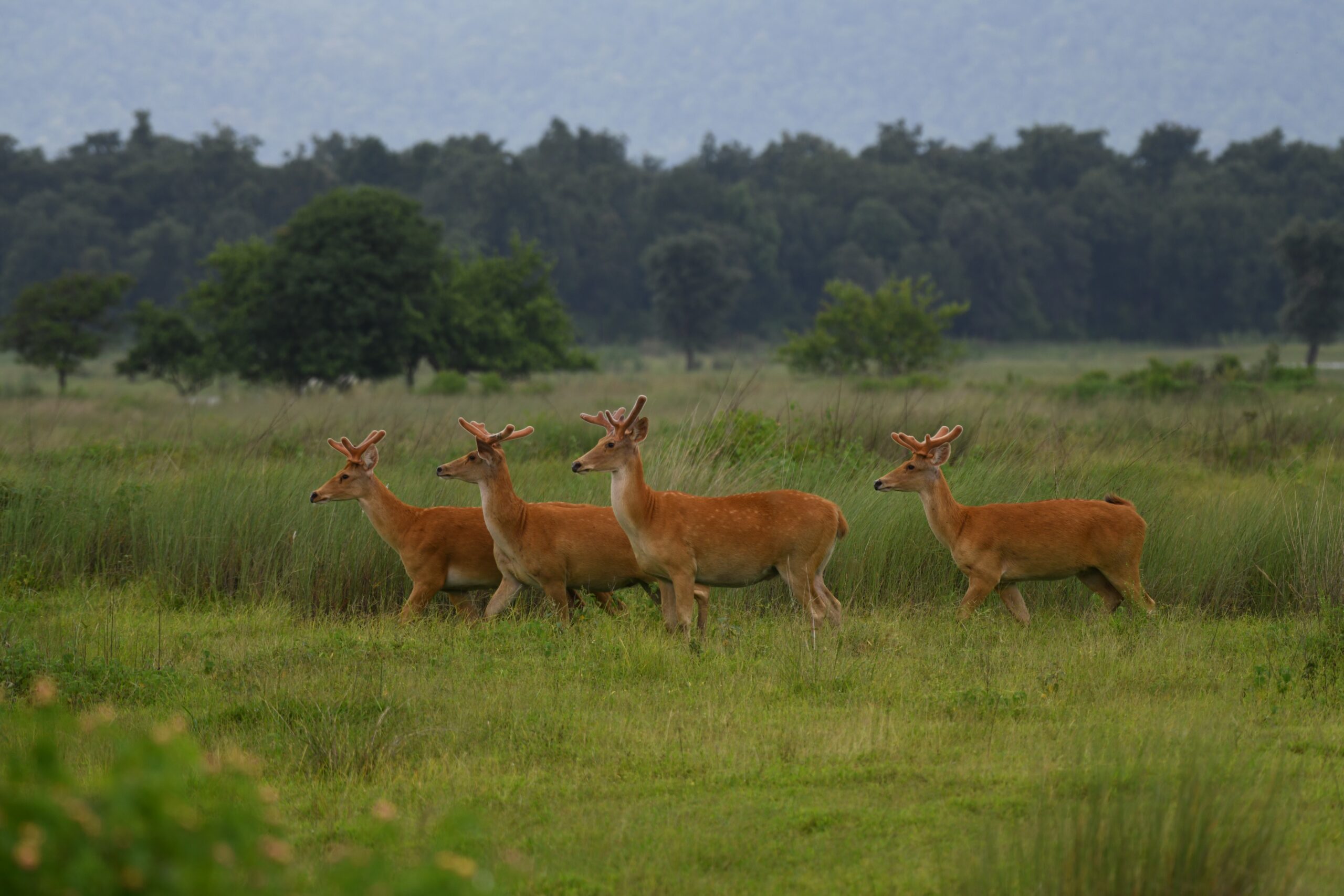
Banner image: Hard-ground swamp deer in their new habitat in Satpura Tiger Reserve. The reintroduction demonstrates how carefully planned conservation interventions can help secure threatened species. Image by L. Krishnamoorthy.