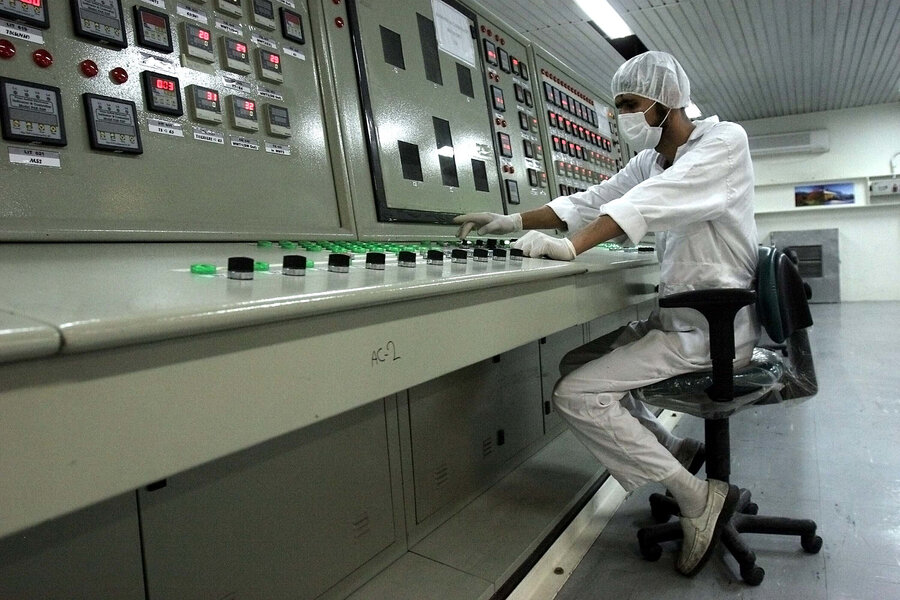
Iran’s nuclear program is the main reason U.S. President Donald Trump said he had to attack the country on Feb. 28. Resolution of the dispute over that program could help move the two sides beyond a ceasefire and toward a negotiated end to the war.
Mr. Trump has vowed for years to deliver a “much better” deal preventing Iran from attaining a bomb than what he calls the “disastrous” one concluded under President Barack Obama more than a decade ago.
A comprehensive deal ending the Iran war could be the president’s last best opportunity to make good on his pledge.
Why We Wrote This
In the absence of renewed U.S.-Iran talks, the combatants are wrangling over the Strait of Hormuz. But the main dispute between the two is still Iran’s nuclear program, and President Donald Trump’s pledge to secure a better deal than did President Barack Obama.
The Iran nuclear deal of 2015 – formally known as the Joint Comprehensive Plan of Action, or JCPOA – was reached after more than two years of intense, marathon negotiations largely between the United States and Iran, though other signatories to the deal were all the permanent members of the U.N. Security Council, plus Germany.
At the time, the Obama White House hailed the JCPOA as a new high mark in nuclear nonproliferation diplomacy, citing the agreement’s limits on Iran’s nuclear program and the roadblocks it placed on Iran’s path to ever acquiring a nuclear weapon. But from the outset, critics – including Mr. Trump and Israeli Prime Minister Benjamin Netanyahu – blasted the deal as seriously flawed, at best only postponing Iran’s nuclear threat to the U.S. and its partners, and rewarding Iran for its bad behavior.
During his first term, in 2018, President Trump pulled the U.S. out of the JCPOA. That freed Iran from the deal’s limits on its nuclear program and cleared the way for the progress that Mr. Trump, in his second term, has so far chosen to address militarily: with airstrikes last June, and now as part of the U.S.-Israeli war.
Yet, as recently as Monday, the president was on social media vowing to replace “one of the Worst Deals ever made” with a great one. So, what were the JCPOA’s pros and cons?
What were the deal’s strong points?
- Under the JCPOA, Iran was required to relinquish almost all of its stockpile of enriched uranium (above a certain threshold of purity, the fissile material for a nuclear weapon), and, indeed, it sent all but a small amount out of the country.
- Iran was required to dismantle thousands of its most advanced centrifuges – the machines that process uranium to higher degrees of enrichment – and was barred for a decade from operating anything beyond several thousand older centrifuges to produce low-enriched uranium for medical and research purposes.
- Under the deal, Iran was subject to unprecedented transparency and inspection measures and required to allow the International Atomic Energy Agency (IAEA) to monitor with cameras and inspectors its centrifuges and stockpiling of uranium.
- The deal awarded Iran sanctions relief for compliance but also included “snapback” provisions for reapplying sanctions in the event of violations.
What were the shortfalls?
- Sunset provisions that allowed the strict limits on enrichment to phase out after a decade, including a return to industrial scale enrichment after 2030. The sunset clauses led critics to describe the JCPOA as more of a speed bump than a stop sign for Iran’s nuclear ambitions.
- A lifting of sanctions that allowed Iran to access billions of dollars of frozen assets – critics claim up to $100 billion – held in overseas accounts. As early as his successful 2016 presidential campaign, Mr. Trump has cited to great effect what he says were the “pallets of cash” that the U.S. shipped to Tehran over the final days of Mr. Obama’s presidency. Critics say those sums helped Iran fund and arm its regional allies, including Hezbollah.
- Transparency provisions that stopped short of “anytime, anywhere” inspections and that allowed Tehran to put its military bases off-limits to IAEA inspectors.
- The agreement said nothing about Iran’s ballistic missile development program – thus ignoring the vehicle that could potentially be used to deliver a nuclear weapon to its target – nor did it address Iran’s use of proxies to further its policies.
Now, in the midst of a costly war, it is the critics’ turn to lambast the president’s “strike first, then talk” approach to Iran’s nuclear program – and to point out that, as imperfect as it might have been, the JCPOA was reached without destabilizing and inconclusive military action.
Still, some protagonists involved with the 2015 nuclear deal say Mr. Trump might have a way to deliver something “better” than the JCPOA. Noting that White House officials have said the president is demanding a “suspension” of all nuclear activity for an extended period of time, even some JCPOA negotiators say a deal requiring a full stop of Iran’s nuclear program would be stronger than one that only puts limits on it.