- Once pushed towards irrelevance by mechanised transport and falling demand, Gujarat’s Halari donkey saw its numbers dropping until its late registration as a distinct breed in 2015.
- Sustained efforts through surveys and advocacy have since brought the breed official recognition and a gradual recovery.
- Linking Halari donkeys to the emerging donkey milk economy has restored economic value to the breed, motivating the pastoral communities to resume their traditional practice of rearing the donkey.
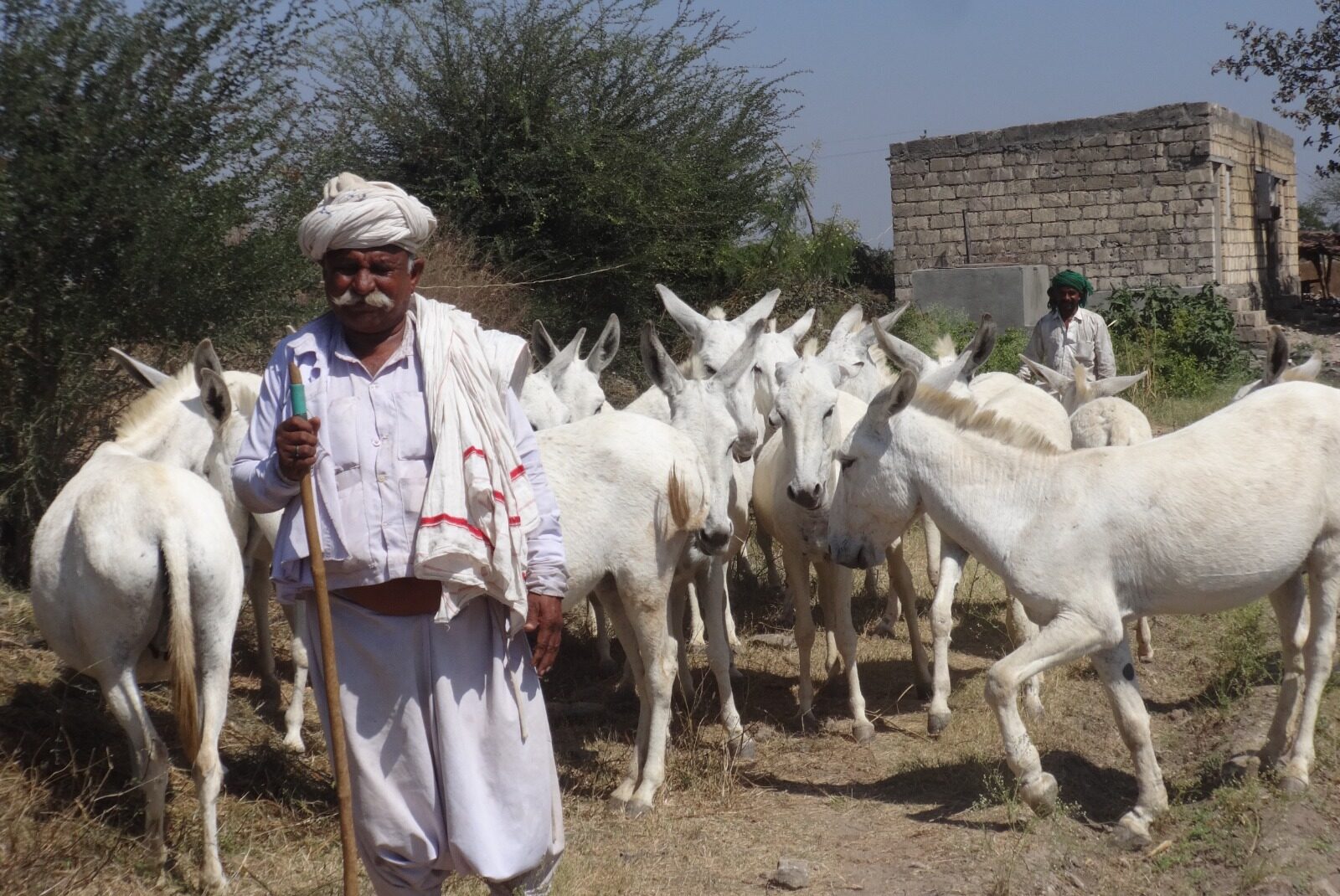
An all-white coat is what makes Gujarat’s Halari donkey stand out from other donkeys. An Indigenous breed named after the erstwhile Halar region of Gujarat where it is found, the Halari donkey has long been an age-old companion of the local pastoralist community, which migrates seasonally, and of potters — both of whom use the donkey to transport their belongings and wares. With changing times, however, the Halari donkey began losing its relevance, and as a consequence, its population started to dwindle. Concerted efforts to save the animal from vanishing have, however, borne fruit. The Halari donkey is slowly walking towards recovery, and for the first time, the breed has received official recognition for its Indigenous status.
The Halari donkey is one of the four Indigenous donkey breeds in India, the other three being the Kachchhi donkey, also from Gujarat, the Spiti breed from Himachal Pradesh, and the Ladakhi from Ladakh. However, it was not registered as a distinct breed until as late as 2015. “Even after that, it was not counted as a separate breed in the 20th Livestock Census in 2019, so its numbers remained hidden within the broader category of donkeys,” says Ramesh Bhati of the Centre for Pastoralism (CfP), which has been working on the conservation of the Halari donkey for more than a decade. The Centre is an initiative of Gujarat-based non-profit Sahjeevan, formed to focus primarily on research and pastoralists’ livelihoods.
The declining numbers of the species were first brought to light when Sahjeevan, which works on animal breed conservation, conducted a survey to count Halari donkeys in 2014. “In Surendranagar, Jamnagar and Dwarka — areas considered part of the Halar region — we counted 1,400 Halari donkeys,” Bhati says. As monitoring continued, the numbers were found to have declined to 1,100, and then further to 662 in 2020. “By 2022, the numbers had dropped to 469,” he adds.
The Bharwads, one of the Maldhari communities, migrate seasonally with their animals in search of greener pastures during the dry winter months. They have traditionally bred the Halari donkey to help carry their belongings, as the animals can walk up to 40 km a day and are used for transporting goods for six to eight months of the year. Over time, however, this primary role was taken over by small tempos and autos because of convenience. As demand declined, the price of young male donkeys — usually sold by breeders at animal fairs — also fell.
Punabhai Bharwar is a Maldhari, or pastoralist, who breeds Halari donkeys. He has 30 of them now, although earlier his family had more than 50. “We have bred these donkeys for generations,” he says. However, by 2017, Punabhai had just eight Halari donkeys left. “We started getting only ₹1,000–2,000 for a young male donkey,” he adds.
Adopting a multi-pronged approach
As demand for the donkey continued to decline, the organisations realised that they needed to find different ways to motivate the community not to give up on the animal. Kavita Mehta, executive director of Sahjeevan, says there was little pride in owning a donkey, unlike rearing cattle or other livestock. “The younger Maldharis were not keen. So we had to adopt a multi-pronged approach to conserve both the genetic pool and the cultural heritage of this land,” she explains.
One of the first initiatives they undertook, therefore, was to engage the community through discussions and cultural events, inviting older Maldharis to share their stories with others. Healthcare initiatives — such as regular health camps for the breed and the distribution of nutritional kits — were also taken up to reduce the cost of caring for the animals for pastoralists. Breeders were further encouraged to form a Halari Donkey Breeders Trust, which was registered in 2023.
Parallel efforts were set in motion to conserve the Indigenous germplasm of the Halari donkey. The ICAR (Indian Council of Agricultural Research)–National Bureau of Animal Genetic Resources (NBAGR) is currently working on a three-year project on in situ conservation of the donkey. B.P. Mishra, former director of NBAGR, under whose leadership the project began in 2023, says they adopted a two-pronged approach. “One is through the Network Project, whose objective is to study the molecular genetic characterisation of Indigenous breeds and conserve the germplasm. Second is to provide support to Sahjeevan and coordinate efforts,” Mishra tells Mongabay-India. Increasing the base population is essential to conserving the breed, he adds.
A study published in the Journal of Livestock Biodiversity found that India’s Indigenous livestock breeds are better suited to meet the challenges of climate change, as they have evolved over time and adapted to harsh conditions. Conserving an Indigenous breed such as the Halari donkey is therefore essential for the livestock sector to mitigate the impacts of climate change and ensure livelihood and food security.
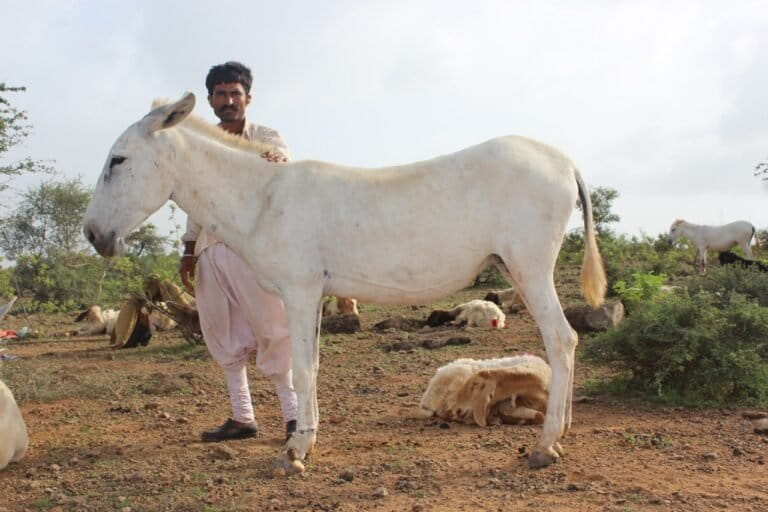
Equally important has been finding ways to motivate the Maldharis to continue breeding this Indigenous donkey. “We did this by connecting them to the milk economy,” Mehta says. Donkey milk has therapeutic properties and can also be used to make cosmetics. This is where Aadvik Foods stepped in.
“We started working on the donkey milk project about three years ago. We buy milk from the breeders and export it in the form of milk powder,” says Hitesh Rathi, founder of Aadvik Foods. The company also makes donkey milk soap. Although still at a nascent stage, Rathi says he hopes the donkey milk vertical will perform as well as other verticals — camel milk and goat milk — which are processed into dairy products, chocolates, and skincare products.
As a result of this, Punabhai says that he is able to sell his Halari donkey milk at ₹200 a litre. “Halari donkeys give about 2-2.5 litres of milk; the income we are earning now is decent. Now that people are becoming aware, the price of young male donkeys has also gone up” he says. In an animal fair recently, male Halari donkeys were sold at ₹35,000-₹40,000. Punabhai has sold 14 male donkeys since the rise in demand.
Seeing the turnaround, Maldharis who had stopped rearing Halari donkeys have slowly begun keeping the animal again. Devabhai of Kathia village in Dwarka, for instance, was inspired by Punabhai. “If our livelihood can be ensured by keeping the Halari donkey, why should we not go back to our traditional ways?” Devabhai asks. Both Punabhai and Devabhai rear sheep and donkeys. “At least three other Maldharis in nearby villages spoke to me about the changes I have experienced after opting to rear these donkeys again. They wanted to hear it straight from me,” Punabhai says.
It is now expected that the number of Halari donkeys enumerated in the yet-to-be-released 21st Livestock Census will be around 550 — a gradual rise from the 469 recorded during the CfP–Sahjeevan survey.
Most Maldharis from the Bharwad community are now preparing for their seasonal migration. The white Halari donkey may not walk alongside them in the impressive numbers of yesteryears, but they may remain with families back home — sustaining and supporting them in other ways.
Read more: A harsh winter reality for Kashmir’s donkeys
Banner image: Ranabhai Bharwad is a pastoralist who rears Halari donkey. Image courtesy of Centre for Pastoralism, Sahjeevan.