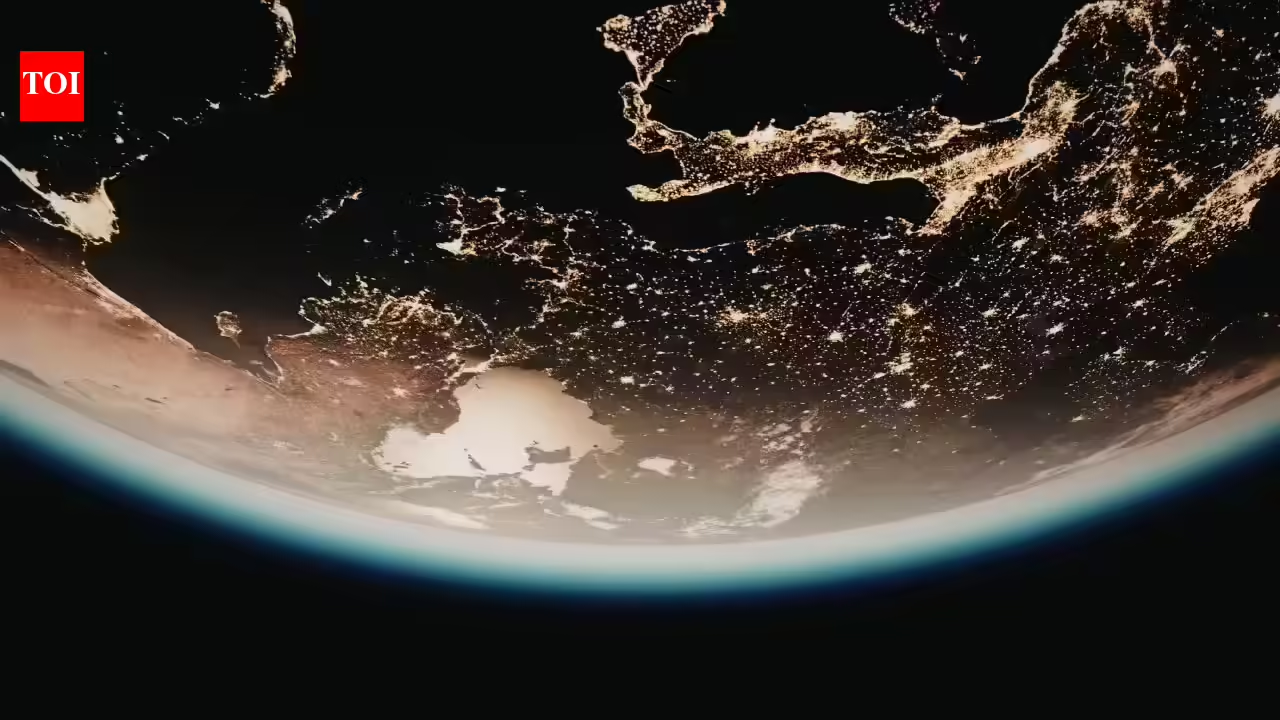
The idea that a day on Earth always lasts 24 hours feels fixed, which is believed to be permanent. The same rhythm people build their lives around. But scientists have long observed that Earth’s rotation is not completely stable. It changes in very small steps over time. The planet is gradually slowing down. This means the length of a day is increasing, although only by tiny amounts that are not noticeable in everyday life. Over millions of years, these small shifts add up. According to NASA reports, in the far future, Earth’s day could stretch to around 25 hours. The process is slow, measured in geological time rather than human lifetimes, but it is real and continuously happening.
Why is Earth’s 24-hour day gradually slowing over time
Earth does not spin at a perfectly constant speed. It rotates on its axis, completing one full turn roughly every 24 hours. This rotation is gradually slowing down according to NASA reports. The change is extremely small, measured in milliseconds over centuries. A day becomes longer by about 1.7 milliseconds every hundred years. This shift does not affect daily life. Clocks do not need adjustment for it in any noticeable way. Still, precise scientific instruments can measure the difference. Over long periods, the accumulated effect becomes significant.The planet’s rotation speed has been decreasing since its formation billions of years ago. It is a continuous process shaped by external forces acting on Earth. The main reason for this change is the Moon. Its gravity pulls on Earth and creates tides in the oceans. These tides are not only water movements. They also transfer energy between Earth and the Moon.This energy transfer slows Earth’s rotation slightly. As Earth loses rotational energy, the Moon gains it and moves slowly away from the planet. Measurements show the Moon drifts about 3.8 centimetres farther from Earth each year. The connection between the two bodies is constant. ‘Earth slows down. The Moon shifts outward.’ This interaction has been happening for billions of years and continues today.
How Earth’s days were once much shorter than 24 hours
Earth’s past shows that days were once much shorter. During the age of dinosaurs, a day lasted around 23 hours. Going even further back, early Earth rotated much faster, with days closer to 18 hours. Fossil evidence helps scientists estimate these changes. Ancient coral formations preserve growth rings that reflect daily and seasonal cycles. These patterns reveal how many hours made up a day in the distant past.The trend is clear. Earth’s rotation has been slowing gradually over time, not in sudden changes but in steady, long-term movement. A 25-hour day will not occur in the near future. Scientific estimates suggest it could take around 200 million years for Earth’s rotation to slow enough to reach that point. This timescale is far beyond human civilisation. Continents will move, climates will shift, and life will continue evolving in ways that cannot be predicted in detail. The change in day length is part of that very long planetary cycle.
How scientists measure Earth’s rotation using atomic clocks and satellites
The modern scientific study of Earth’s rotation employs highly sophisticated instruments. Atomic clocks provide highly accurate measurements of time. Satellites observe the position and movement of Earth. Observations of astronomical bodies determine Earth’s rotational rate. Earth’s rotation displays small irregularities that are measured using these techniques. The rotation of the Earth is not consistent. It slows at different rates depending on the earthquake or ocean activity. These factors influence the rotation rate of the Earth. For the clock time to be consistent with Earth’s true rotation, a leap second may occasionally be inserted.
Earth’s 24-hour cycle is stable but slowly changing over time
The day on Earth lasts for 24 hours, but it is not eternal. It is just one element in an endless process that is determined by various forces, including gravitational pull, energy exchange, and movement of celestial bodies. One day in the future, the Earth will have longer days, a new rhythm of life, and perhaps even more night than it has now. However, at this point, the day cycle is relatively stable from the human perspective.