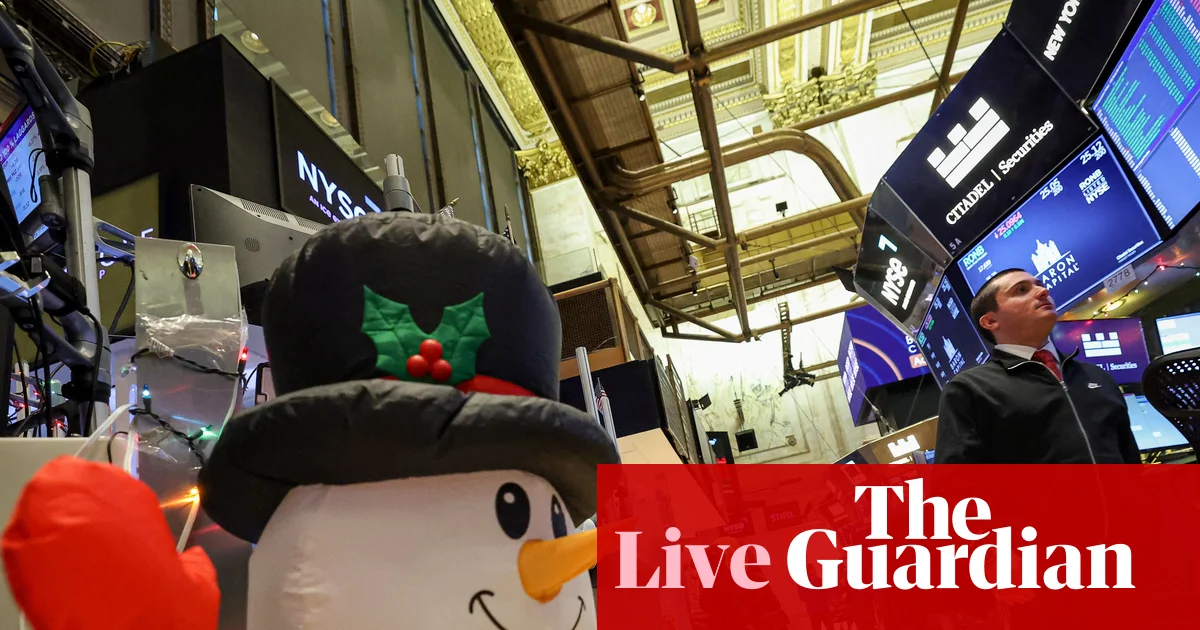
Introduction: Best year for global markets since 2019
Good morning, and welcome to our rolling coverage of business, the financial markets and the world economy.
It’s the last full trading day of the year, and investors around the world can look back at some strong gains over the last 12 months.
The MSCI All Country World Index, which tracks equities across developed and emerging markets, has gained over 21% during 2025, its best annual performance since 2019 and the second best since 2009.
It was a choppy year, though; nine months ago, we were bracing for Donald Trump’s ‘Liberation Day’ tariffs, which triggered a market slump in early April, followed by a rebound as the US president blinked.
It’s also been a year in which US markets failed to keep pace with the rest of the world, as investors have looked to diversity away from American assets. The S&P 500 index has gained 17% this year, a strong performance, but one that lags behind Germany’s DAX (+22%), the UK’s FTSE 100 (+20%), or Japan’s Nikkei (+26%)
And it was a rough year for the US dollar, which had its worst first half-year in more than 50 years.
Tuesday is the last trading session of the year for several equity markets, including in Japan, South Korea and Thailand, so we can start looking back at the year today (London is open for a half-day session tomorrow).
S&P Global Ratings’ EMEA chief economist, Sylvain Broyer, says one of the lessons from 2025 is that Europe’s economy was better than expected at absorping external shocks.
Broyer explains:
The year delivered a mix of expected and unexpected developments for the European economy. Household consumption strengthened, unemployment fell further, and confidence and productivity finally began to recover. At the same time, the U.S. administration’s decision to raise tariffs on European goods, reinforced concerns about the external environment.
One of the biggest surprises of 2025 was the sharp appreciation of European currencies against the U.S. dollar, despite a tariff shock that would normally argue for a weaker euro, pound, and Swiss Franc.
Another was the scale of fiscal stimulus unveiled by the German government, which prompted substantial upward revisions to growth forecasts over 2026–2028. Together, these factors reshaped the macroeconomic narrative in ways we hadn’t anticipated at the start of the year.
2025 was also dominated by artificial intelligence, of course, and some tech companies had a rather better year on the markets than others.
Google’s parent company, Alphabet, is up 65% this year, as its Gemini service has grown its market shares. Microsoft, though, has gained a more modest 15%.
Chipmarket Nvidia is up 40%, in a year in which its value surged over $4.5bn, while Oracle has risen 17%, amid fears about the amount of debt being issued to fund the AI infrastructure rollout.
The agenda
Key events
London’s stock maket has opened a little higher, although the City has yet to see much sign of the traditional “Santa rally”.
The FTSE 100 share index is up 10 points, or 0.1%, at 9876 points, moving a little closer to the record high of 9,930 set in mid-November.
Mining companies are leading the risers, such as precious metals producer Fresnillo (+2.6%), Anglo American (+1.7%) and copper miner Antofagasta (+1.7%).
Octopus Energy to spin out Kraken at $8.65bn valuation
There’s some festive deal excitement in the UK energy market today.
Octopus Energy has moved closer to spinning off its technology arm, called Kraken, as an independent company, with a valuation of $8.65bn.
The UK energy company is selling a minority stake in Kraken, worth around $1bn, to a syndicate of investors including D1 Capital Partners, Fidelity International, Durable Capital Partners and Ontario Teachers’ Pension Plan Board.
Kraken licenses its AI-powered operating system to utilities worldwide; Octopus says it is now contracted to serve over 70 million accounts worldwide through licensing agreements with major utilities.
Octopus says the move paves the way for Kraken’s formal independence and demerger.
Greg Jackson, founder of Octopus Energy Group, says:
“Kraken is in a class of its own, in terms of technology, capability, and scale. As an independent company with world-class backers and outstanding leadership, it will be free to grow even faster and is set to be a true UK-founded success story.
“Having incubated Kraken, Octopus is a powerhouse of innovation and technology, and will now have even more horsepower to deliver the transformation of energy globally. With over 10 thousand staff, 11 million customers, $10bn of generation under management, and businesses from EV leasing to heat pump design and manufacture, Octopus is set for even greater things over the coming years.
Japan’s Nikkei posts record year-end finish above 50,000 points
Japan’s stock market has ended 2025 at its highest year-end level ever.
The benchmark Nikkei 225 stock average closed above 50,000 on the Tokyo Stock Exchange today.
On the day, the Nikkei shed 187.44 points, or 0.37 pct, from Monday to finish at 50,339.48.
That’s a gain of 10,444.94 points, or 26.18%, this year.
Optimism that Japan’s new prime minister, Sanae Takaichi, will push through higher government spending to stimulate the economy boosted stocks in recent months. Takaichi attended the traditional ceremony to mark the end of the tradng year today,
European weapons makers, and banks, record strong year
2025 was a good year for European defence companies, and the region’s banks.
An index tracking European weapons makers has surged by 55% by this year, as NATO members have begun to scramble to rearm – with the Russia-Ukraine war continuing and the Trump White House increasingly critical of Europe.
European bank stocks have had their best year since 1997, Reuters reports, up 65% this year.
Introduction: Best year for global markets since 2019
Good morning, and welcome to our rolling coverage of business, the financial markets and the world economy.
It’s the last full trading day of the year, and investors around the world can look back at some strong gains over the last 12 months.
The MSCI All Country World Index, which tracks equities across developed and emerging markets, has gained over 21% during 2025, its best annual performance since 2019 and the second best since 2009.
It was a choppy year, though; nine months ago, we were bracing for Donald Trump’s ‘Liberation Day’ tariffs, which triggered a market slump in early April, followed by a rebound as the US president blinked.
It’s also been a year in which US markets failed to keep pace with the rest of the world, as investors have looked to diversity away from American assets. The S&P 500 index has gained 17% this year, a strong performance, but one that lags behind Germany’s DAX (+22%), the UK’s FTSE 100 (+20%), or Japan’s Nikkei (+26%)
And it was a rough year for the US dollar, which had its worst first half-year in more than 50 years.
Tuesday is the last trading session of the year for several equity markets, including in Japan, South Korea and Thailand, so we can start looking back at the year today (London is open for a half-day session tomorrow).
S&P Global Ratings’ EMEA chief economist, Sylvain Broyer, says one of the lessons from 2025 is that Europe’s economy was better than expected at absorping external shocks.
Broyer explains:
The year delivered a mix of expected and unexpected developments for the European economy. Household consumption strengthened, unemployment fell further, and confidence and productivity finally began to recover. At the same time, the U.S. administration’s decision to raise tariffs on European goods, reinforced concerns about the external environment.
One of the biggest surprises of 2025 was the sharp appreciation of European currencies against the U.S. dollar, despite a tariff shock that would normally argue for a weaker euro, pound, and Swiss Franc.
Another was the scale of fiscal stimulus unveiled by the German government, which prompted substantial upward revisions to growth forecasts over 2026–2028. Together, these factors reshaped the macroeconomic narrative in ways we hadn’t anticipated at the start of the year.
2025 was also dominated by artificial intelligence, of course, and some tech companies had a rather better year on the markets than others.
Google’s parent company, Alphabet, is up 65% this year, as its Gemini service has grown its market shares. Microsoft, though, has gained a more modest 15%.
Chipmarket Nvidia is up 40%, in a year in which its value surged over $4.5bn, while Oracle has risen 17%, amid fears about the amount of debt being issued to fund the AI infrastructure rollout.