
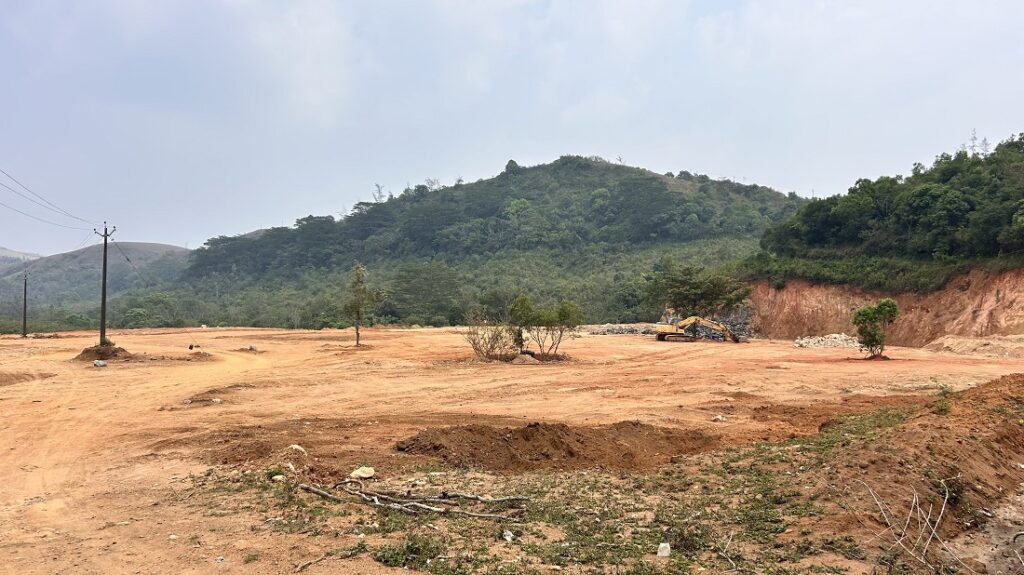
The most striking evidence of this change is the scale of hill cutting now underway across the region. In multiple locations, slopes have been sliced open to create flat surfaces for resorts, homestays, parking areas and other tourism infrastructure.
Entire sections of hillsides have been removed, leaving behind steep vertical faces of exposed laterite and loose soil that bear little resemblance to the original contours of the land. These are not minor interventions. In several stretches, the cuts run deep enough to permanently alter the shape and stability of the hills.
Temporary retaining structures have been erected in some places, but many exposed slopes remain untreated, without vegetation or proper reinforcement. What emerges is a landscape in transition, where natural forms are being steadily replaced by engineered surfaces that may not withstand the pressures of a heavy monsoon.
The ecological cost of this transformation is profound, though not always immediately visible. The grasslands of Vagamon, often mistaken for vacant land, are in fact an integral part of the high-altitude ecosystem of the Western Ghats, one of the world’s recognised biodiversity hotspots.
These meadows act as natural sponges, absorbing rainfall and releasing it gradually into streams and groundwater systems, while also stabilising soil and supporting a range of endemic species. When these grasslands are cut, compacted or built over, their ecological functions collapse.
Rainwater that would have been absorbed instead flows rapidly downhill, increasing surface runoff, eroding soil and weakening slopes. In a region that receives intense seasonal rainfall, such changes can quickly escalate into landslides.
Kerala’s recent history offers repeated warnings of how altered terrain, combined with extreme weather, can trigger disaster, and Vagamon shares the same vulnerabilities.
Driving this transformation is a surge in tourism that has reshaped Wagamon’s economy and land use patterns. Once promoted as a quiet alternative to more crowded hill stations, the region is now marketed as an adventure destination, with paragliding sites, off-road trails, hilltop viewpoints and a growing network of resorts drawing increasing numbers of visitors.
Each of these developments demands space, and in a terrain like Vagamon, space is often created by cutting into hills. Access roads are widened by slicing through slopes, hilltops are levelled to accommodate viewing platforms, and meadows are converted into parking areas and private properties.
The cumulative effect is a steady re-engineering of the landscape, carried out in fragments that may appear small in isolation but together amount to a significant transformation of the region’s ecological character.
Equally significant is the fragmentation of Vagamon’s once continuous grasslands. Open stretches that once allowed water to move, soil to stabilise and species to thrive are increasingly being divided into smaller parcels, fenced and developed for commercial use. This process disrupts natural water systems, reduces groundwater recharge and increases the risk of erosion and slope failure.
It also alters the social landscape, as areas that were once accessible to local communities become restricted and privatised. The loss of openness is not merely aesthetic. It represents the breakdown of an ecological system that depended on continuity to function effectively.
Concerns about these changes have been formally raised by local environmental groups, highlighting not only the scale of the damage but also the apparent lack of administrative response.
In a letter dated February 8, 2026, addressed to Dineshan Cheruvat IAS, the High Range Environment Protection Council reported large-scale destruction of plantations within the ecologically sensitive areas of Wagamon village. The complaint had earlier been submitted to minister K Rajan and forwarded to the district administration along with photographic evidence. According to the council, no action had been taken even weeks after the issue was escalated, raising serious questions about enforcement in a region that is already recognised for its ecological fragility.
The warning contained in the complaint is particularly stark. The area where land disturbance has been reported lies within about one kilometre of Kootickal, where a devastating landslide in 2021 claimed more than 20 lives following intense rainfall. The proximity of current hill cutting activity to a known disaster site underscores the risks associated with altering slopes in such environments.
The Kootickal tragedy remains a powerful reminder of how quickly ecological imbalance can translate into human loss, as hillsides weakened by natural and human factors gave way under the force of heavy rain. Vagamon, with its similar terrain and climatic conditions, is not insulated from such risks. If anything, the ongoing disturbance of slopes increases the likelihood of similar events in the future.