- A Multi-Modal Terminal constructed in Varanasi, for transportation via National Waterway-1 has not had regular traffic flow as yet.
- According to an analysis, the cargo transported from this terminal between November 2018 and December 2025 remains far behind the planned targets.
- Non-availability of cargo for the return journey and low participation of the private sector in ship operations are some of the challenges.
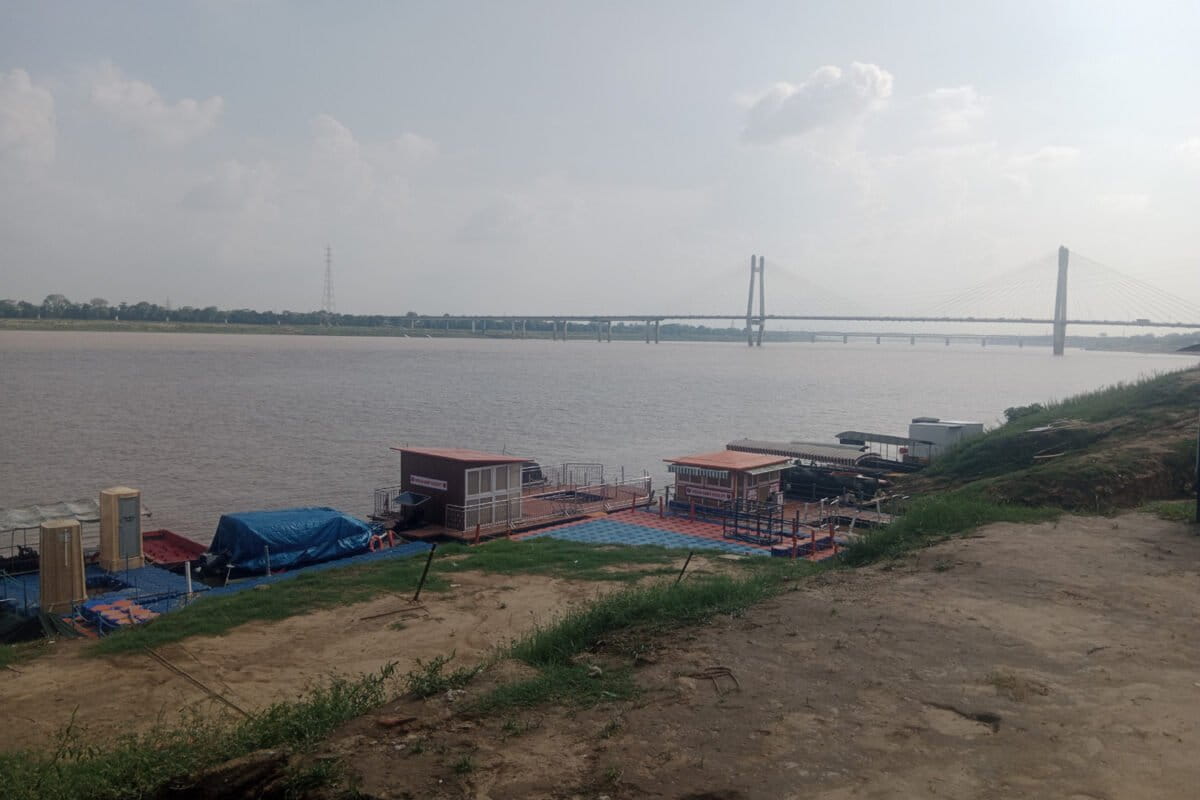
In 2016, Nitin Gadkari, the then Shipping Minister, laid the foundation stone for a multi-modal terminal (MMT) in Ramnagar, near Varanasi in Uttar Pradesh, and symbolically flagged off two ships. In November 2018, Prime Minister Narendra Modi inaugurated the completed terminal, built on the banks of the Ganga River, as a key stop on National Waterway-1.
“Inland waterways will save time and money, reduce road congestion, fuel costs and vehicular pollution,” the Prime Minister had said at the time.
However, today, transportation through National Waterway-1 remains inefficient and unreliable. Adequate river depth remains a major problem for water transport throughout all months.
Targets set in the Detailed Project Report (DPR) projected that the multi-modal terminal had the potential to transport 3.55 million tons annually by 2020, 3.82 million tons by 2025, 10.12 million tons by 2035 and 10.32 million tons by 2045. However, the Inland Waterways Authority of India (IWAI) is far behind these targets.
When Mongabay-India asked about the number of trips from the terminal and operational challenges, Sanjeev Kumar, Assistant Director at IWAI, did not provide any concrete response.
Goals vs reality
According to a data analysis of the IWAI cargo portal by Manthan Study Centre (an organisation that conducts research on waterways), only two shipments were flagged off from the Varanasi MMT in 2024-25. From November 2018 to December 2025, about 1,057 metric tonnes were transported from Varanasi MMT, far lower than the stipulated goal of 3.82 million tons by 2025.
“The ground situation is completely different from what the government has been claiming. The target was to transport 3.55 million tons cargo (as of 2020) annually from the Varanasi MMT, which is not even remotely feasible. The depth of water and the flow required to transport such huge quantities are not available throughout the year,” Shripad Dharmadhikari, founding coordinator of the Manthan Study Centre, told Mongabay-India. “Also, there isn’t enough demand from cargo owners to meet the target. Other transportation options will deliver goods faster than waterways, so freight carriers are not seeing any benefits,” he adds.
Dharmadhikari adds: “It’s expensive to build a navigation channel. On top of that, maintaining it during floods or low tide situations will be difficult. The government is providing subsidies to encourage water transport. I think the project needs proper evaluation.” Navigation channels are water passages made suitable for large ships, with requisite water flow, width and depth.
According to a government statement, the transit time set on Waterway-1 is seven days between Kolkata and Patna, five days between Patna and Varanasi and 14 days between Kolkata and Varanasi.
The government, in response to a question from Members of Parliament in the Lok Sabha, stated in December 2025, that contracts have been awarded to develop navigational pathways on 10 stretches of National Waterway-1 from Haldia to Varanasi. In response, Sarbananda Sonowal, the Ports, Shipping and Waterways Minister, explained that the flow of the river, significant seasonal variations between the monsoon and dry seasons, and the presence of dams, barrages and irrigation projects in the upper stretches or areas without navigation locks are some significant challenges. Furthermore, the absence of cargo on the return journey, low industrialisation along the waterways, high overall costs due to first-and last-mile connectivity and low private sector participation are other factors that hinder growth.

Government efforts to promote waterways
The Union Ministry of Ports, Shipping, and Waterways launched the ₹95.42-crore Jalvahak Scheme in December 2024 to attract cargo owners from rail and road transport to water transport. Cargo owners who choose water transport for distances exceeding 300 km on National Waterways-1, 2, and 16 are reimbursed 35% of their operating expenses.
Meanwhile, around ₹1,313 crore has been allocated for fairway maintenance on National Waterway-1. According to data provided by the government in response to a question in Parliament, ₹767.52 crore has been spent on dredging various stretches of National Waterway-1. Dredging has been initiated on the Ghazipur to Varanasi stretch in 2025 and will be completed by 2028.
In its report, the Parliamentary Standing Committee on Transport, Tourism and Culture, states that it observes an imbalance in capital investment and maintenance expenditure. The committee noted that while the project has shown progress in building multi-modal terminals in Varanasi, Sahibganj and Haldia, evidence suggests that implementational challenges remain. Some tenders have been cancelled due to bids significantly exceeding estimated prices.
The committee stated that regular dredging and maintenance of channels is essential to ensure navigability of the waterway, and the current allocation of ₹267 crore appears insufficient. The report suggests a comprehensive inland waterways investment framework to attract private investment, which is currently low.

Limited utility along the Varanasi-Prayagraj stretch
While the government has extended Waterway-1 from Haldia to Prayagraj, the stretch from Varanasi to Prayagraj (230 km long) is a comparatively low-priority area for transportation.
Brajesh Kumar, IWAI’s deputy director in Prayagraj, told Mongabay-India: “Our main infrastructure is in Varanasi, with a small floating jetty at the Saraswati Ghat here (in Prayagraj).” He also acknowledged that there isn’t enough water for transportation on normal days. In response to a question in the Rajya Sabha in April 2022, Shipping Minister Sonowal said: “The Prayagraj to Varanasi stretch of National Waterway-1 is navigable for only six months. During the lean period, various shallows, hard layers and the construction of pontoon bridges make navigation on this stretch difficult.”
This story was reported by Mongabay’s Hindi team and first published on our Hindi site on February 23, 2026.
Banner image: Saraswati Ghat on the Yamuna River. Image by Rahul Singh.