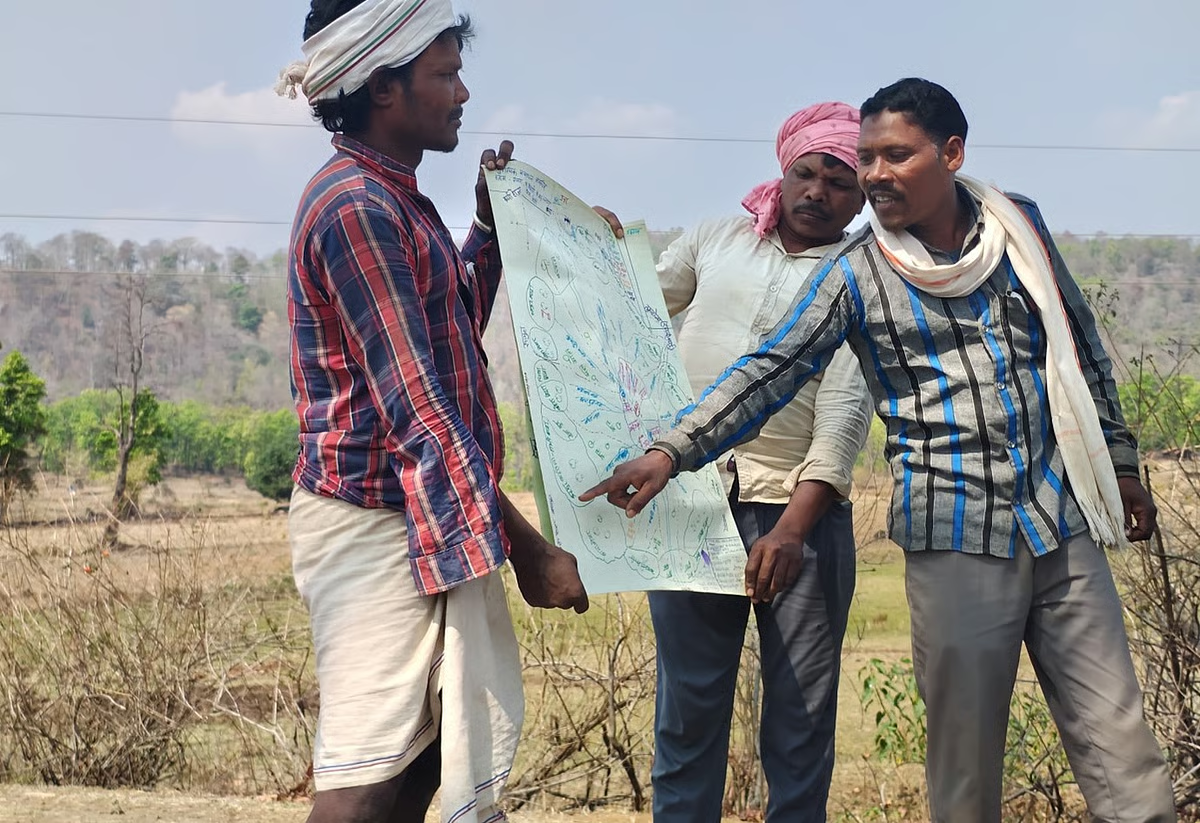
Nestled amid the sal forests of the Maikal range, Ranjara—a small Baiga village in the Samnapur block of Madhya Pradesh’s Dindori district—has turned its forest into a canvas of collective action. Classified as a ‘forest village’, Ranjara lies within the Baiga Chak region, where the community resides within and around forest landscapes and remains deeply dependent on forest resources for its livelihoods and cultural practices. Here, the trees that stand tall along the forest edge now bear blue markings, not just as boundary signs, but as symbols of unity, identity, and stewardship.
The initiative, led by the Gram Sabha of Ranjara, marks a significant step in the community’s long journey to claim and manage their rights under the Forest Rights Act (FRA), 2006, and the Panchayats (Extension to Scheduled Areas) Act, 1996 (PESA).
A village rooted in the forest
Ranjara is home to around 854 people from 172 households, with nearly 95 per cent belonging to Scheduled Tribes, primarily Baigas—recognised as a Particularly Vulnerable Tribal Group (PVTG)—alongside Gonds and other forest-dwelling communities. Their lives are deeply interwoven with the rhythms of the forest. Non-Timber Forest Produce (NTFP), such as mahua flowers, tendu leaves, and char seeds, provides seasonal income. Firewood, medicinal herbs, and wild edibles form the backbone of daily sustenance.
Agriculture, practised on small patches of rain-fed land, supplements their livelihoods, but it seldom suffices to meet their needs. The forest is not just an additional source of income—it is a cultural and spiritual lifeline. Their songs, festivals, and rituals mirror this connection, invoking forest deities and celebrating harvest cycles. “Our ancestors lived with these trees. The forest is our temple and our protector,” said a respected elder of the village.
The idea of a ‘blue boundary’
The idea of colour-coded forest demarcation emerged during a Gram Sabha meeting, where villagers discussed recurring issues of overlapping forest use with neighbouring villages. Without clear visual markers, boundaries often became contentious, especially during NTFP collection and grazing.
Instead of waiting for official survey teams, the community decided to act. Using a participatory and inclusive approach, the Gram Sabha initiated a process to mark their traditional forest boundaries through a colour-coded system applied on selected trees in an ecologically sensitive manner. The markings are carefully applied without harming the trees, reflecting the community’s deep respect for the forest.
The colour blue, chosen collectively, symbolises peace, protection, and belonging. This approach serves two important purposes—it helps clearly distinguish traditional boundaries among neighbouring villages, reducing the risk of conflict, and enables community members to navigate forest pathways and resource zones more effectively.
Each family contributed time and effort, and over several days, men, women, and youth walked together along forest trails, marking trees to create a visible, community-recognised boundary.
“The blue markings remind us where our forest begins—and where our responsibility starts,” said a Baiga community member who participated in the demarcation drive.
Community-led governance in action
The initiative, which began in 2025, goes beyond boundary marking—it represents a shift toward self-governance. The villagers are not just claiming their rights; they are demonstrating what responsible rights-holders look like. By identifying, marking, and monitoring their resource boundaries, the community is building a foundation for sustainable forest management.
The Gram Sabha has also begun documenting resource zones, identifying patches of bamboo, medicinal plants, and NTFP collection areas to integrate into their management plans. This participatory mapping process reinforces the FRA and PESA, which envision recognising and vesting forest rights and governance authority in forest-dwelling communities to ensure livelihood security, justice, and the sustainable conservation of forest ecosystems.
Cultural continuity meets conservation
The initiative has also enabled the Gram Sabha to introduce locally grounded and collectively enforced resource management practices.
Through regular Gram Sabha discussions and mutual agreement, community members have established norms for the seasonal collection of NTFP, ensuring that resources such as mahua, tendu, and other forest products are harvested only after maturity, allowing for natural regeneration. Grazing practices are being planned and rotated collectively, with herders following agreed routes and timings to prevent damage to young vegetation, reduce soil compaction, and maintain soil health.
The community has also strengthened its response to forest fires through collective patrolling, early detection, and the creation of fire lines, with villagers taking shared responsibility during the fire season. In addition, traditional norms around forest access are being reinforced through community decisions, including restrictions during wildlife breeding seasons and in areas deemed sacred or inviolate, reflecting both cultural values and conservation priorities.
These practices are not imposed externally but are decided, monitored, and followed by the community itself, demonstrating how traditional knowledge and collective governance contribute to sustainable forest management.
These efforts ensure that securing rights does not lead to increased exploitation; rather, it fosters a strong sense of ownership and stewardship among the community.
“The people of Ranjara are showing that conservation is strongest when communities lead,” said a local animator supporting the process.
A model for other villages
Ranjara’s initiative is slowly inspiring neighbouring villages to consider similar participatory boundary demarcations. It has been demonstrated that forest management need not wait for external interventions—communities, when empowered, can act decisively and responsibly. With consistent technical support from WWF-India, ATREE and NIWCYD, other right holders in the Baiga Chak region are being trained for forest governance with a strong emphasis on ownership and responsibility.
The blue-marked trees of Ranjara now stand as living symbols of a larger movement—one that blends identity, ecology, and governance. They tell a story not of confrontation but of coexistence; not of waiting for recognition, but of earning it through action.
Ranjara’s story reminds us that the true power to protect our planet lies within communities—through collective responsibility, local knowledge, and a deep-rooted commitment to conservation.
Tapas Das is Coordinator Communities-Central India Landscape, WWF-India
Views expressed are the author’s own and don’t necessarily reflect those of Down To Earth