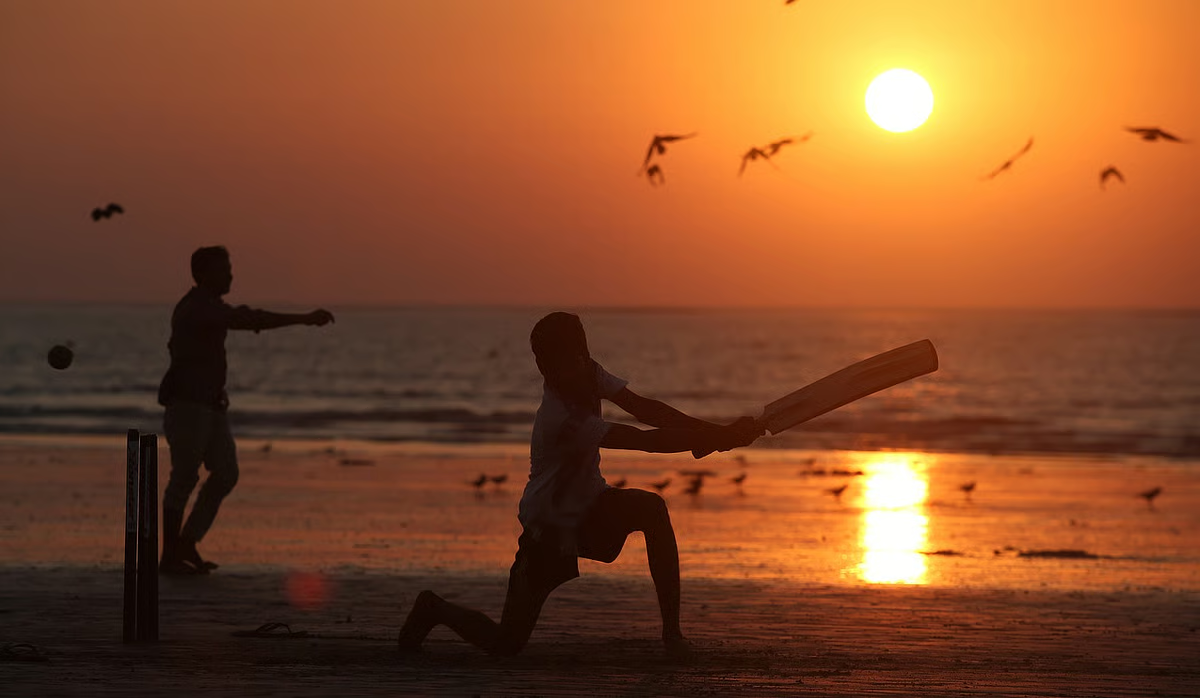
Mumbai’s intimacy with the sea is a famous affair. People of this city arrive at the seaside at any opportunity that presents itself. A Sunday, a quiet afternoon, a tired evening. They step out of musty squalors crowded with housemates and laundry, sprint away from the sensory mayhem of traffic and construction, and avoid the general assaults on their privacy to sit at the shore and hook their eyes on far-away nothingness. The horizon is a respite from everything else. It reminds them of space — of there being something larger than the immediacy of everyday life — and beckons them to breathe.
But something different has been happening of late. Now, when people go to meet the sea, they see the oneness of sea and sky injured by sprawling urbanisation, by the roadways being built from Marine Drive to Worli, Worli to Bandra, Bandra to Versova, and Versova to Bhayander. Essentially, across Mumbai’s entire coast.
To object to the coastal roadways is to pronounce yourself an irrational and imbecilic romantic. While I can’t honestly claim I’m neither of those, let me be clear: I am not anti-development. I am not against easier mobility. I wholeheartedly support better traffic flow and less congestion. Most of all, I do not reject change. I live in a city where change personifies itself more manifestly than anywhere else. But the existence of the city is changing now in a way entirely unforeseen. Along with the country, I suppose. And the gap between who it helps and who it affects is swelling rapidly.
Who rides the roads?
Before I talk about the esoteric subject of this article, which is the death of a horizon, I must address the material, positive claims of the coastal road network. I must do this to have you take my spiritual claims seriously, and to make a case for why the material benefits do not outweigh the metaphysical costs.
The roadways serpenting the Arabian Sea coast of Mumbai are said to have freed up the life of an average commuter. The highway projects cut down travel time by various impressive figures. For the Brihanmumbai Municipal Corporation (BMC) and the state government, they are game-changers in Mumbai’s congestion. And they really do ease life — for some. The rest remain stuck in congestion, in longer and longer bus queues, and in the frustration of poorer public services.
The coastal roadways are built exclusively for cars. Two-wheelers, rickshaws, and heavy vehicles are banned, while bus routes do not traverse. The inadequate expansion of public transportation systems due to their exclusion from urban planning runs alongside the promotion of car-infrastructure. A bus, on average, carries the load of eight cars, but the number of operational BEST buses has been dwindling over the years. With the BMC — India’s richest municipal body — substantially diverting funds away from public transport services, BEST’s fleet of buses is about a half of what it was 15 years ago. At the same time, the number of cars on the road has grown to 2.75 times, almost triple, of what it was 15 years ago. Even then, as of 2024, merely 48 lakh (4.8 million) people rely on private vehicles for daily commute, of which only 14 lakh (0.14 million) rely on cars (others on two-wheelers), whereas 108.7 lakh (10.87 million) people continue to rely on public transport. So, there are 7.8 times more people using public transport (excluding auto rickshaws and cabs) than private cars. To put it simply, Mumbai’s urban infrastructure increasingly favours less than one-eighth of the population. “The better eight,” as Cal Hockley, Titanic’s noxious villain, might explain.
In a relatively respectable feat, BEST is planning bus routes on the Coastal Road connecting Marine Drive to Worli, but there are no public transportation systems across the Bandra-Worli sea-link, the Mumbai Trans Harbour Link, or the upcoming Bandra-Versova sea link, and they are unlikely to materialise any time soon. These roads cut off access for the lower-middle class of Mumbai (without even considering toll prices). Like all car-designated infrastructure, this design excludes most people. While India has one of the largest and fastest-growing roadway networks in the world, why have we so consistently failed in addressing traffic issues which endlessly plague our lives? Why are the eight-lane highways cutting across the country’s forests and farmlands running empty? Can it be that “more roads” is not the solution we need? Investment in road infrastructure is unstudied and misguided, focusing on quantity instead of quality use and overlooking solutions for better traffic flow, better traffic regulations, and better public transport with last-mile connectivity. The coastal roads seemingly help cars escape congestion, but the logic that blames congestion on two-wheelers, rickshaws, and buses is quickly ruptured when one considers that cars have the lowest number-of-people-transported to space-taken ratio. By now it is well known that the more roads we have, the more congestion we have. Increased funding opportunities for private vehicles is ironically bound towards increased traffic on the roads, thereby increasing the need for more roadways, crystallising the cycle towards urban hell.
Is this to say that people should stop using cars? Of course not. They’re good things. They’re luxuries. But should the government be focused on spending crores to grant the already-luxurious transport easier and easier access across the city while absolutely stripping others of mobility? Those without cars are left with options for commute that are either non-existent, or expensive and exhausting in the way that makes a person feel like a caged chicken tumbling along with limited prospects of and conditions for life.
Why is it like this? “Because people who move around in cars are decision makers,” notes Shivanand Swamy, the economist and urban planner who was involved in planning one of India’s first bus transit systems in Ahmedabad. And because inducing demand helps the highway lobby make more money (on automobiles, construction, oil, asphalt, rubber), which makes them friends of politicians. In our narrow, and inevitably sinister, schema of development, planners and engineers are trained to systemically favour vehicular mobility instead of people-mobility. When asked, the BMC attributes its dwindling funding for the BEST to the buses’ “loss-making” inefficiency, instead of stepping up to fund incentives for efficiency. Buses are not trophies in the economy the way competitive car brands are; the fact that they serve the people more than the market is no matter. The government cheers for the rich with mottos of Convenience and Efficiency etched on its pompoms, surrendering public services and its dignity to privatisation, all while honing myopic and self-interested notions of progress.
Mumbai is in dire need of better public transportation. It has historically had one of the most functional public transport systems amongst Indian cities. Dismantling the system and limiting opportunities for its growth might render it obsolete. The desperation is growing for Mumbai’s citizens, but their voices are being squelched under decisions beyond their reach — lost to endless hours of risky commute — all so that a lucky few can revel in the view of the skyline as they speed past the city.
Lots more can be written about the defective logic of car-promotive infrastructure. But for now, I want to focus on the soul issue.
Where will they go?
Mumbai is kept alive by the sea. People flocking to Maya Nagri can accept it as their own because of the indiscriminate affection the sea brews in them. It forms a continuity between them and the world. All the people dotting Marine Drive and Bandstand and Juhu Chowpatty and Silver Beach are, in a way, sitting together. At the same time, looking away from the city reminds them that something more exists. It’s a promise of something larger. A raft for the imagination. The sea boasts of expanse, an experience distinct from sitting by a lake or a pond. It leads you somewhere. It connects you to places smaller and bigger, before and after.
Public spaces are few in most Indian cities, and even fewer are those that invoke any real sense of serenity. In Mumbai, the most usable public spaces have always been the seaside promenades. While access to the sea naturally privileges those residing in the peninsula’s borders, families, lovers, and employees have always flocked to the shore to vitalise their existence. To turn away from the wrestle that is building a life in Mumbai. But it’s becoming harder now to kindle that kind of forgetfulness. In the way stands that obstinate thing — concrete. The bridges and highways are encroaching on public spaces from afar. Teasing, untouchable, immovable.
We already suspect many of concrete’s ominous effects on our geography and nervous systems. Here is a specific one to do with Horizon-Gazing. Looking off into the distance helps us expand our visual field and allows the body to turn off its stress response. A theory goes that our ancestors would have widened their vision to scan the landscape for threats, and knowing that there is no danger till far away — that no immediate actions need to be taken — would have a calming effect. Research shows that our field of vision narrows, that is, our eyeballs rotate inwards, when we look at something stressful or exciting so that it is in sharp focus. Naturally, the body is able to switch off stress by expanding the visual field. It is impossible to sufficiently emphasise how important this is for the people of Mumbai. On these streets, something is always coming at you. One manoeuvres around hustling people, spitting people, running people, rat-infested garbage, water dripping from strange sources, automobiles, honks, construction, dust, and potholes in a whirlwind of sensory comprehension. It’s a wonder that everyone isn’t afflicted with squints in their eternally contracted eyes. The city keeps you on high alert, the senses in overdrive, and the body in a speed-overdosed state. Nothing is respite but the sea. It is the reminder that no immediate action needs to be taken, a reminder that can only be registered if viewed in its inexhaustive splendour. The splendour now interrupted, broken by the geometric, sordid shapes of industrialisation. We’re trading in the fresh silver-blue wholeness of the scenery for more of the stale grey-browns we can’t seem to escape.
In a city so fraught with problems of space, spaciousness holds great value. I suspect the moments people share with the horizon provide reorienting clarity as they blink awake to a brief spiritual asylum. These effects may be thus far unarticulated and unrealised, but once gone, shall affect the mental equilibrium that fuels the Keep Goingness of the city. Mass redevelopment of chawls, homes, and community spaces is already leaving the poorest of the city with fewer opportunities to exist meaningfully. The views and silences atop multi-storeys will probably keep some of us afloat, but changes of this sort will force people to Keep Going, hollower and more battered than before.
Because of the Coastal Roadways and road-widening projects, access to the seaside promenades is becoming restricted, inconvenient, and unsafe, instead of continuous and open. It fosters isolation, with limited access points and fragmented pockets of greenery. Alan Abraham writes, “Designed primarily for the elite, this road not only physically but also socially segregates the city. Its message is clear: buy a car!” Meanwhile, coastal road construction signboards read “Connecting People and Places.” Their efforts to placate any suspicion of the disconnect they might be causing make me laugh.
How we see affects our emotional health and well-being. We’re bundles of nerves that drag ourselves to the sea to let its rhythm and rapture unwind us, let its movement ground us. Somehow, the project builders have deemed it worthwhile to subject the city’s population to psycho-somatic asphyxiation.
Mumbai’s seafront is its largest public asset. Cutting off access to it for millions is a dishonour that may only be realised in the future. Without the opportunity of spiritual and sensory decluttering, I wonder whether Mumbai will be able to experience any calm. I wonder what kind of rage this confinement will bring. Will Mumbai lose perspective? Will it be able to romanticise the details? Will we be able to register life?
A word on the environment, the land, and its people
Much of Mumbai is built on reclaimed land which often renders environmental lambasts unemphatic. However, the world was different when the British reclaimed land to connect Mumbai’s seven islands. Although biodiversity was lost, environmental threats had not compounded as they have now. Nonetheless, the effects emerge today as various threats. Reclamation has engendered severe flood risks for current-day Mumbai. For a few days every year, the city submerges and stops. Materialised from the city’s perpetual vulnerability to floods, for instance, the floods of 2005 killed hundreds. Many flooded areas consisted of new developments built atop mangrove forests that once abated approaching seawater. But that warning for not sufficient, as ongoing reclamation and reckless construction continue to destroy intertidal zones. For the current coastal road projects, swathes of mangroves — vital pieces of infrastructure — have already been severed and floodplains compromised, both of which safeguard against floods and house rich biodiversity. Recently, the Bombay High Court approved the BMC’s proposal to cut 45,000 out of 60,000 mangroves for the Versova-Bhayander Coastal Road project. It rationalised this permission by planning to replant these mangroves — but in another city. Nearly a thousand kilometres away. This kind of compensation only conciliates the fools who believe that ecosystems are transplantable, moveable, ahistoric, and guaranteed to grow. It’s an ironic reinforcement of the country’s growing hunger for space and unabated construction, which is sure to swallow up all green land. When ancient forests are not forgiven, what hope do we have for nascent ones? For a 20,000 rupee crore project, 102 hectares of mangrove land will be compromised. I wonder if this is the best urban plan, the best idea they could afford with 20,000 crores. We, as a populace, have problems at every front. We must question whether these are the solutions we really need.
Tides have started breaching the Gateway of India. The shiny beauty of Mumbai’s skyline is disappearing behind thick blankets of pollution. Fewer creatures, fewer plants, fewer bacteria live to clean it up. Species further out in the sea are being pulverised under drill machines and molten cement. We keep forgetting that the effects of imbalanced ecosystems are entirely tumultuous, unpredictable, and discrepant. They make life uglier. Science attempts to but barely grasps the enormous complexity and order of natural systems; they are best not messed with. At least not as flagrantly as they currently are.
And then there are the sea-dependent communities. At this point, fisherfolk protests have been too frequent, too scattered, and too easily silenced to be of notice. While in 2021, there was uproar as plans of the Coastal Road were released to the public, helpless despair has settled among fishing communities whose livelihoods lie in the line of fire, or ‘zone of influence,’ as the official term goes. I spoke to groups of fisherfolk across Bandra’s Chimbai village, whose work will be obstructed by the Versova-Bandra sea link. While all the individuals I spoke to declared the highway’s construction to be a major disturbance which pushes fish that were once easy to catch deeper into the sea, some believe this to be a temporary effect on their livelihoods. When the construction finishes, they hope the fish will return. “New rocks will form,” a gentleman said, “where we can catch crabs and mussels.” Others are concerned about the waters receding permanently, habitat-loss for crabs and coastal species, and about new opportunities for land reclamation that will render fishing impossible. In general, not only does the drilling and oil-release push fish deeper into the sea, but the roadway projects limit the fishers’ access to certain points along the coast. Some folks hinted at old protests, and when I asked what silenced them, I was met with reticence. Convinced or coerced, compensated or not, the fisherfolk housed a general air of resignation. “What are you trying to write for now? It’s already being built.”
Yes, it is already being built. I do not dream of this article waving itself around like a zealous flag to halt the construction. I do hope it incites happy commuters to reconsider lauding the roads. Birthed by dust, disturbance, and egregious amounts of money, the coastal roadways are one grain in the sandpile of India redistributing its resources to the favoured few. Land, water, space, air, sky. Mumbai is not shy about this; it has briskly been pricing out renters and eroding community living spaces. For the highway luxuries of a few, the livelihoods, mobility, and joy of many are being tarnished. The government has made it clear, and any doubt on this should now be asunder, that it’s wedded itself to corporates and will offer up the land, the people, the social fabric of this country as eager dowry. Once again, as Arundhati Roy writes, “India’s poorest people are subsidising the lifestyle of its richest.”
We love reminiscing over photographs from older centuries and saying “Ah! Bombay doesn’t look like that anymore!” It will never look like that again, no matter where “that” stands. Of all the things moving in this city, the unthinkable has been moved. The city’s affair with the sea. We are already seeing perverse LED advertisements projected onto the face of the Sea-Link. Who knows what other creative opportunities the highways will provide to deface life. Something beautiful has been taken away from the people of Mumbai. The space, time, and air that people gasp for when roaring across the coastal roads is the air that’s been stolen from the people at the shore. The suffocation shall not be immediate, it shall creep up on the city slowly. This is a record, perhaps, for a later time when the sea does not glimmer the same as the sun dips down. And when eyes no longer relax into unforeseen distances. And when the lovers and dreamers of the coast wonder why their dreams seem so much smaller.
Shreya Sharma began her career in the urban development and environmental sector, and now works full-time as an artist. She is a filmmaker, photographer, and writer, currently working in the commercial film space. She wants to use her creative practice to engage with politics, culture, and power.
Views expressed are the author’s own and don’t necessarily reflect those of Down To Earth