
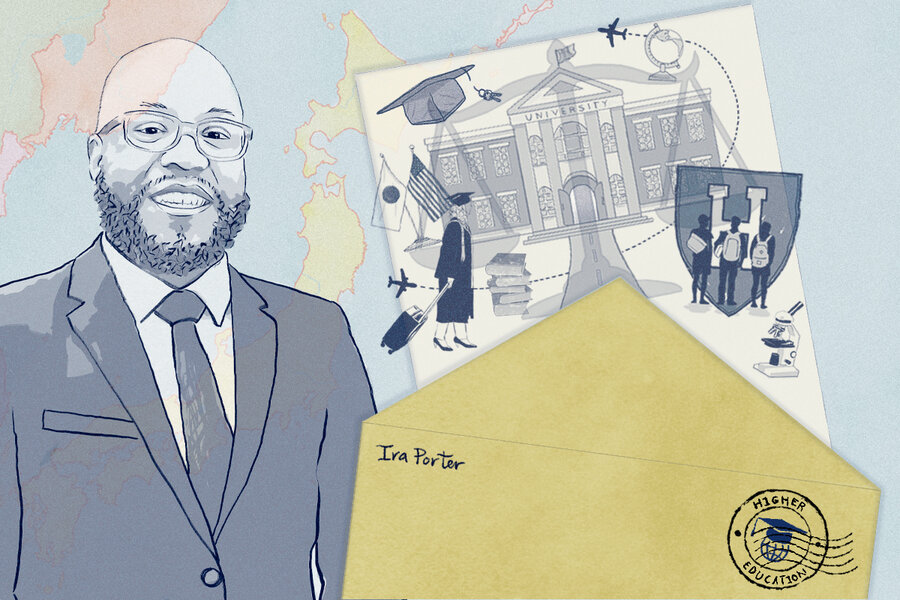
As a journalist, I get swept up in the news of the day, including reports about higher education, which is what I cover for the Monitor. This year, there was much to consider on my beat – from settlements between colleges and the White House, to research and Ph.D. cuts, to American faculty looking for international assignments. But nothing gave me greater joy in my job this year than traveling to Japan to write about Black male college students from the U.S. studying abroad.
There aren’t that many Black men who take that leap, which is why I wanted to address it for a fellowship I received from the Education Writers Association. My reporting took me to Tokyo to meet a student named Tremaine Collins, originally from Ohio, but now studying art at Temple University’s Japan campus. Mr. Collins is cerebral in his pursuit of a greater reality for himself than what his family, including his grandmother and mother who raised him, and an absentee father, got to see. While there, I met other students, including Demarris Johnson, a business major from Delaware with enough confidence and belief in himself to fuel turning his dreams into a reality.
“I hope that through people seeing what I’m doing and what others like me are doing that they believe in themselves, that they believe that they can do it as well,” Mr. Johnson says of Black men studying abroad. While some family members tried to sow doubt in Mr. Johnson’s mind about the trip, his mother supported him, he adds. Her blessing fueled his confidence.
Why We Wrote This
The past year was one that saw U.S. colleges and universities go head-to-head with the federal government, affecting everything from funding to staffing to enrollment. Education writer Ira Porter reported on the effects on campuses, and on the choices schools made about settling with the Trump administration. His favorite assignment of 2025, though, was not about battles – but opportunities. Fueled by a fellowship, and a bit of nostalgia, he went to Japan to spend time with Black men from the U.S. studying abroad. How were such experiences helping them? What kept them going? “Witnessing their journeys created collective moments of joy for me,” he writes.
“I also want [other] families to see that it is possible, it is happening, and we’re doing it,” he says. “And if you just gave these children a little more support with their big, outrageous thoughts, they could go a lot farther.”
Their stories triggered nostalgia for me about my long gone college days. Like Mr. Collins and Mr. Johnson, I relished having the privileges of being an adult, i.e., my own dorm room, no curfew, a schedule that I could create, and the freedom to pick and choose how I moved in the world. They are full of pride and optimistic about their ability to construct a world that they like looking at. So was I.
“I wanted to go out into the world and figure out my own path,” says Mr. Collins, about leaving his family back in Ohio.
I loved watching him get excited about joining the jiujitsu club on campus. Watching from the shadows during his campus tour, I witnessed him enthusiastically greet everyone from the dean of the school, Matthew Wilson, to advisers and other students. He paid particular attention to a group of students who took turns wrestling each other, sweeping opponents to the ground with their weight, and using moves like chokeholds and joint locks to force tap outs.
“I have an interest in mixed martial arts, specifically Brazilian jiujitsu, and while I’m in Japan, I think it’ll help further my experience in a positive way,” Mr. Collins shared with me after snatching a flyer to join the club.
Months later, I looked him up on Instagram and saw that he stayed true to his commitment to give it a try.
I never studied abroad in college, and I much regretted it once I became a full-fledged adult. Traveling is spiritual and life-affirming. Each journey is packed with lessons that you can only get by doing it. Meeting people who are different from yourself: different races, religions, ethnicities, genders and beliefs. Eating foods that are different from what you were raised eating. Crossing oceans and seeing the sun rise and fall from other vistas.
There was political turmoil when I was in college in the United States. I feared for what my future would look like after listening to all the people pontificate on cable news and in newspaper columns. The students I met in Japan were caught up in the middle of something similar, but instead of allowing themselves to be distracted by the day’s news, they swam further from shore and forced themselves, without mom and dad or all things familiar, to figure things out.
“One of the things about being here is the opportunities that you have to learn outside of the classroom, just by interacting with so many people from so many different cultures, in an environment that is friendly and open and everybody’s in the same boat,” Mr. Wilson, the dean, shares with Mr. Collins during a campus tour.
Mr. Wilson says students studying in Japan are off the beaten path – opting for something different than going to a local college or one in a neighboring state. They also buck the trend of people going across the country to college, because even those people are going places where everyone speaks the same language.
“The cultures don’t differ that much. You flip on the TV, it’s the same language, it’s the same programs, same food that you’re eating,” he says.
In Japan, students were a big group of individuals with different ambitions.
“Everybody is extraordinary. It’s just getting you to realize and allowing us to help you realize that you’re an extraordinary individual for doing this,” he shared in parting wisdom to Mr. Collins.
I liked hearing that encouragement. We hear a lot about the low return on investment in college today. College has become too expensive, which is true for many, and legislation such as the One Big Beautiful Bill, which caps and eliminates certain loan programs for students and parents, might put an added strain on those trying to earn a degree. What Mr. Collins heard from an administrator how his collegiate experience will set him apart from other candidates and make him more desirable.
After each visit that I made to Temple, I would use the hourlong train ride back to my hotel to tell my wife how inspired I was by listening to these young people talk, and watching them dream in living color. These were Black men being as audacious and ambitious as they wanted to be, without holding on to the fear of everything that could zap opportunity away from them. They were learning to write with hiragana and katakana while I exchanged messages with readers about skepticism for university research projects, faculty relocating overseas, and fallout from political polarization.
Witnessing their journeys created collective moments of joy for me, which was the best reporting assignment of my year.