- With broken links and a loosened food web, the Veli-Akkulam estuary now has few top predators.
- Invasive fish are pushing out native species and reshaping the ecosystem into a simpler, more fragile one, with impacts on biodiversity and fishing.
- Scientists call for urgent, ecosystem-based management focused on invasive species control, habitat restoration, and catchment-scale interventions.
Exotic fish, invasive plants, and urban waste are quietly reshaping a scenic estuary in Thiruvananthapuram. Beneath the calm surface of the Veli-Akkulam estuary, ecosystem modelling over three decades reveals its food web is fraying, key links are broken, and top predators like local fish and birds are being edged out, even as tourists and migratory birds still flock to its waters.
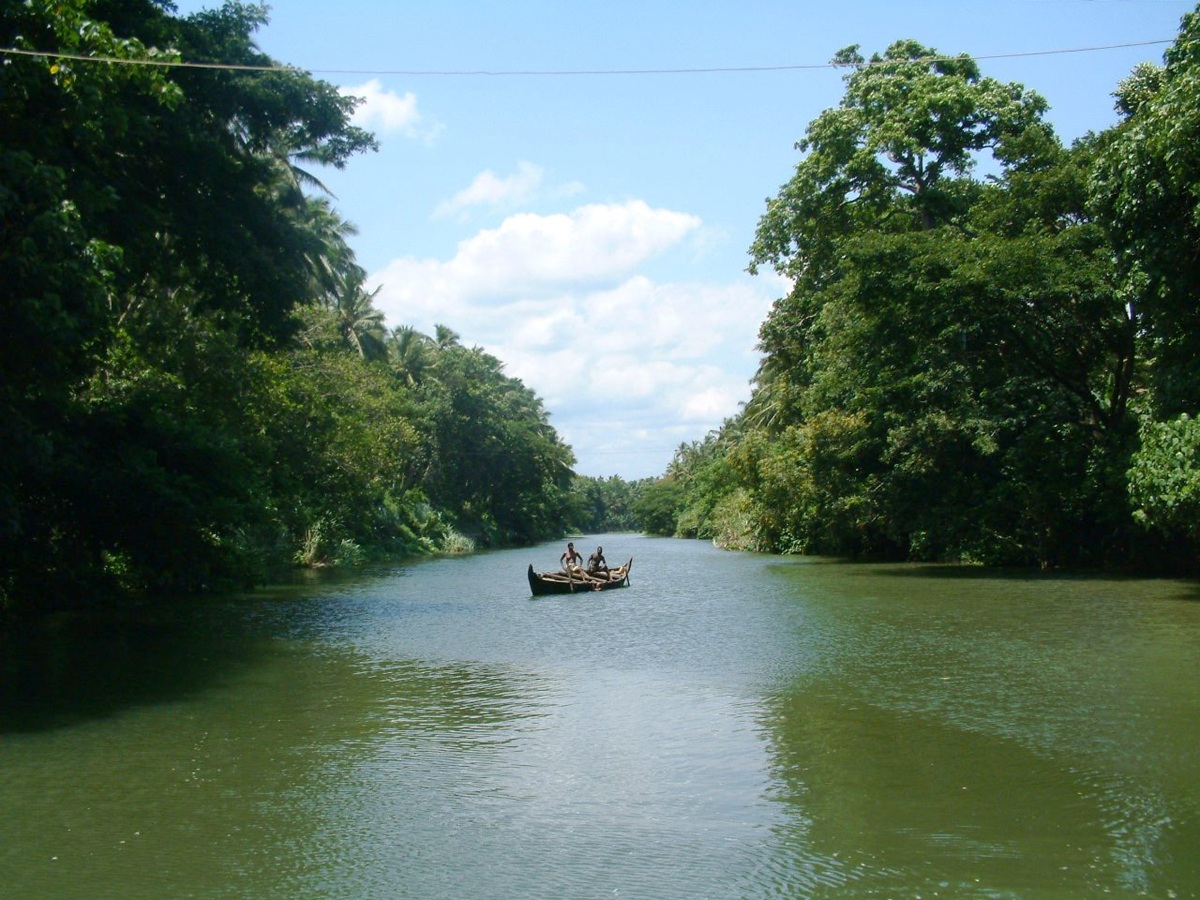
Flanking some of India’s premier scientific institutions, including the Vikram Sarabhai Space Centre, the estuary spans just 0.85 sq. km., about the size of a golf course. Its shallow waters—on average 1.3 metres deep—are a temporarily closed system within the fabled Kerala backwaters, oriented perpendicular to the Arabian Sea. During the monsoon, a narrow sandbar at its mouth is breached briefly, allowing two-way flow with coastal waters –letting in fish and other marine creatures to spawn here.
The lake is not collapsing. It is reorganising into a simpler system dominated by invasive species with ecological links under stress. That signals a slow but steady erosion of ecosystem health. An ecosystem is a community of organisms, across different levels of the food chain (called trophic levels), including producers (organisms like plants that make their own food), consumers (organisms that eat other organisms), and decomposers (organisms that break down dead material), all interacting with each other and their environment. These interactions sustain vital functions like nutrient cycling, fisheries, and water purification, which support biodiversity and human well-being.
“Over three decades, we have observed measurable restructuring of energy pathways and trophic interactions,” said A. Biju Kumar, Vice Chancellor, Kerala University of Fisheries and Ocean Studies (KUFOS) and co-author of the new study. “No commercial fishery, pollution, invasive species, and encroachment – in fact, you can hardly call it a lake,” he told Mongabay-India.
The study, published in the journal Marine Environmental Research, uses a type of ecosystem modelling called Ecopath with Ecosim—a method that traces how energy moves through all the organisms (the food web) in the estuary. Scientists from KUFOS, University of Kerala, and the Indian Council of Agricultural Research – Central Coastal Agricultural Research Institute analysed 17 functional groups—meaning sets of organisms with similar roles in the ecosystem—from phytoplankton (microscopic plants) and detritus (decaying organic matter) at the base, to fish, prawns, and birds higher up in the food chain. The model detected changes across three time periods—1993, 2008–10, and 2022–23—covering three decades of rapid growth around Thiruvananthapuram.
“It provides one of India’s first comprehensive decadal assessments of bio-invasion impacts in an estuarine ecosystem using trophic modelling,” Biju Kumar told Mongabay-India.
Proliferation of invasive species
The estuary’s food web — the network of “who eats whom” in an ecosystem — has been dramatically reshaped. The shift is most visible at the middle and higher levels of the food chain, as the study shows. Native fish such as the local delicacy karimeen (Etroplus suratensis), barbs, and indigenous catfishes have dwindled. Fast-growing invasive species such as Mozambique tilapia (Oreochromis mossambicus) and Nile tilapia (O. niloticus) have thrived amidst stiff competition for food and habitat.
Alien species are usually non-native species that spread into natural waters, crowd out local fish, and disrupt biodiversity and aquatic ecosystems – yet they are often welcomed by fish farmers, according to review studies. Native to Africa, Nile tilapia, for instance, thrives in almost any condition. It is a fast-growing, adaptable, and aggressive – traits that have made it an aquaculture staple and at the same time a formidable invasive species. Amazon sailfin catfish are popular scavengers in aquaria as they clean up algae. Once released, they too spread rapidly in the wild and survive in dirty environments, facing few local predators.
In short, the estuary has become an ecosystem “primarily driven by the aggressive proliferation of invasive species,” as lead author of the study and head of the Department of Zoology at Sree Narayana College, Thiruvananthapuram, Regi S. R. described it in a statement.
“Veli–Akkulam estuary’s food web has been reshaped over recent decades, with invasive species and human-driven nutrient pollution pushing the system toward a simpler, lower-trophic structure,” said P. R. Jayachandran, a coastal-marine ecologist who has studied the invasive species in the Kerala backwaters.
Trajectory of ecological decline
The estuary is slipping into what Regi and colleagues call a “clear trajectory of ecological decline—from a balanced system to one marked by trophic simplification.” Trophic simplification means the food web becomes shorter, less diverse, and less complex than in healthy ecosystems, which have many interconnected layers and are dynamic. In a healthy ecosystem, many species interact—eating and being eaten—across different levels. Plants and algae thrive at the base, herbivores (plant-eaters) feed on them, and predators from small fish to birds keep the system in order.
In a healthy ecosystem, roughly a tenth of the energy is transferred from one level of the food web (called a trophic level) to the next. In the Veli-Akkulam estuary, that transfer efficiency rate has fallen—from about 10.9% to 7.69% between 2008–10 and 2022–23. Most energy is now trapped at the base of the food web, made up of algae and decaying organic matter, with far fewer predators at the top.
Regi called it “a dangerous shift toward a simplified, unstable ecosystem.”

“It’s a strong reminder that invasions can transform ecosystem function, not just species lists,” Jayachandran added.
Drivers of degradation
Temporarily closed estuaries are known to experience reduced flushing, oxygen stress, and simplified food webs, often favouring tolerant and opportunistic species. The Marine Environmental Research study, however, makes clear that the system is under sustained stress from people, largely due to city runoff and waste.
Rapid and often poorly regulated land-use change across the catchment—along with expansion and encroachment—has increased sediment loads, reduced effective flushing, and degraded habitats. Water quality has deteriorated due to increased nutrient inputs, organic pollution, and heavy metal contamination from both point and diffuse sources, the study notes.
The estuary is further burdened by dense mats of invasive water hyacinth (Pontederia crassipes), which chokes the waterbody and blocks boating and fishing. Nutrient-rich runoff, sewage inputs, and limited water exchange due to periodic mouth closure together fuel algal growth and increase organic loading.
Native species are more sensitive to these changes, while hardier, opportunistic invasive species step in and take over.
A city changing its character
People who grew up in Thiruvananthapuram recall the 1990s, before the boom. Areas around the lake were sparsely populated. They functioned as the city’s green lungs and rain sponges, absorbing rainfall and soaking up excess water, preventing floods. “The first time I saw Veli Lake, it was a sensory overload,” said Godwin V P, assistant professor of economics at Christ University’s Nodal Office in Thiruvananthapuram. “I remember standing there, watching fishermen glide across the lake in small boats, kites, kingfishers, storks, and eagles circling above.” He was seven, awe-struck.

“As the years passed, the change began—slow at first, then undeniable, and then unbearable,” Godwin recalls. “Waste crept in silently at first—domestic sewage, discards of a growing city. The water lost its clarity, darkened, thickened, and began to smell.”
The 155 sq. km Akkulam–Veli lake basin—that comprises the lake and the surrounding land that collects and channels water through streams, runoff, and drainage into it—has been on a steady decline ever since. A recent satellite-based analysis traces this slide over the past two decades. In line with the city’s rapid urbanisation, driven by expanding infrastructure and development along the nearby infotech corridor.
In 2000, close to half of the lake basin was classified as “excellent”—areas marked by dense vegetation, high moisture, low surface heat, and minimal built-up disturbance—as the satellite study shows. This share dropped sharply to about 15 % in 2015 and further to a little over a tenth by 2023. A team of University of Kerala geographers, who published the study in the journal Geology, Ecology, and Landscapes, points out that the damage is distributed in clear clusters across connected parts of the basin.
“If left unmanaged, such shifts may irreversibly compromise ecosystem services, fisheries productivity, and biodiversity stability,” warned Biju Kumar.
Amid the dramatic decline, the Marine Environmental Research study also points to a way back to life: “Urgent, ecosystem-based management is needed, focused on invasive species control, habitat restoration, and catchment-scale interventions.”
Read more: [Commentary] The coasts need science-based policy action
Banner image: Veli-Akkulam backwaters. Beneath the calm surface, three decades of ecosystem modelling show a fraying food web, with broken links and top predators, including fish and birds, in decline. Rajithmohan via Wikimedia Commons (CC-BY-SA-3.0)