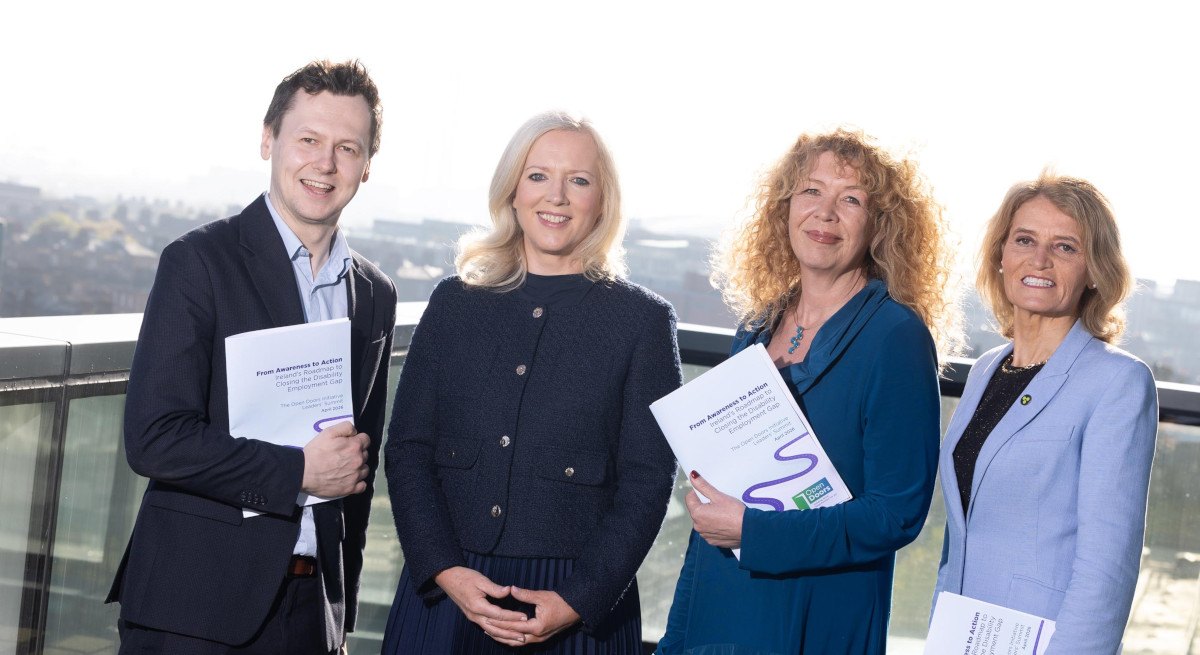
The ODI’s report urges CEOs and Government leaders to better implement systemic changes to integrate people with disabilities into the Irish workforce.
The Open Doors Initiative (ODI), an NGO that creates opportunities for marginalised people to enter the workforce, has launched the From Awareness to Action: Ireland’s Business and Policy Roadmap to Closing the Disability Employment Gap report.
Developed in partnership with EY and informed by roundtables with business leaders, policymakers and individuals with lived experience, the report explores how, despite near full employment, Ireland maintains one of the highest disability employment gaps in the European Union.
According to the report, 22pc of people in Ireland live with a disability, yet less than half (49.3pc) of those who are of working age are employed, compared to 70.8pc of people living without a disability. This 21.5pc employment gap is among the largest in the EU, according to the ODI.
The ODI is of the opinion that for businesses, this represents a significant missed opportunity, as companies leading in disability inclusion were found to have 28pc higher revenue and have twice the net income according to previous research from Accenture.
Commenting on the findings of the report, Jeanne McDonagh, the CEO of ODI said: “Ireland is facing a stark reality. Inaction in tackling this paradox further increases the risk of poverty and social exclusion for members of the disabled community. We can no longer view disability inclusion as a ‘social issue’ managed by the state through welfare.
“It is a systemic failure within the labour market and a missed economic opportunity for Irish businesses. As a CEO with a disability myself, I stand here to advocate for the hiring of my peers. When barriers are removed and an equitable playing field created, people can work to their full potential.”
Changing the tone
The ODI said there needs to be a “fundamental shift from corporate social responsibility (CSR)”, which is often viewed as “charity”, to corporate social justice, which demands that businesses “actively dismantle systemic barriers within their core operations to ensure equity, dignity and justice”.
“This involves designing workplaces for human diversity, building trust through transparent data, equipping managers with practical tools and crucially, placing disability representation at the leadership table,” said the ODI.
“The business case for inclusion is clear: diverse and equitable organisations are more adaptive, innovative and resilient,” said McDonagh. “They bring creativity, problem-solving and a different lens, all of which benefits the bottom line and strengthens stakeholder capitalism. This is not simply a matter of compliance, it is a strategic imperative.”
Onwards and upwards
The report offered a roadmap for how change can be implemented across the board, starting with three phases: foundation, embedment and transformation, as well as five priority recommendations for businesses and the Government.
Among the recommended steps, the ODI’s report calls for the redesigning of recruitment and workplace systems for inclusion by default, wherein companies move beyond what can be seen as initial advocacy and truly embed the core concepts of accessibility and flexibility from the get go.
The ODI also said there should be efforts to build employer and business trust via clear information and communication. Managers should be equipped with practical and proactive tools that move beyond limited awareness training and instead offer vital resources and clear guidelines.
The report also suggested that Government action is needed to reduce the financial risks that come with employment for disabled people. This would involve decoupling essential supports from employment status and implementing a permanent, non-means tested cost of disability payment.
Lastly, the ODI suggested an increase in the visibility of disability leadership, wherein there are significant efforts put in to ensure that people with the lived experience of managing a disability are present in leadership and decision-making roles.
“Businesses play a pivotal role in driving this change, but Government initiatives are equally crucial,” said McDonagh.
“By investing in education, addressing the cost of disability and simplifying support systems, policymakers can empower individuals with disabilities and enrich our society and economy. I urge you to join Open Doors as a partner and help us build on this work, ensuring Ireland becomes a leader in disability inclusion.”
Don’t miss out on the knowledge you need to succeed. Sign up for the Daily Brief, Silicon Republic’s digest of need-to-know sci-tech news.