The bag Emily Karst keeps in her car is filled with everything but her phone.
Instead, she usually packs her journal, some watercolor supplies, a needlepoint kit, a reading light and a murder mystery-themed puzzle book.
Karst, 32, calls it her “analog bag,” and she’s not the only one rocking one this year. Many people say carrying the accessory — typically packed with hobby supplies rather than electronic devices — has become their way to minimize their screen time.
“Even when I’m home and my analog bag is over on the hook, when I’m like, ‘OK, what do I want to do?’ that neural pathway that used to say, ‘Well, grab your phone,’ is starting to fire with the urge to maybe do needlepoint,” said Karst, who is an assistant principal at an elementary school in Ohio.
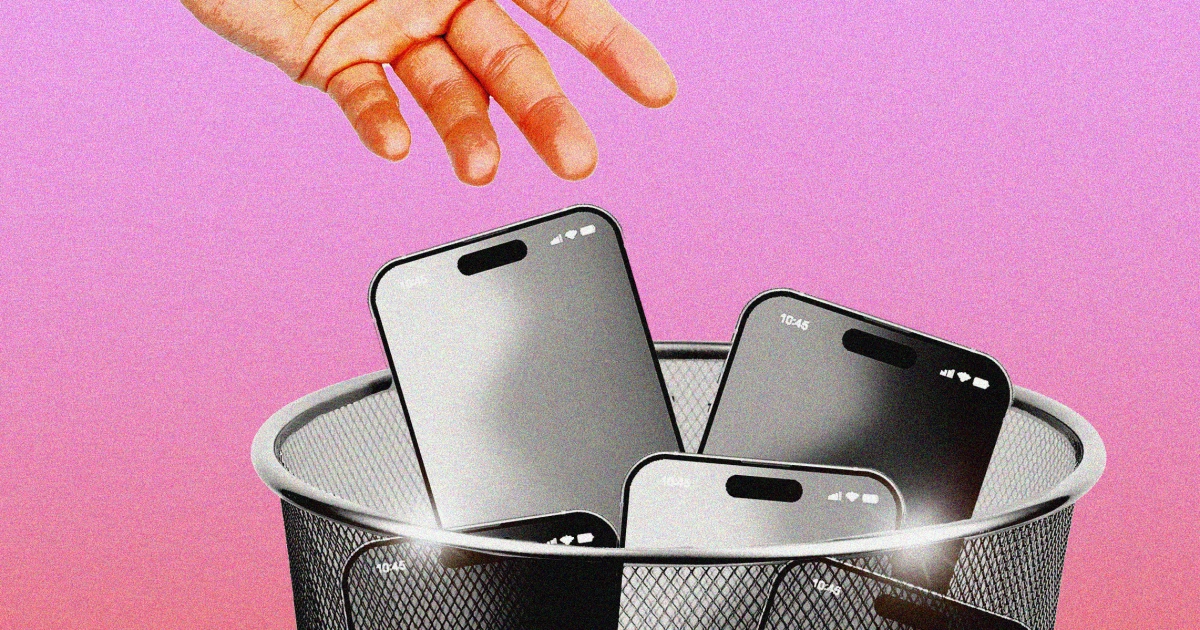
The popularity of the bag reflects a broader shift in 2025: People have generally become more intuitive about how much of their time they want to spend online. By turning to nondigital activities for entertainment, they’re trying to unplug, reclaim their attention spans and find renewed fulfillment in real-life experiences.
I think we’re all craving to just get back into community and real life.
— Maddie DeVico, 31, a small-business owner in Colorado
Ironically, those who choose to step away from the internet have also turned to social media to document their digital detox journeys. In addition to showing off their “analog bags,” some social media users have started online movements around the concept of returning to nondigital activities, from junk journaling — a type of scrapbooking that often involves pasting in found or recycled ephemera — to “rawdogging boredom,” a trend in which people challenge themselves to simply sit around and do nothing.
There has also been an appetite from consumers for mobile apps and tech products aimed at combating doomscrolling, or the tendency to scroll excessively online, which often entails heavy consumption of depressing content.
YouTuber Hank Green’s Focus Friend app, which topped the Apple App Store charts earlier this year, gives users a little bean on their phones that knits more items the longer the user keeps away from certain blocked apps. Also generating buzz this year was a small app-blocking device called the Brick, which locks users out of distracting apps and websites until they touch their phones to the Brick to deactivate the locks.
“I think we’re all craving to just get back into community and real life, like real, tangible relationships. Everyone’s so online now that it’s hurting my soul,” said Maddie DeVico, a small-business owner in Colorado. “There’s a huge movement here. I think the culture is starting to shift and people are realizing how detrimental being constantly connected can be for your mental health at the end of the day.”
To combat her own social media addiction, DeVico, 31, took some clay and molded a physical dock for her to “hang up” her cellphone like a landline when she has no pressing need for it. It reminded her of her childhood, when phones were tied to a designated place, like the kitchen wall.
When she shared the idea on TikTok this summer, a wave of viewers responded by creating and posting about their own copycat phone docks. Now, DeVico said, she hangs up her phone in its clay dock every night. She tries to implement phone-free mornings and phone-free dinners, as well as a few phone-free zones in her home.
Aside from finding more time for hobbies such as writing, painting and cooking, DeVico said, the habit has also enabled her to get excited about the little things again — like spotting a roly-poly in her garden.
Others have touted similar attempts to physically separate themselves from their phones. One writer, Tiffany Ng, chronicled her experience chaining her phone to the wall for a week. Tech founder Cat Goetze, who goes by CatGPT online, built a Bluetooth-compatible landline phone and surpassed $120,000 in sales within the first three days of its July launch.
What many people misunderstand about the no-phone movement, Goetze said, is that it doesn’t require an all-or-nothing approach: “There’s a lot of people who say: ‘Just get a flip phone. Take this supercomputer, chuck it into the ocean and go back to the ’90s and just get a dumb phone again.’”
“What I realized is that the thing that actually works is balance, and balance doesn’t mean getting rid of your smartphone,” Goetze said. “It’s about putting external factors in place that make your smartphone less easily accessible at all times.”
But people aren’t just detoxing from their phones to boost productivity. For many, learning how to have analog fun is just as much the goal.
As DeVico put it, “grandma hobbies are so back.” Tutorials on crocheting, knitting, scrapbooking and other forms of crafting have found sustained success on platforms like TikTok and Instagram. Meanwhile, social clubs organized around everything from books to running to mahjong have exploded in popularity in recent years.
Shun Hawkins, 31, loves junk journaling. In her analog bag, she packs stickers, washi tape and fashion magazine clippings to collage. She brings the bag out when she wants to immerse herself in a day of crafting, keeping a doodle book and a Nickelodeon-themed coloring book complete with a box of colored pencils and felt-tip pens inside.
“It’s reawakened something in me that I feel like I lost a long time ago. I didn’t even go to school for something that I’m passionate about. And now, being 31, being at home and being able to do things like junk journaling and doodling again, that’s reigniting this passion for me — even wanting to go back to school just to take on fashion,” said Hawkins, who lives in Tennessee. “Something like that, I feel like it wouldn’t be possible if I wasn’t detaching myself from social media.”
Another silver lining for Hawkins: More crafting has meant less doomscrolling. One recent morning, she found herself reorganizing the trinkets in her room upon waking up instead of immediately reaching for her phone.
The urge to go analog has also become a selling point at social events and in nightlife.
Hush Harbor, a cocktail bar in Washington, D.C., began offering its patrons a rare experience by prohibiting cellphones within the establishment to encourage people to be more present and better connect with their communities.
Christa Eduafo, a New York-based DJ who goes by DJ Chvmeleon, has also had success with her monthly phone-free parties, which she launched in June.
The goal, she said, is to revive a culture in which people feel comfortable enough to dance and let loose without fearing that they might be photographed or recorded by a stranger.
“There’s more of an interest in capturing a moment to post later than experiencing a moment in real time, and that’s impacting the real-time experience,” Eduafo said. “So it’s almost like everyone’s going to an event or to a bar because maybe they saw it on TikTok and they saw that there might be a moment they could capture and post themselves. But if there’s a room full of people waiting for something to capture, then there’s nothing to capture.”
Goetze, who also hosted a “no-phone party” in Los Angeles this fall that drew more than 700 people, said the concept forced people to interact with one another without being able to pull out their phones as a social crutch. She noted that it made the experience “one of the most present events that I have attended in a really long time.”
She plans a small tour of no-phone parties elsewhere next year. It has become clearer than ever, she said, that people are desperate to form real-life connections again.
“They’re craving the ability to be present with others. It shows up in every aspect of our lives. And we’re going to get there through a variety of different factors,” Goetze said. “We’re going to get there through physical events; we’re going to get there through reconnecting with our hobbies and spending time in groups. And I do feel very strongly that the solution is not just about getting rid of something. You have to add something new.”