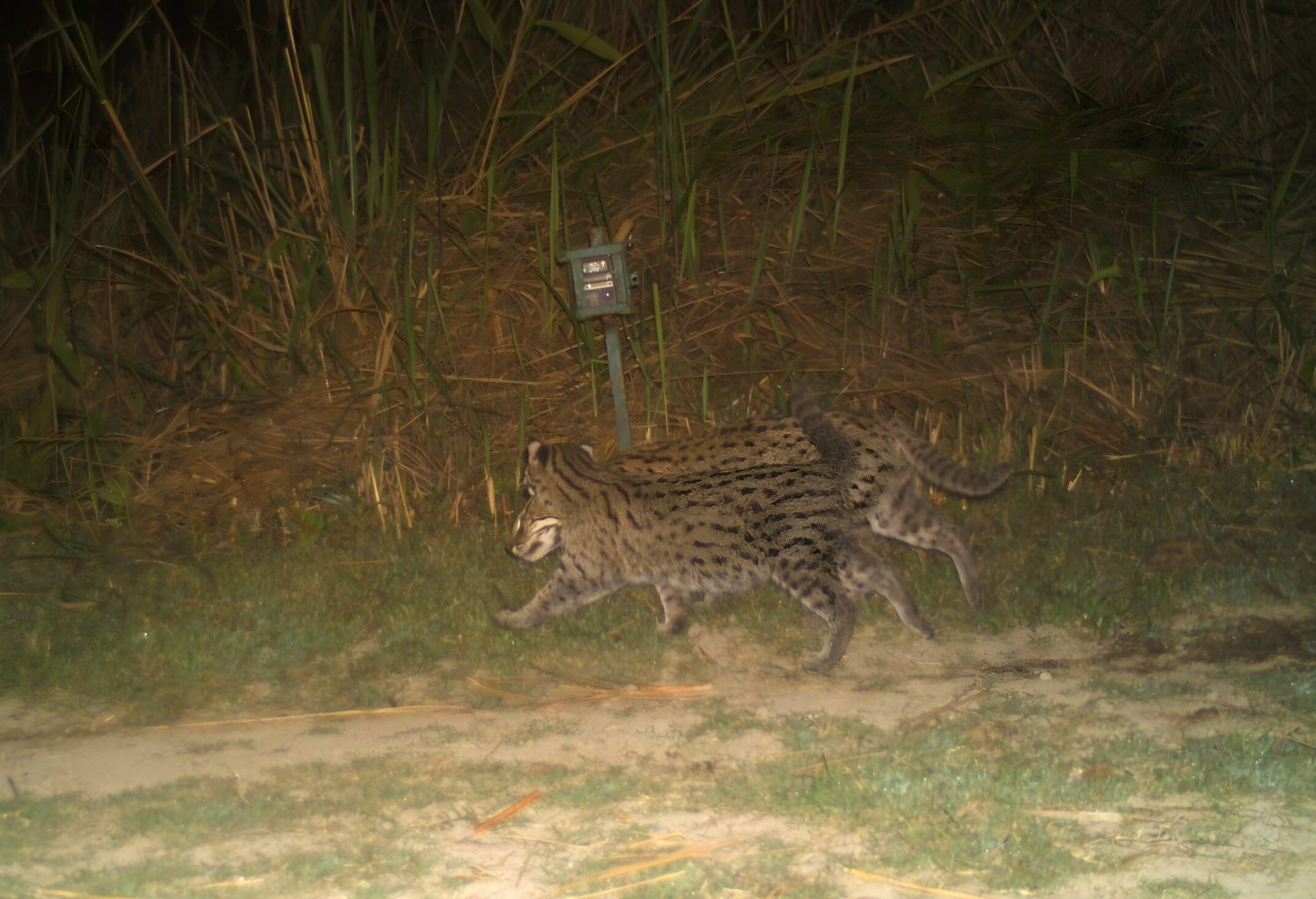
- A survey of fishing cats in Kaziranga National Park and Tiger Reserve confirmed that the species is widely distributed and is actively reproducing across the reserve’s floodplains.
- Researchers used data from a camera-trap survey designed for tigers which are larger felids. Therefore, the number may be an undercount.
- While the findings indicate healthy wetlands in Kaziranga, wildlife experts note that road accidents and habitat change still pose threats to fishing cats.
The first scientific survey of fishing cats (Prionailurus viverrinus) in Kaziranga National Park and Tiger Reserve has recorded 57 individuals, confirming that the species is widely distributed and actively reproducing across the reserve’s floodplains.
Conducted by Kaziranga’s Tiger Cell in coordination with the Fishing Cat Project, the survey report was released on February 22 – International Fishing Cat Day.
“This is one of the highest numbers in the freshwater floodplain, which reinstates KNP as one of its finest habitats. It is important for us to know that these are good habitats for fishing cats,” Sonali Ghosh, Director, Kaziranga National Park and Tiger Reserve, tells Mongabay-India.
Analysing camera trap images
The survey drew from bycatch data through camera traps originally set up to monitor tigers. “It is not possible to conduct a separate survey for every species found in KNP, as there are logistical and time constraints. We had to study more than 14 lakh images from the camera traps,” says Ghosh.
Analysing these images presented some challenges, says Tiasa Adhya, a wildlife biologist and one of the co-founders of the Fishing Cat Project. “If the weather is foggy, you won’t get good images. If it is raining, that’s a problem too. Sometimes the animal comes too near the trap, while sometimes only a portion of the body is visible,” she says.
As the camera-trap grid was originally designed for larger felids, wildlife officials believe that the number 57 could be an undercount. While this limitation creates uncertainty, it also establishes an important baseline for monitoring potential impacts of alterations to freshwater habitat caused by changing flood behaviours, climate change, and river modifications over time.
The fishing cat, known as meseka in Assamese folk tales, is an indicator of ecological health. Its presence in large numbers is indicative of healthy wetlands and the appropriate functioning of floodplain dynamics.
Kaziranga ranks as one of India’s leading floodplain habitats for aquatic species (particularly fish, the main food of the fishing cat), with numbers exceeding those of other well-known wetlands such as Kishanpur and Dudhwa in Uttar Pradesh, the survey notes. However, despite the high concentration of fish in Kaziranga, estuarine ecosystems, such as the Sundarbans, continue to support greater fish densities.
Threats and challenges
Protected under Schedule I of India’s Wildlife Protection Act, 1972, the fishing cat is classified as vulnerable in the International Union for Conservation of Nature (IUCN) Red List. It faces threats of habitat loss and hunting across its range in South and Southeast Asia.
“Fishing cats prefer long and tall wet alluvial grasslands or marshes as their homes. Recent literature has indicated that drier years could lead to changes in the woodland-grassland dynamics, meaning woodlands might replace marshes,” says Adhya. How fishing cats are affected by this change needs to be studied. “However, since Kaziranga is a protected area, there isn’t any loss of habitat in the protected area, and there is definitely no poaching of fishing cats inside,” she adds.
Road accidents are another threat to the species and have contributed to their deaths in states such as West Bengal. In Kaziranga, there has been one reported incident when a fishing cat was killed on NH-75 on September 24, 2024. Local conservationist Manoj Baruah points out that there have been even more unreported stray roadkill incidents involving fishing cats in the region, especially during floods.

Coexisting with fishing communities
As fish are the primary food source for fishing cats, there is potential for conflict with local fishing communities. However, local environmentalists and forest officials refute the possibility in Kaziranga.
Former honorary Wildlife Warden of Kaziranga, Uttam Saikia, asserts that the fishing cat population within Kaziranga is well protected, while those outside the park hunt in unprotected wetlands, ponds, and marshes and also feed on small reptiles and rodents. “There are fisheries outside, but those are well protected by nets and so are out of bounds for fishing cats,” he says.
Bijit Dihingia, a ranger in Bagori, says, “In Mihibeel, a wetland in Kohora, there is a very good population of fishing cats. There are some canals between the Kanchanjuri tea estate and Burapahar tea estate. There are quite a few fisheries in those areas. However, the fishermen don’t have conflicts with fishing cats. Otters eat more fish than fishing cats.” He adds that within the range he covers, there are more than 40 wetlands which have plenty of prey for fishing cats.
Read more: Heavy metals, microplastics found in fishing cats
Banner image: A camera trap catches an image of a fishing cat with its kitten in Kaziranga. Image courtesy of Kaziranga National Park and Tiger Reserve.