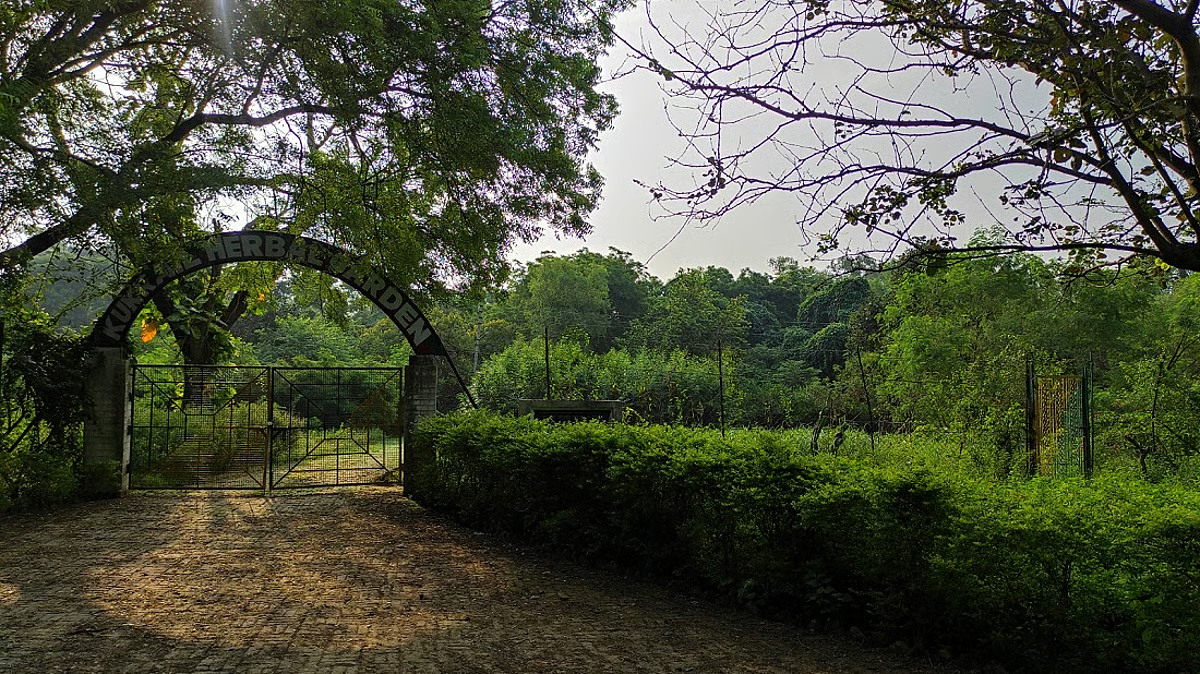
Kukrail Reserve Forest, one of the most ecologically significant green zones of Lucknow, is facing unprecedented deforestation in the name of so-called “eco-tourism development.” The Uttar Pradesh government has embarked upon large-scale infrastructure construction inside the reserve forest, including a jungle safari, adventure park, camping resorts, auditorium, officers’ residential bungalows, multiple multi-storey buildings, cafeteria, 7D theatre, auditorium, parking facilities, tramway, walking trails, veterinary hospital, quarantine centre, operation theatre, animal enclosures, four-lane approach road and much more.
These activities, according to government reports, require felling of more than 6,000 mature trees, with environmentalists asserting that the actual number may be significantly higher. A massive budget of Rs 1,500 crore has been sanctioned, and tenders have been awarded, signaling irreversible ecological damage. Alarmingly, nearly 1,200 acres of forest land—almost 30 per cent of the total Kukrail Reserve Forest area—has been earmarked for non-forest use, fundamentally altering the character of this reserve forest. Equally alarming is the fact that for these massive infrastructure projects, no opinions were sought from environmental experts, civil society organisations, or independent ecological groups, nor was any attempt made to place the matter before public scrutiny and consultation. Given that the issue directly affects the right to life and environmental health of the public at large, such exclusion raises serious constitutional concerns.
India is in the midst of rapid urban expansion, and cities like Lucknow are devouring natural spaces to meet infrastructure and real estate demands. Kukrail Reserve Forest is the only forest available to Lucknow and can be safely considered as the last green lungs helping regulate the local climate. It is a precious ecological lung, especially in an urbanising zone where air quality is deteriorating, and green space per capita is shrinking, urban rivers like the Gomti and its tributary, the Kukrail, are already degraded and biodiversity is in free fall, as observed by the vanishing of native birds, butterflies, reptiles, and mammals. The approximate number of vehicles in year 1950 was around eight thousand (8,000) compared with forty lakh (40 Lakh or 4 million) as in 2025. The population has increased by almost twenty times, compared to 1950. Hence, the Lucknow of today needs three or more Kukrail like forests for its longevity. But instead of establishing more such forests, the government is hell bent on destroying it for establishing totally unnecessary commercial entertainment infrastructure.
Running parallel to this is the shifting of the 100-year-old Nawab Wajid Ali Shah Zoological Garden (Lucknow Zoo) from its existing location in the heart of the city to the Kukrail Reserve Forest. This proposal threatens a double ecological loss: Lucknow stands to lose a century-old urban green lung, while Kukrail faces massive deforestation to accommodate zoo infrastructure, access roads, utilities, visitor facilities and much more.
Why are they important?
The Kukrail Reserve Forest, notified in 1950, spans approximately 4,500 acres currently, making it the largest contiguous green cover in Lucknow. Though it accounts for less than one per cent of the district’s total geographical area, its ecological value is unparalleled. The forest functions as a major carbon sink, moderates local temperatures, supports groundwater recharge, and provide a critical habitat for urban biodiversity, including numerous bird and reptile species.
In a rapidly urbanising city like Lucknow—already grappling with rising temperatures, extreme heat waves, unplanned development the preservation of Kukrail forest is indispensable. It serves as a natural buffer against climate stress and contributes directly to the environmental resilience of the city. This importance is underscored by the steady decline in Lucknow’s green cover. Between 2001 and 2023, the city lost 227 hectares of tree cover, representing a 20 per cent reduction since 2000. Vegetation cover fell from 34.95 per cent in 1992 to 22.72 per cent by 2022. The air quality index level is more often in the severe category crossing the value of 300 in many parts of the city. In this context, Kukrail remains one of the last natural assets capable of maintaining ecological balance, improving air quality, and safeguarding public health for current and future generations.
Equally significant is the role of the Nawab Wajid Ali Shah Zoological Garden, which for over a century has evolved into a dense green zone within the city. Beyond its conservation and educational functions, the zoo provides crucial environmental relief in an increasingly congested urban core. Relocating it would not only dismantle this urban green space but also transfer environmental pressure onto a reserve forest.
Despite this, the state government is on a mission to establish extensive infrastructure with plans to complete the Zoo and Night Safari projects by 2026. This stands in direct contradiction to the principle of sustainable development as well as the principle of intergenerational equity enshrined in the Indian Constitution.
A citizens’ struggle
I, along with fellow activists and environment lovers under the banner of Citizens of Lucknow Forum, have been striving to preserve the forest and zoo in a struggle marked by persistence, lawful engagement, and a demand for transparency amid sustained administrative apathy.
We have filed multiple Right to Information (RTI) applications seeking basic information on tree felling, construction activities, approvals, and environmental clearances for the said projects. In response, the office of the Principal Chief Conservator of Forests, Uttar Pradesh, exhibited willful ignorance, refusing to disclose even the number of trees in the Kukrail Reserve Forest or details of ongoing and proposed construction. The evasive nature of the reply strongly suggested mala fide intent. After receiving no timely response, I as the main petitioner, was forced to make repeated visits to the forest department’s office and eventually obtained the RTI responses in person. Upon examination, it was found that my name and address had been deliberately misstated, ensuring that the reply would never reach me—further exposing deliberate obstruction of statutory transparency.
Formal representations to the Uttar Pradesh Forest Department, the Union Ministry of Environment, Forest and Climate Change (MoEFCC), and other authorities went largely unanswered. In response to representations by the Citizens of Lucknow Forum, the government constituted a committee to examine the night safari and zoo projects. However, the committee consisted entirely of government officials, with no civil society members or independent environmental experts, rendering it a superficial exercise with no findings of the committee ever shared with the forum. The Citizens for Lucknow Forum protested this exclusion and sought a meeting to place citizens’ views on record. Upon being persuaded by the MoEFCC, the Uttar Pradesh government issued meeting notifications twice. But on both occasions, the meetings were cancelled at the last moment. The meetings were never rescheduled, reinforcing the perception of deliberate avoidance and lack of sincerity.
The legal battle
Left with no administrative remedy, I filed Original Application No. 1382 of 2024 as an applicant-in-person before the National Green Tribunal (NGT) in December 2024 against the three parties –a) PCCF Uttar Pradesh, b) Environment, Forest and Climate Change Department, Uttar Pradesh, c) MoEFCC
The petition challenged the legality of all proposed and ongoing non-forest activities inside Kukrail, citing violations of the Environment (Protection) Act, 1986, the Forest Conservation Act, 1980, and binding directions of the Supreme Court. It highlighted illegal deforestation without statutory approvals, disregard of the Supreme Court’s interim order dated February 19, 2024, in Writ Petition (Civil) No. 1164 of 2023, lack of clarity regarding the future use of the existing zoo land, and absence of expert consultation and public participation.
On December 24, 2024, the NGT heard the matter, with I as petitioner appearing in person. A two-member Bench recorded that the application raised substantial issues relating to environmental compliance, ordered to issue notice to the Respondents, restrained illegal tree felling, and fixed the next hearing for April 21, 2025. Notices were served by me as petitioner in early January 2025. The notice highlighted the violation of the Supreme Court order. The government, after receiving the notice, could not ignore the matter and finally filed an impleadment application in the Supreme Court seeking permission to establish a safari and shifting of the zoo to Kukrail. But it is deeply disturbing that despite showing the intention to take clearance from Supreme Court, the government continued to float tenders and awarded a Rs 600-crore contract to NCL in February 2025, revealing its intent to proceed regardless of pending litigation.
The state of Uttar Pradesh filed an impleadment application on April 8, 2025, in Writ Petition (Civil) No. 1164 of 2023. I, as petitioner, filed an intervention application on April 11, 2025, in the same writ petition to inform the Supreme Court about the matter pending before the NGT and that I should also be heard while deciding the application of the Uttar Pradesh government. On August 29, 2025, the Supreme Court heard both the sides and observing the gravity of the matter, referred it to the Central Empowered Committee (CEC) for its report within four weeks.
The matter was listed for October 8, 2025, but did not come up for hearing and is now tentatively scheduled for January 19, 2026.
Meanwhile in the NGT, the government was directed to file its reply by April 14, 2025. But in the subsequent hearings, the government has been always asking for more time to file the reply. In the last hearing held in the NGT on October 29, 2025, I raised the issue of non-compliance with the NGT order to file the reply to which the government again sought two weeks’ time to place on records the IAs filed in Supreme Court. This is recorded in the order published by the NGT on October 29, 2025. The next date of hearing is January 30, 2026.
The legal battle thus continues, raising fundamental questions about forest protection, judicial compliance, and the right of citizens to a healthy environment—questions whose answers will shape not only the future of Kukrail Reserve Forest and Lucknow Zoo, but also the credibility of environmental governance in India.