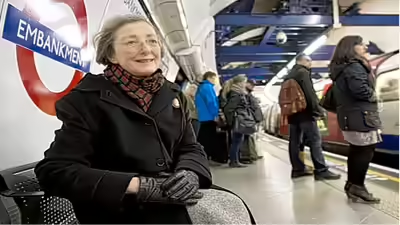
On most London commutes, the words “Mind the gap” disappear into the background noise of the day. But at Embankment station, those three words became something much more intimate: a thread back to a husband lost and a voice a widow was not ready to leave behind. Dr. Margaret McCollum had been hearing the station announcement recorded by her late husband, Oswald Laurence, and the routine mattered to her so much that when the voice vanished during a system upgrade, she felt the loss sharply enough to ask for it back. Scroll dow to read more…
A commute turned into a memorial
Oswald Laurence was not simply an anonymous voice on a platform. He was a theatre actor and RADA graduate, and the recording that made him part of London life dates back more than 45 years to the late 1960s. For years, his “Mind the gap” announcement could be heard along the northbound Northern Line before it was gradually phased out across most of the network, leaving Embankment as the place where his voice still lingered. Laurence died in 2007, and after his death, McCollum kept returning to the station because it let her hear him in one small, ordinary way.That detail is part of what makes the story endure. It is not a grand monument or a dramatic gesture. It is a platform, a speaker, and a few seconds of recorded speech. Yet for McCollum, it was enough to turn a public transport announcement into a private keepsake. According to reporting on the story, she would sometimes stay on the platform a little longer just to listen again before continuing on with her day.
When the voice disappeared
In 2012, Transport for London updated the station’s announcement system with new digital voices, and Laurence’s recording was removed. That change hit McCollum hard. She approached staff and asked what had happened to the voice she had come to rely on. The response, according to later accounts, was not indifference but curiosity and then sympathy: once staff understood who she was and why the voice mattered, the search for the old recording began.The restoration effort was more than a simple technical fix. Reports say old tapes were tracked down in archives, the recording was restored, and the announcement was returned to Embankment in March 2013 so that McCollum could hear it again. The same story was later retold as one of the most quietly moving examples of how public systems can still make room for private grief.
Why this story travels so far
Part of the reason the story keeps resurfacing is that it captures something deeply human about memory. Public infrastructure is usually designed for efficiency, speed and standardisation. The London Underground is no exception. But Embankment’s version of “mind the gap” became different because one woman attached a personal history to it. What was for everyone else a safety warning became, for her, a fragment of her husband’s presence. That contrast is what gives the story its emotional force.It also says something about how cities hold people’s lives in unexpected ways. A station can become a place of grief, routine and comfort all at once. A recording made decades earlier can outlive the man who spoke it and still matter to the woman who loved him. And a transit authority, faced with a request that is both unusual and deeply personal, can choose to respond with care rather than procedure alone.
A small act that carried a large meaning
The power of this story lies in its restraint. There is no grand speech, no public ceremony, no attempt to turn loss into spectacle. Instead, there is the sound of a familiar voice on an underground platform, and the recognition that love does not always ask for dramatic symbols. Sometimes it survives in a phrase heard between train arrivals, in a place visited day after day, in the simple hope of hearing someone one more time.That is why the Embankment recording continues to resonate well beyond London. It is a reminder that memory often lives in the smallest details: a voice, a route, a station, a habit kept after everything else has changed. In this case, the ordinary machinery of a city became the keeper of a very personal kind of devotion. And for one woman, that made all the difference.