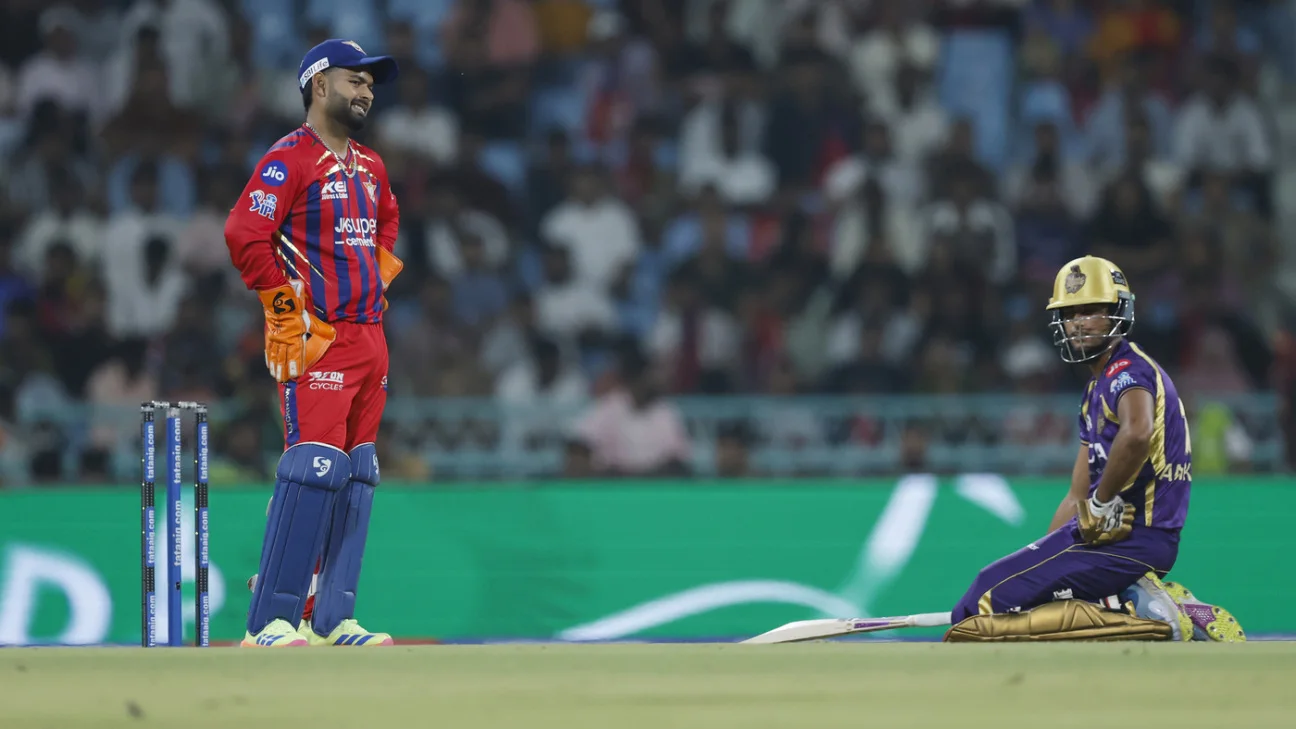
That the deliberations in the decision-making process were heard live on the broadcast was actually an educative experience for those willing to learn. Pandit didn’t burden himself with questions of intent, but was instead bothered with establishing only two fairly objective events: did Raghuvanshi change direction significantly and did he do it without probable cause? Once the answer to both these questions was yes, Pandit didn’t really have a choice.
In fact, Pandit went beyond the letter of the law to give Raghuvanshi every chance of surviving. He even checked if the batter was watching the line of the throw to rule out lack of “probable cause”. He might even have allowed Raghvanshi probable cause had he not been aware of the probable path of the throw.
Raghuvanshi’s last step towards the non-striker’s end is bang in the middle of the pitch, in line with the stumps. While turning around, his eye is peeled on the mid-off fielder and he stutters to his left to the edge of the pitch by the time he starts building speed. He then ends up well off the cut strip, which is a significant enough change of direction, but he changes his line again as he dives, this time closer to the stumps. In the process he ends up in the line of the throw.
Pandit needn’t have gone as far as he did looking for probable cause, but he did so, found none of it and had no choice in the end. He would have had a really tough time defending a not-out decision there.
It must be remembered that the law doesn’t say anything about the batter’s intent in changing said direction. It is not the umpire’s job or outlook to establish if the batter indeed changed the direction to block the throw.
On most such occasions, a major source of consternation is batters feeling they are being accused of something sinister. If KKR and Raghuvanshi were indeed upset – and it stretched to coach Abhishek Nayar having a seemingly heated exchange with the fourth umpire in full view of the crowd and the camera – because they felt he didn’t intend to block the throw, it is purely the batters’ privilege at play. It is no different to the opponents of the run-out backing up saying the batter moves out of the crease only as a matter of habit and not as a sharp practice.
It is quite simple if you bother to read the law: don’t change your running direction significantly unless there is a reason to do so, and you will be fine. Whether the batter really did intend to block the throw, whether the throw would have indeed hit the stumps, whether the batter would have been caught short, none of this matters.