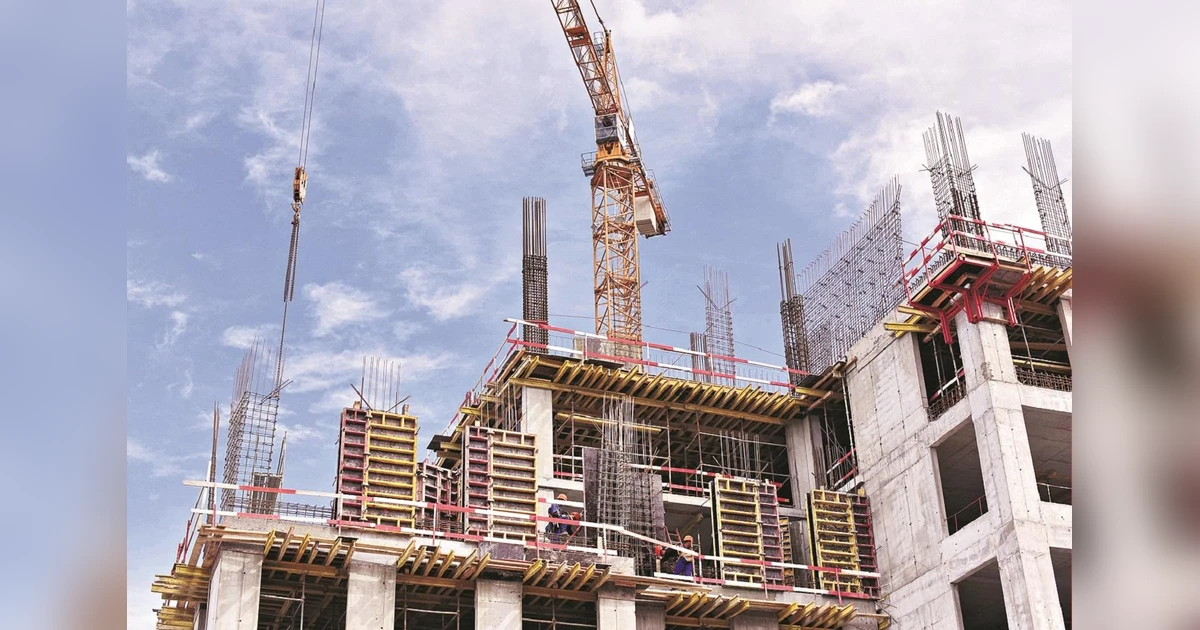
Residential: Volumes soften, value holds firm
Housing sales volumes across top seven cities are estimated to be lower in 2025 by about 15 per cent versus 2024, Anuj Puri, chairperson, Anarock, said high prices, global uncertainty and geopolitical tensions weighed on sentiment, though end-user demand remained intact. Around 4.59 lakh homes were sold in 2024, down 4 per cent year-on-year (Y-o-Y). In the first nine months of 2025 (9M 2025), about 2.86 lakh homes were sold, a 20 per cent Y-o-Y decline.
But market fundamentals remained strong. Sumeet Chunkhare, chief marketing & communications officer, Sobha, said, “2025 has been a stable year, with the market clearly shifting towards end-user–driven demand, as discerning homebuyers prioritise quality, trust and long-term value over speculative purchases.”
Average housing prices rose an estimated 6–9 per cent in 2025 across major cities, according to Anarock, with Delhi-NCR standing out due to premium-led supply. Premiumisation continued with higher-ticket homes driving sales value even as volumes moderated. Anarock expects sales value to grow 5–10 per cent by the end of 2025, from ~5.68 trillion in 2024.
“While residential volumes moderated, the underlying health of the sector remained intact. The continued growth in sales value underscores the structural strength of the market, driven by premiumisation and evolving buyer preferences,” said Sunil Pareek, executive director, Assetz.
Large, branded developers continued to outperform, supported by balance-sheet strength and execution credibility. Aakash Ohri, joint managing director and chief business officer, DLF Homes, noted resilient demand for quality projects, citing rapid sell-outs of premium launches in Gurugram and Mumbai.
In contrast, the affordable housing segment struggled. According to Anarock, affordable housing’s share of overall sales fell from 38 per cent in 2019 to 18 per cent in 9M 2025, while supply dropped from 40 per cent to 13 per cent.
Commercial: A record year
Despite global uncertainties and IT layoffs, India’s office market extended its post-pandemic upswing in 2025. Gross leasing is expected to cross 80 million square feet (msf), up 11.26 per cent Y-o-Y, among the highest levels recorded, according to Anshuman Magazine, chairperson and CEO, India, South-East Asia, Middle East & Africa, CBRE.
Leasing touched 60 msf in January–September, led by global capability centres (GCCs), technology, BFSI, engineering and manufacturing firms, and a rising share of domestic occupiers. GCCs are likely to account for 35–40 per cent of total office demand in 2025 and over 55 per cent of large deals in 9M 2025.
According to Kshitij Bahri, senior general manager and head, commercial leasing, Oberoi Realty, GCCs were the biggest demand driver for offices in 2025. Bahri is expecting their share in overall leasing to go above 40 per cent due to good real estate, cost arbitrage, and great talent availability.
Flexible workspaces added momentum. “Flexible workspaces now contribute close to 20 per cent of the country’s all commercial leasing transactions,” said Utkarsh Kawatra, CEO and cofounder of myHQ by Anarock, underlining the segment’s evolution into a mainstream asset class.
The Reit market mirrored this strength. Citing regulatory clarity, strong leasing and rising distributions, Amit Shetty, CEO, Embassy Reit, said, “2025 has marked a pivotal year for India’s Reit sector.”
From January 1, 2026, Reits will be reclassified as equity instruments following Sebi’s decision, enabling wider mutual fund participation and index inclusion, according to Ramesh Nair, CEO and MD, Mindspace Reit.
Retail real estate saw an experience-led revival in 2025, with 2.2 msf of new supply and about 4.6 msf of absorption in 9M 2025, led by Hyderabad, Mumbai and Delhi-NCR. Leasing is set to hit a record 9 msf in 2025, up from 7.8 msf in 2024, aided by new grade A supply, according to Cushman & Wakefield.
India’s industrial & logistics sector is expected to post its highest-ever annual absorption of 76.5 msf in 2025, up 18.6 per cent Y-o-Y, fuelled by manufacturing (29 per cent share, up from 22 per cent in 2024) and steady 3PL (28 per cent share) contributions, according to Savills India.
Demand for last-mile infrastructure, especially from quick commerce players, pushed rents up by as much as 10 per cent Y-o-Y in key micro-markets, CBRE said.
The commercial segment is set to enter 2026 with strong tailwinds. Sanjay Dutt, CEO and MD, Tata Realty & Infrastructure, is anticipating a sustained momentum across urban and metro cities driven by demographic demand and growing investor interest in green-certified assets.
Investments: Capital flows hit new highs
Institutional investments are estimated at a record USD 10.4 billion in 2025, up 17 per cent Y-o-Y across 77 transactions, with equity accounting for 83 per cent of volumes, according to JLL. Office (52 per cent) and residential (28 per cent) led inflows, while data centres, student housing and life sciences gained traction.