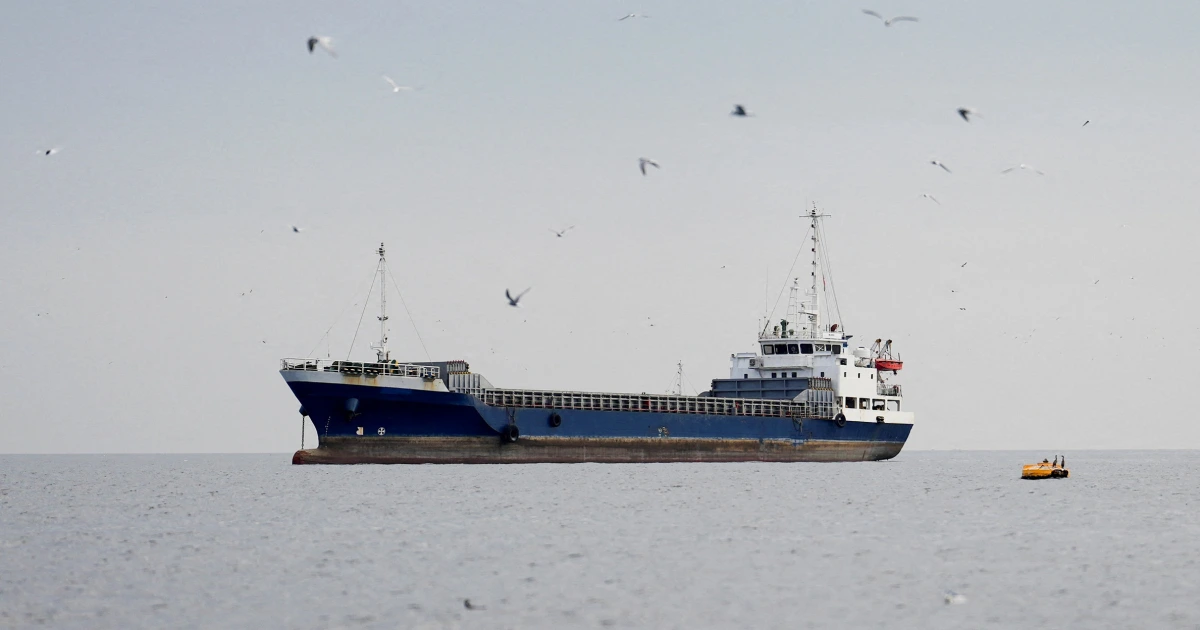
The price of oil plunged sharply and two U.S. stock indexes hit all-time highs Friday after Iran’s foreign minister said the Strait of Hormuz was open for commercial vessels.
Subscribe to read this story ad-free
Get unlimited access to ad-free articles and exclusive content.

“In line with the ceasefire in Lebanon, the passage for all commercial vessels through Strait of Hormuz is declared completely open for the remaining period of ceasefire, on the coordinated route as already announced by Ports and Maritime Organisation of the Islamic Rep. of Iran,” Abbas Araghchi wrote in a post on X.
U.S. crude oil plunged 12% to around $83 per barrel, while international Brent crude also slid more than 10% to around $89 per barrel.
Heating oil futures, which are a proxy for jet fuel, plummeted 11%. Wholesale RBOB gas futures also fell 6%.
It was not immediately clear if the reference to a “coordinated route,” meant that ships would need to pay a toll to Iran, as some have reportedly done in recent weeks. It was also not immediately clear if ships in the region, which have been threatened and attacked, would trust this announcement.
Shortly after the Iranian minister’s post, President Donald Trump celebrated the news with his own post on Truth Social, which read: “IRAN HAS JUST ANNOUNCED THAT THE STRAIT OF IRAN IS FULLY OPEN AND READY FOR FULL PASSAGE. THANK YOU!”

FORSUBSCRIBERS

Diverging Trump-Netanyahu goals muddle path to peace
04:48
However, Trump, in a second post, said that “the Naval blockade will remain in full force and effect as it pertains to Iran, only, until such time as our transaction with Iran is 100% complete.”
GasBuddy analyst Patrick De Haan wrote on X that the shift in oil prices could quickly translate to lower gas prices.
“This could accelerate sending fuel prices lower starting this weekend with the national average likely falling below $4/gal to perhaps $3.65-$3.85,” De Haan wrote.
As of Friday morning, the average price per gallon was $4.09, according to AAA, and has been declining a few cents each day this week.
Oil prices remain elevated, however, even given Friday’s drop. Since the start of the war, the price of U.S. crude oil is up 25%, and it’s up more than 45% since the start of the year.
In midday trading, the S&P 500 rose 1.4% and the Nasdaq Composite jumped 1.6%. Both set new all-time highs as a result.
The Dow jumped more than 1,000 points, or 2.3%, and the Russell 2000 index rose 2.2%.
U.S. Treasury yields also moved sharply lower. The yield on the 10-year U.S. government bond fell to 4.23%, its lowest level since March 18.
Stocks across Europe also rallied higher on the Iranian minister’s announcement, with the Stoxx 600 index rising 1.4%. Germany’s DAX jumped 2.2%, stocks in France rose 2%, and the benchmark FTSE 100 index in the U.K. rose nearly 1%.
European leaders, who were holding a summit when the announcement from Iran emerged, cautiously welcomed the news.
“Under international law, transit through waterways like the Strait of Hormuz must remain open and free of charge,” said the E.U.’s top diplomat, Kaja Kallas, in a post on X. “Any pay-for-passage scheme will set a dangerous precedent for global maritime routes.”
French President Emmanuel Macron and U.K. Prime Minister Keir Starmer, who were leading the summit, also welcomed the news. But Macron said that securing the strait needed to be done by a neutral and independent party. “The strait should be reopened immediately with no tolls and no restrictions,” Starmer added.
Two of the world’s largest shipping companies also responded cautiously to the news.
“Since the outbreak of the conflict, we have followed the guidance of our security partners in the region, and the recommendation so far has been to avoid transiting the Strait of Hormuz,” Maersk said in a statement. “Any decision to transit the strait will be based on risk assessments and close monitoring of the security situation.”
Hapag-Lloyd said “there are still some open questions,” but that its “crisis committee is in session and will try to resolve all open items” in the next 24 to 36 hours.
“If all open issues are cleared (i.e. insurance coverage, clear orders of Iranian government/military about the exact sea corridor to be used and the sequence of ships leaving) we would prefer to pass the strait as soon as possible,” the company’s statement said.