- During Gangtok’s water crisis, springs continued to supply households, acting as a reliable water source alongside centralised water infrastructure.
- Most springs remain accessible common resources, protected through local practices, shared use, and strong cultural and religious connections.
- Protecting recharge zones, implementing springtide management, and formally incorporating springs into municipal water governance can strengthen climate resilience and future urban water security.
- The views in this commentary are those of the authors.
In the winter between November 2025 and February 2026, Gangtok faced a crisis it could not ignore. After September 2025, rainfall almost completely stopped, and the city’s main water source, the Ratey Chu River, saw its discharge drop by nearly 50%. The Public Health Engineering Department, Government of Sikkim, issued a public notification on February 11, 2026, rationing municipal water to once a day and issuing repeated warnings against wasting water.
Five months later in April 2026, the crisis, though somewhat resolved, still persists.
Gangtok’s centralised water system has always been vulnerable. When monsoon landslides damage intake pipelines or winter droughts shrink rivers, supply collapses quickly. Additionally, Gangtok’s water system was under increasing strain due to population growth, rising tourist inflow, and rapid urban expansion.
Yet as the formal water infrastructure struggles, another water network has quietly supported the residents of Gangtok.
Gangtok’s freshwater springs (locally known as dharas), continue to function as a parallel source of water. Far from being used only during crises, these springs remain part of everyday urban life. Emerging from underground aquifer networks beneath the town, these springs form an invisible yet resilient water system that sustains residents long before and long after crises emerge.
A city-wide assessment conducted by Ashoka Trust for Research in Ecology and the Environment across all 19 municipal wards identified 56 springs in Gangtok. The findings challenge the common perception that springs are only a minor water source. Nearly 73% of the mapped springs were found to be perennial, flowing throughout the year and continuing to supply water even during the driest months. Measurements taken between February and April 2025 when the water recharge is lowest, showed that most springs maintain moderate discharge levels sufficient for everyday household needs. While only a few springs produce high volumes, many provide steady flows.
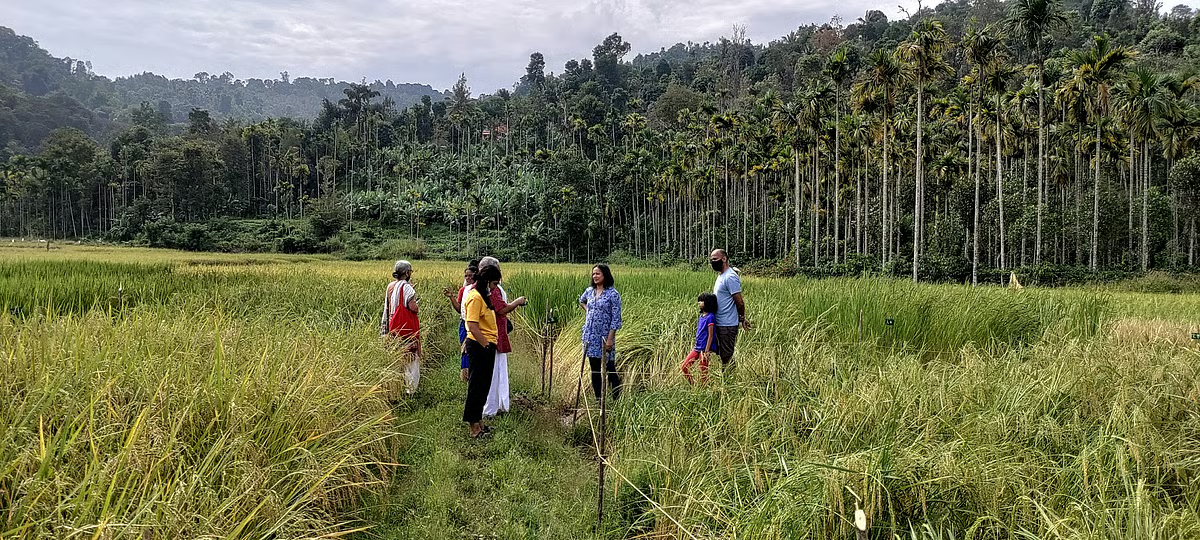
For locals, these springs are not a hydrological feature but part of everyday life. Residents reported using them for drinking water, bathing, washing clothes, and small-scale irrigation. Even households connected to piped supply continued to depend on springs as a reliable alternative when scheduled distribution failed.
Ownership patterns varied with around 58% of springs being located on private land, while the rest managed by government agencies. Yet access was almost universally open. Community members shared water freely, regardless of ownership boundaries, a reminder that springs in Gangtok function as common resources rather than individual assets.
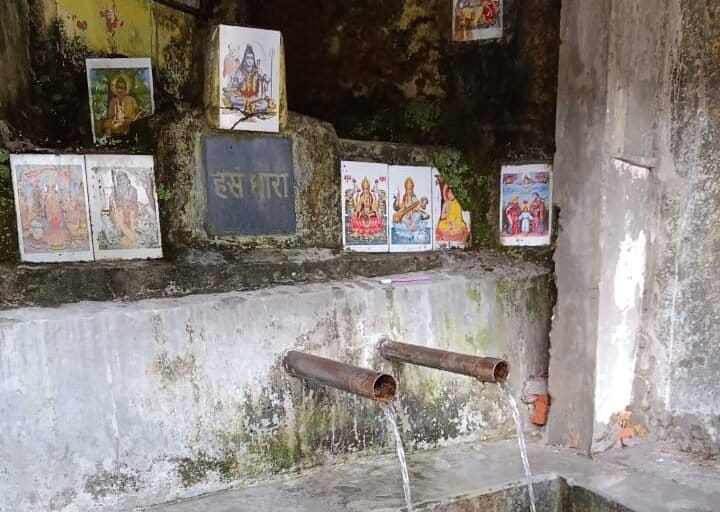
In many places, communities rely on simple local arrangements such as containers or basic collection points. These systems may be modest, but they help keep the water usable and accessible. The springs are also cultural spaces with about 87% of them considered sacred, often linked to local deities such as Naag and to community rituals and beliefs. Many are used during festivals and religious gatherings, turning them into places of shared memory and responsibility. That cultural connection helps explain why many springs survive. Residents regularly clean the sources, maintain access paths, and protect surrounding vegetation, often without formal support. This kind of stewardship reflects a long-standing relationship between people and water, one based on cultural ties as much as necessity.


Despite this, Gangtok’s springs are showing signs of stress. Many residents reported declining discharge over recent years, with some formerly perennial springs becoming seasonal. Urban growth appears to be one of the major pressures. Roads, slope cutting, and expanding concrete surfaces reduce infiltration, the natural process that allows rainwater to seep into the ground and recharge aquifers. The spatial distribution of springs also reveals an important pattern: settlements in Gangtok appear closely associated with areas where natural water sources are present. More than half of the mapped springs (52.2%) occur within built-up areas, indicating a strong spatial overlap between existing settlements and spring locations.
Urban springs in the past had rarely appeared in formal planning. Urban water policy in the past mostly favoured large engineering solutions, while the role of springs in daily life remained underrecognised. Today, as climate change and rapid urban growth strain water supplies, these natural sources are being rediscovered as vital lifelines.
Across the Indian Himalayan Region, the spring-shed management programme led by NITI Aayog is helping communities map, protect, and revive springs as climate-resilient water systems. One of the most significant efforts comes through the spring-shed management programme promoted by NITI Aayog for the Indian Himalayan Region, which aims to protect and restore springs and manage springsheds as climate-resilient water systems for mountain communities.
Sikkim itself has already demonstrated what is possible. The pioneering Dhara Vikas (Spring Revival initiative, launched in 2028), demonstrated immense success in reviving dying springs across rural areas through scientific groundwater recharge, contour trenching, and community-led watershed management. Similar urban-focused initiatives now need to be delivered.
Gangtok has taken an important step in this direction through the Aquifer Management Plan for Gangtok Municipal Corporation under NAQUIM 2.0. Led by the Central Ground Water Board with support from Central Agricultural University and Sikkim Manipal University, the study explored how geology, climate, and expanding urban development influence the city’s springs. As Gangtok’s first comprehensive groundwater assessment, it offers a much-needed scientific roadmap for securing the city’s future water sources.
Another important step is turning research findings into practical action that communities and city planners can use to protect springs.
This requires a targeted, watershed-level strategy that safeguards recharge zones, modernises storage and distribution, fosters community stewardship, and formally integrates springshed networks into municipal governance. Approaches promoted by NITI Aayog through six strategic steps and 25 best practices offer a useful model. This approach combines scientific monitoring and assessment, inclusive governance, sustainable financing, community participation, and impact evaluation to restore and secure Himalayan springs as climate-resilient water systems. When aligned with national initiatives such as the Jal Jeevan Mission and the Vision for Sujalam Bharat led by Ministry of Jal Shakti spring rejuvenation efforts can move toward an integrated urban water security strategy.
Gangtok’s current water crisis is a warning, but it is also a lesson. It shows that even in a modern urban center, the smallest water sources can be the most reliable. As climate change and urbanisation intensify across the Himalaya, the future of water security may depend less on distant mega-projects and more on protecting the springs that have quietly sustained mountain communities for generations.
Sailendra Dewan is a Fellow in Residence at the Ashoka Trust for Research in Ecology and the Environment (ATREE), working with the Biodiversity Conservation and Resilient Urban Landscapes Programme, and is associated with The Himalaya Initiative. Niharika Bindal worked as an intern in ATREE and The Himalaya Initiative. The commentary draws from the authors’ own study and fieldwork in Gangtok.
Citation:
- Sharma, A., Joshi, M., Joshi, R., Kumar, D., Singh, M., Kumar, K., … & Barfal, S. S. (2022). Effect of rapid urbanisation on water quality: an experimental study from Indian Himalayan city, Gangtok. In Facets of a Smart City: Computational and Experimental Techniques for Sustainable Urban Development (pp. 76-91). Bentham Science Publishers.
- Rathod, R., Kumar, M., Mukherji, A., Sikka, A., Satapathy, K. K., Mishra, A., Goel, S., & Khan, M. (2021). Resource book on springshed management in the Indian Himalayan Region: Guidelines for policy makers and development practitioners. International Water Management Institute (IWMI); NITI Aayog, Government of India; Swiss Agency for Development and Cooperation (SDC). https://doi.org/10.5337/2021.230
- Central Ground Water Board (CGWB). (2024). Aquifer Management Plan of Gangtok Municipal Corporation, Sikkim (NAQUIM 2.0). Ministry of Jal Shakti, Department of Water Resources, River Development and Ganga Rejuvenation, Government of India. https://cgwb.gov.in/cgwbpnm/public/uploads/documents/1744936116761066172file.pdf
- Singh, S., Tanvir Hassan, S. M., Hassan, M., & Bharti, N. (2020). Urbanisation and water insecurity in the Hindu Kush Himalaya: insights from Bangladesh, India, Nepal and Pakistan. Water Policy, 22(S1), 9-32.
- Sharma, G., TelWala, Y., & Chettri, P. (2024). Integrating nature-based solutions for water security in fragile mountain ecosystems: lessons from Dhara Vikas in Sikkim, India. Nature-Based Solutions, 6, 100169.
Banner image: An active urban freshwater spring channeled through PVC piping amidst residential buildings in Tadong, Gangto, Sikkim. Image by Avantika Thapa.