- A new study finds significant volumes of land-based and human-activity related plastic litter at four key olive ridley mass nesting beaches in Rushikulya.
- Plastics including bottles and wrappers made up over 85% of recorded litter. These also included transboundary litter from six neighbouring countries.
- Discarded fishing nets made up more than 32% of all litter at some sites, while thermocol contributed more than 31% at others.
- Derelict fishing gear poses serious threats of entanglement for hatchlings, with the study recording 237 dead and 121 entangled olive ridley hatchlings. The threat extends to adult turtles in nearshore waters as well.
The Rushikulya rookery in Odisha’s Ganjam district is among the most important turtle rookeries in the world. Every year, hundreds of thousands of olive ridley sea turtles (Lepidochelys olivacea) converge here to lay eggs in a synchronous mass nesting event or arribada, with almost 700,000 olive ridleys coming ashore to lay eggs in February 2025 alone.
However, plastic pollution and its associated problems plague this important 10-km stretch along India’s eastern coastline. A recent study by the National Institute of Oceanography (NIO), Goa, reports significant presence of plastic waste and discarded fishing nets across four nesting beaches at Rushikulya, reflecting a global crisis of ever-increasing marine plastic pollution.
Nesting among plastics
Surveys across four nesting beaches — New Podampetta, Purunabandha, Siddhantnagar, and Prayagi — during the peak 2025 nesting season recorded more than 1,100 litter items, over 85% of which were plastic. The presence of plastic bottles, wrappers, and bags indicated both land-based runoff and direct human activity as key sources.
Fisheries-related debris, including discarded nets, thermocol, and nylon rope fragments — collectively termed as ‘ghost gear’ or abandoned, lost, and otherwise discarded fishing gear (ALDFG) — made up 41% of all recorded litter across all sites. Fishing nets alone made up around 32% of the recorded litter at New Podampetta, while thermocol too contributed a little over 31% at Siddhantnagar.
Concerningly, standardised environmental quality indices like the Plastic Abundance Index (PAI) and Clean Coast Index (CCI) classified all four beaches as ‘dirty’ to ‘extremely dirty’ with very high plastic abundance, placing Rushikulya’s litter levels among the higher ranges reported globally from nesting beaches.
Despite multiple attempts, Mongabay-India did not receive a response from NIO at the time of publishing.
This reality is not limited to just Odisha’s coast.
“Most nesting beaches in India are located near densely populated coastal areas. Studies have reported plastic litter on nearly all beaches along the Indian coastline, including remote sites like the Lakshadweep Islands.” explains Chandana Pusapati, who previously studied turtles with Dakshin Foundation and is currently a PhD Scholar at Laurentian University, Canada.
While most debris recorded in the study came from local land-based and fishing activities, some plastic items carried labels from Southeast Asian countries including Myanmar, Malaysia, Vietnam, and Singapore, indicating transboundary pollution reaching Odisha’s coast via circulating oceanic currents. Ocean circulation models explain this occurrence, showing that plastic debris can travel long distances and accumulate in coastal zones, far from their point of origin.
This complicates management, as the sources of this litter lie beyond local jurisdictions. Although international frameworks such as the United Nations Convention on the Law of the Sea (UNCLOS), the International Convention for the Prevention of Pollution from Ships (MARPOL), and regional initiatives under UNEP’s Regional Seas Programme emphasise cooperation among coastal nations to protect the marine environment, enforcement and monitoring remain uneven.

Compounding risks
Plastics dominate marine and coastal litter worldwide, making them one of the most pervasive ecological threats. An estimated 4.8-12.7 million tonnes of plastic waste entered the oceans in 2010, rising to 19-23 million tonnes (~11% of total generated) in 2016, and projected to reach an alarming 53 million tonnes annually by 2030. While exact figures are unclear, it is estimated that thousands of marine animal species including seabirds, fish, turtles, and mammals ingest plastics every year.
“Increasing plastic pollution at nesting beaches and foraging areas is an emerging threat, especially for females and hatchlings. Olive ridleys also prefer nesting nearing river-mouths, where plastic and other land-based waste often accumulate”, explains Pusapati.
Turtle hatchlings are particularly vulnerable because of their size, limited strength, and reliance on natural cues for seaward navigation such as beach slope, sand texture, and moonlight. Physical barriers like litter and discarded nets along with artificial night-time lighting (especially LEDs) disrupt these cues, increasing disorientation and time spent exposed on the beach. Even partial entanglement can result in longer crawl times, raising the risk of dehydration, heat stress, and predation by birds and feral dogs. Coastal erosion at Rushikulya is also exposing nests and eggs, adding to potential threats from climate change-driven sea-level rise.
General plastic pollution degrades nesting habitat but derelict fishing gear (ALDFG) poses a more direct threat to hatchling survival. Abandoned or damaged nylon nets and synthetic ropes were widespread in upper beach areas used by fishers (for repairs) and hatchlings alike. The study recorded 237 dead and 121 entangled hatchlings, most caught in ghost nets and ropes, which can form near-invisible barriers when partially buried in sand.
Similar entanglement has also been reported from beaches in the Maldives, Australia, and Sri Lanka. Although ALDFG makes up only around 10% of marine litter by volume, it accounts for a disproportionate share of wildlife mortality due to its entangling nature. Along some coastlines in India, ALDFG accounts for over 47% of all beach litter, with plastics predictably making up the remaining chunk. Made from non-biodegradable synthetic polymers like nylon, fishing gear can persist in the environment for decades, continuing to trap animals.

Impacts beyond the beach
The impact of plastics extends into the sea, where turtles interact with debris throughout their lives. Olive ridleys inhabit diverse habitats, travel large distances, and consume a wide range of prey, making them particularly susceptible.
Vidisha Kulkarni, who was a Programme Officer with Dakshin Foundation’s Marine Flagships Programme at the time comments were provided, shares the team’s observations. “Turtles frequently mistake clear plastic bags for prey like jellyfish and cannot easily distinguish between the two. They have backward-facing papillae in their oesophagus that prevent regurgitation of food, an adaptation that becomes problematic when plastic is ingested,” she said.
Ingested plastics can cause blockages and lacerations, or a false sense of fullness, ultimately resulting in starvation. Additionally, microplastics can introduce toxic risks due to accumulation in tissues and organs, which can then enter food webs and accumulate across trophic levels through biomagnification.
“High concentrations of microplastics and heavy metals have been found in egg yolks and shells, so hatchlings acquire a pollution load even before they emerge,” adds Kulkarni, who is currently pursuing a PhD at Srishti Manipal Institute of Art, Design and Technology.
Conservation implications at a critical rookery
“Arribadas occur at two sites on India’s mainland coastline, both located along the Odisha coast: Gahirmatha and Rushikulya”, explains Kulkarni, highlighting the importance of Odisha’s coastline.
Pusapati adds, “Following major population declines in the 1980s and early 1990s, consistent conservation efforts like nest protection and nearshore monitoring by State Forest Departments and local NGOs have helped stabilise, and in some regions, increase olive ridley populations.”
Currently, at Rushikulya, beaches are often cleared of fishing nets during arribada events, and human activity is regulated. However, these interventions are typically short-term and localised.

The study recommends coordinated and targeted site-specific conservation actions including stricter enforcement of seasonal fishing bans, improved community-level waste management, and programmes to retrieve and replace derelict fishing gear with environment-friendly alternatives. Long-term community-based interventions and awareness campaigns targeting local stakeholders, and stronger regional cooperation are also needed to address both local and transboundary litter sources and protect turtle populations.
While data on land-based runoff is available, local research on the physiological impacts of this pollution in turtles, and offshore data on the movement of debris are still limited.
“Offshore monitoring could supplement these findings, as plastic debris may be washed ashore from the ocean. We have observed instances during arribada when turtles emerge from the water already entangled in fishing nets”, concludes Pusapati.
On Odisha’s nesting beaches, high litter density, entangled hatchlings, and the changing habitat itself, are sounding the alarm. Even if hatchling mortality from entanglement is relatively low, consistent losses year after year, coupled with increasing plastic pollution, can erode population resilience, particularly for a species already classified as vulnerable by the IUCN.
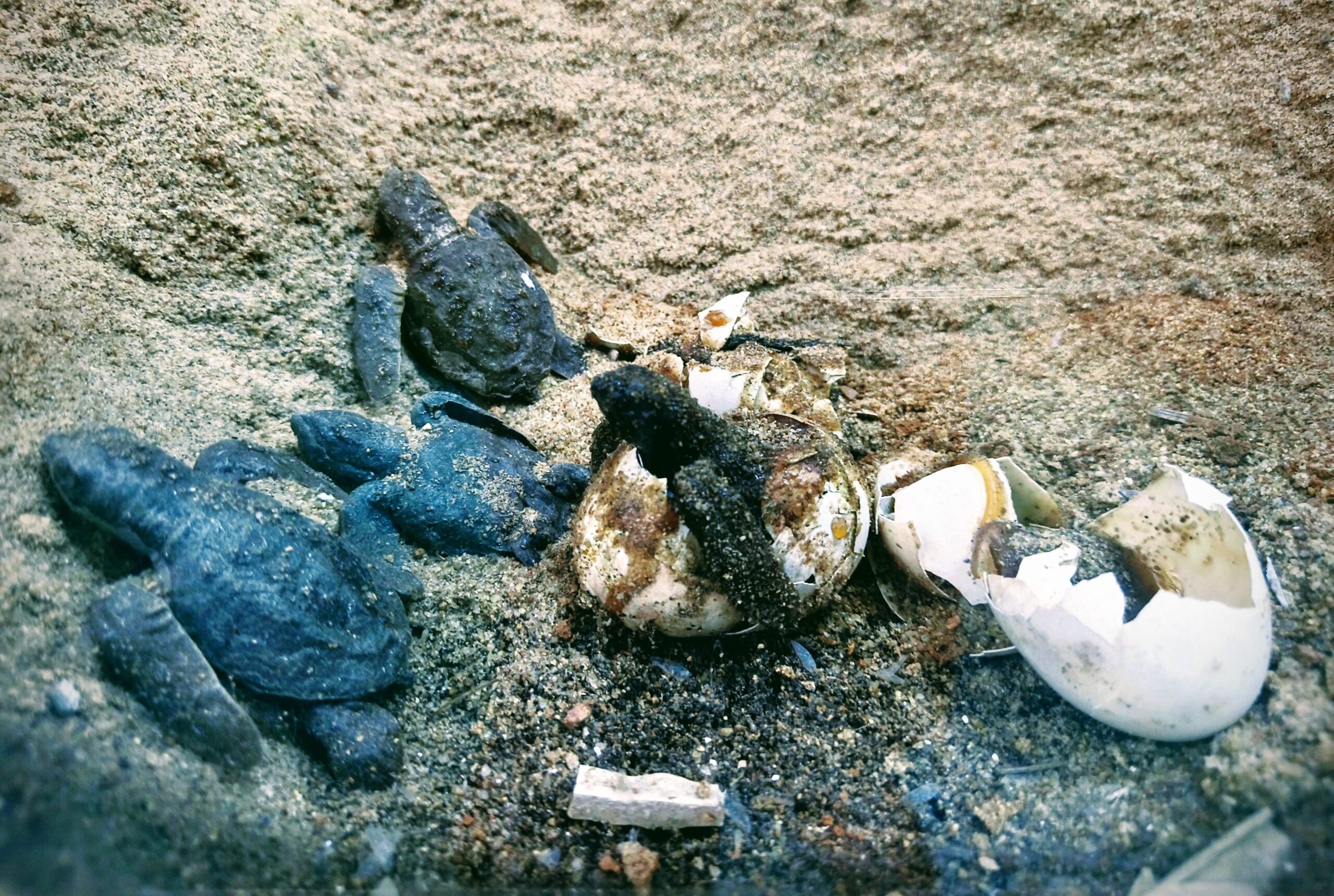
Banner image: Olive ridley hatchlings at Rushikulya. They are especially vulnerable due to their size and limited strength, and face a myriad of threats on their seaward journey. Image by Aliva Sahoo via Wikimedia Commons (CC BY-SA 4.0).