- Shekha Jheel Bird Sanctuary in Uttar Pradesh, has been designated a Ramsar site, taking India’s total to 99 and the state’s tally to 12 wetlands of international importance.
- The wetland is an important bird habitat and lies on the Central Asian Flyway supporting migratory and resident birds.
- Eutrophication, sewage inflow, invasive water hyacinth, disturbance and encroachment are key pressures facing the wetland currently.
Shekha Jheel Bird Sanctuary in Aligarh, Uttar Pradesh, has been designated a Ramsar site, taking India’s total number of wetlands of international importance to 99 and Uttar Pradesh’s tally to 12.
The 40-hectare freshwater wetland in the Upper Gangetic Plain that supports 249 bird species, including 62 water bird and wetland-dependent species. The perennial water body regularly hosts more than 20,000 water birds in peak winter and serves as a refuge during dry months, supporting vulnerable species such as sarus crane, common pochard, greater spotted eagle and endangered freshwater turtles.
The Ramsar site is characterised by a mosaic of wetlands, grasslands, forests and agriculture lands.
The Ramsar official information sheet describes the wetland’s role in groundwater recharge, irrigation support, nature tourism, education and research, while also noting that it is facing pressures from invasive alien species, excess heat and noise, temperature extremes and grazing. The management plan lists several on-ground measures already proposed or taken at the site, including mounds for bird resting and nesting, a nature trail, two watchtowers, weed removal in some areas, afforestation, awareness drives and involvement of local villagers in conservation.
India’s Environment Minister Bhupender Yadav said, in a press release, that Shekha Jheel acts as “a crucial stopover on the Central Asian Flyway,” providing habitat for migratory birds such as the bar-headed goose, painted stork and various ducks during winter.
The Ramsar dossier says Shekha Jheel supports several species of higher conservation concern, including the vulnerable sarus crane, common pochard, greater spotted eagle and river tern. It also records near threatened species such as ferruginous duck and Asian woolly-necked stork, underlining the wetland’s importance beyond its large winter bird numbers.
Critical ecosystem services
The Ramsar designation gives Shekha Jheel Bird Sanctuary international recognition under the Convention on Wetlands, which promotes conservation and the wise use of wetland ecosystems. Experts said the importance of the site lies not only in the new count, but also in its ecological role in a human-dominated landscape.
“Shekha Jheel (Bird Sanctuary) is an ecologically significant freshwater wetland that supports high biodiversity, particularly avian diversity. It provides critical ecosystem services such as nutrient cycling, groundwater recharge, flood buffering and carbon sequestration. The wetland also acts as breeding, feeding and roosting habitat for resident and migratory bird species, making it an urban wetland refuge,” said Orus Ilyas, professor at the Department of Wildlife Sciences, Aligarh Muslim University.
Ritesh Kumar, director, Wetlands International South Asia said the wetland is “part of a larger hydrological system connected with the Ganga Canal” and that “it’s an important monsoonal wetland that we have and it is this diversity that makes it an excellent water bird habitat as well.”
He added that as a significant congregation site in the Central Asian Flyway, managing the wetland for water birds while addressing the livelihood dependencies is crucial.
In a 2009 case study, environmental group Kalpavriksh noted that Shekha Jheel supported not only water birds but also local livelihoods through activities such as water chestnut cultivation, fishing and grazing.
Read more: [Explainer] What are wetlands and why do we need to protect them?

Management crucial after Ramsar tag
Both Ilyas and Kumar said the Ramsar tag by itself will not secure the wetland unless it is followed by sustained management.
“The Ramsar tag by itself is a commitment that wetlands are to be maintained for wise use. Wise use is maintenance of ecological character of the site,” said Kumar. “So if we have to live up to the commitment beyond just the designation, we will have to put in place management which complies to the Ramsar site designation commitment and which is over a period to maintain the necessary ecological and hydrological conditions which enable the wetland to sustain bird habitats but also sustain its hydrological regimes, which is then linked to its multiple functions.”
He added, “These shallow systems are very highly prone to invasive species and since they are located in a landscape which is dominated by agriculture, nutrient enrichment is given.”
“One has to manage Shekha by considering the whole landscape and see what this system can actually bear in terms of anthropogenic disturbance, and try to manage the livelihood connections and the biodiversity values in a more holistic way,” Kumar said.

Faiyaz Khudsar, a wildlife biologist, said, Shekha Jheel, along with other smaller jheels (wetlands) in the Aligarh district, are significant on the Central Asian Flyway because they provide “roosting and foraging ground for migratory birds.”
Khudsar said year-round water availability is critical for resident birds, especially the sarus crane. He noted that extraction of water from the wetland for irrigation and farming activity around the wetland, needs close monitoring and regulation to prevent excessive extraction and maintain water levels needed for birds, aquatic biodiversity and the long-term health of the water body. Media reports have also pointed to low water levels as a problem in recent years.
Ilyas identified “habitat degradation due to eutrophication, untreated sewage inflow, and encroachment” among the main pressures on the site. She said, “A major concern is the rapid spread of invasive aquatic vegetation, particularly water hyacinth, which reduces open water area, depletes dissolved oxygen, and negatively impacts aquatic biodiversity.” She also pointed to “human disturbance, solid waste dumping, and unregulated tourism” as additional threats.
Read more: Wetlands hold carbon and climate hope
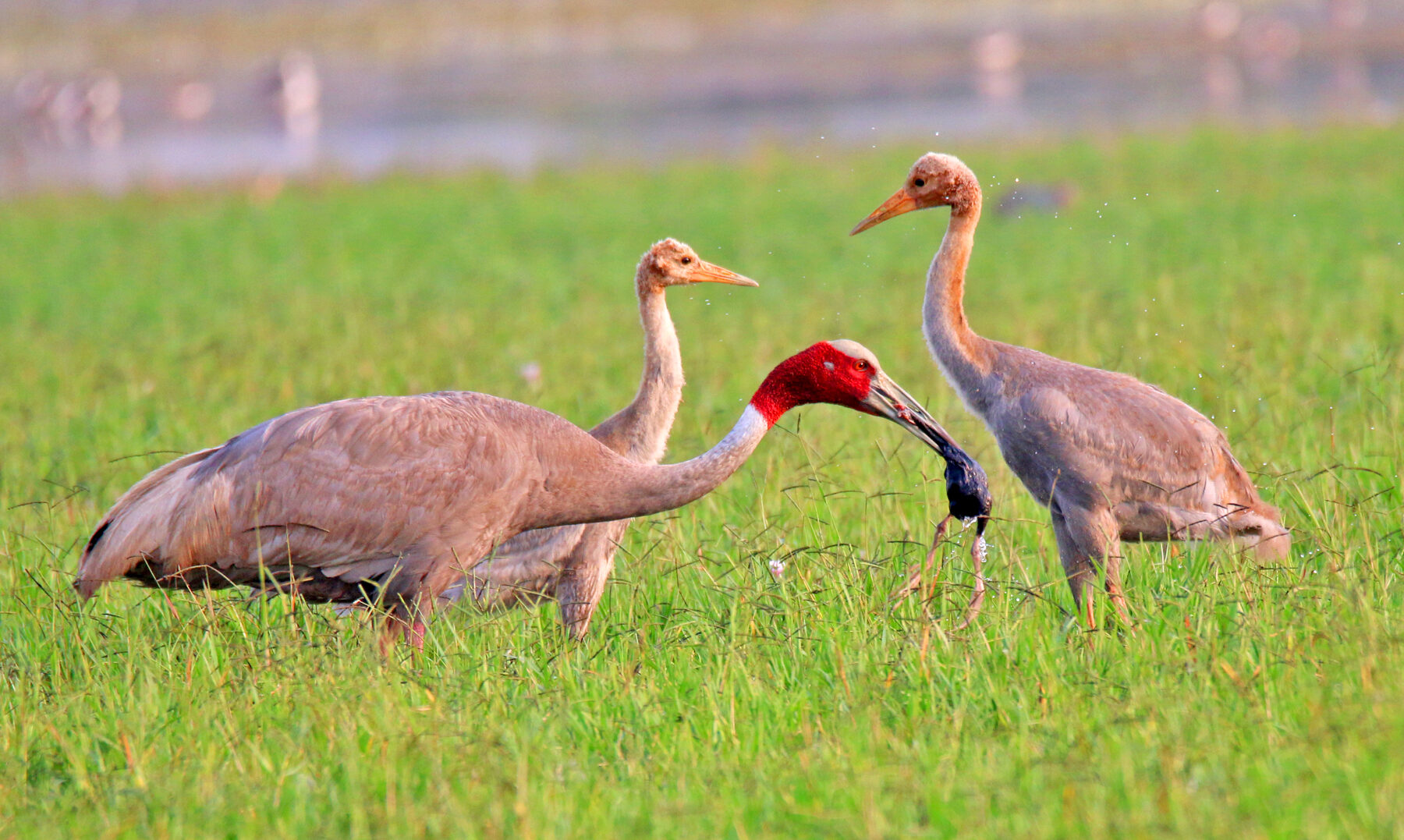
Banner image: A sarus crane feeds its offspring. It is listed as vulnerable by the IUCN Red List, and Shekha jheel is a critical stronghold for the species. Representative image by Drsssuresh1961 via Wikimedia Commons (CC BY-SA 4.0).