- The Indian government recently amended the forest conservation rules.
- The rules compromise public and expert scrutiny of proposals seeking forest diversions, but allow project proponents to meet relaxed compliance protocols before receiving final approval for forest diversion.
- They also allow more projects to carry out compensatory afforestation in degraded forests, which are important ecosystems in themselves and are highly dependent on wildlife and livelihoods, resulting in no real forest gain in effect.
“Forest conservation goes beyond tree planting and requires preservation of the entire ecosystem,” said Bhupender Yadav, the Union Minister of Environment, Forests, and Climate Change (MoEF&CC), on the occasion of World Forest Day at a national workshop at the Forest Research Institute Dehradun on March 21. While the minister expressed a pro conservation sentiment, certain legal changes made by the environment ministry do not follow the same sentiment.
As per Indian environment law, forest clearance is required to divert land when a project of a non-forestry nature is planned in a forest area. The clearance process involves both the central and state governments. The proponent of the project submits an application to the state forest department, which examines the proposal and, if satisfied, forwards it to the central government with its observations. There, either the Forest Advisory Committee, the Empowered Committee at the regional office, or the head of the regional office of the environment ministry reviews the proposal, mainly to determine whether the project absolutely needs to be located on forest land or can be shifted elsewhere. If the committee agrees with the project’s need for forest land, the central government grants a Stage I, or in-principle, clearance.
Stage I approval comes with certain conditions, including (but not limited to) the need for compensatory afforestation to make up for the loss of trees and payment of net present value to offset the loss of ecosystem services of the forest being lost. Once the project meets these conditions and the state government certifies the compliance, it can apply for Stage II or final clearance, which follows the same approval route — starting from the state, going to the centre, and returning to the state for the final nod. The process has been in place since the enactment of the erstwhile Forest (Conservation) Act 1980.
In 2023, along with the change in this Act’s name to Van (Sanrakshan and Samvardhan) Adhiniyam (Forest [Conservation and Augmentation] Act), the Government of India brought in a complete overhaul of the Act through an amendment in August last year. The environment ministry issued the Van (Sanrakshan Evam Samvardhan) Amendment Rules, 2025 which introduced several changes.
The Amendment limited the application of the Forest Act to notified forests or lands recorded as forest in government documents. It added, to the list of ‘forestry and allied activities’ activities, the creation of zoos, safari parks, agroforestry plantations, and ecotourism, in effect diluting the act as it meant that these activities didn’t need to obtain forest clearance anymore as they were not of a non-forestry nature.
Strategic linear projects of national importance and defence-related projects within 100 km of international borders were also made exempt. These amendments were widely criticised for promoting commercialisation of forests and undermining provisions of the Forest Rights Act.
Fast-tracking appraisal but faltering compliance
The Amendment allowed the proponents of ‘projects related to defence, strategic and national importance, and exceptional cases related to public interest or emergent nature’ to submit applications offline. Such projects could then be out of the state government’s clearance process.
“It is not mere bypassing of the usual course; it compromises public scrutiny. Currently, during the course of project consideration, from application, through stage I and stage II approvals, anyone can see the project details, where it is proposed, how much forest area it entails, what stage of approval process it is at, what kind of conditions the forestry panel allowed the project with, and so on. Allowing these projects to apply offline now will affect the public’s access to this information. It makes the approval process completely opaque and therefore open to manipulations and large-scale diversions without any public scrutiny,” says Prakriti Srivastava, a former Indian Forest Service officer.
Also, the validity of the in-principle approval for all project proposals has been increased from 2 to 5 years. It means that a project proponent will have 5 years (instead of 2) to comply with the conditions imposed in the in-principle or Stage-I approval. Essentially, the change allows project proponents more time to arrange funds for compensatory afforestation, identify land for it, and also pay the net present value of the existing forest.
In the past, the MoEFCC has taken several steps to fast-track forest clearance. It has activated auto-forwarding, which means a proposal will automatically move to the next stage if the concerned authority does not take action on it within a given time.
But the same kind of urgency is not demonstrated when compliance is awaited from the project proponents. Prior to this amendment, when the two-year period for compliance with Stage I approval expired, the approval would automatically become null and void. Now the central government may revoke it, as per the new Rules.
Besides, the amendment also shrinks the time period for processing of all proposals seeking prior approval for diversion of forestland from 5 to 40 ha to 130 days from 160 days.

Where is the compensatory afforestation?
The Rules allow state governments to carry out work in a forest division even without a duly approved work plan in place, as approved by the regional office of the environment ministry. A working plan, as prepared by the state government, includes details of forest land diverted, the land identified for compensatory afforestation in lieu, and its status.
Until the passing of this Amendment, an approved plan was mandatory before commencing any work; now, work can be carried out while the approval is awaited, and such work shall be ‘dealt with and disposed of’ by the regional office.
“It essentially means easier and quicker diversions for project proponents. In the absence of an approved plan for an area, there is a possibility of lands that have already been afforested to be planted over,” said Srivastava.
The Rules also make it optional for the state government to notify areas for compensatory afforestation as ‘protected forests.’ Earlier, it was obligatory. Now, only the transfer and mutation of land identified for compensatory afforestation in the name of the concerned forest department will suffice. This may again save the proponent some time in obtaining the final clearance.
In general, the Forest Conservation Act mandated that non-forest land of an area equal to the diverted forest land be planted over. In certain special cases, the Act allows compensatory afforestation to be carried out on degraded forest land, but on double the area.

Now, this concession has been extended to pipelines and “other public utility projects”. The Rules, however, do not define “public utility”. Projects seeking to mine critical and strategic minerals from forest areas have also been allowed to avail this offer, unless they fall in states and union territories with over 33% as forest area. There, afforestation is to be carried out over degraded forest land measuring three times the area of the forest being diverted.
The period for which the project proponent must support the protection of plantations of less than ten hectares and between 10 and 25 hectares has been reduced from 20 to 10 years in the Rules. Forest cover will eventually be reduced without actual compensation, as plantations on degraded forests often fail, according to Srivastava.
A 2022 media report on compensatory afforestation listed several such afforested degraded lands where actual plantations do not exist. With reduced time for their protection, the chances of their survival get slimmer. “We do not have an independent system that certifies that an area has not been planted over already in the past, failed, and been repeatedly planted over,” says Srivastava.
On March 16, Union Minister of State for Environment, Forest and Climate Change, Kirti Vardhan Singh, informed the Parliament that India has identified degraded lands across its states for compensatory afforestation under the Green Credit Programme. Green Credit Rules were notified in 2023 to encourage voluntary environmentally positive actions, including raising plantations, which can be exchanged for credits. The Rules provide for the verification of land parcels selected for afforestation to ensure that degraded forest land parcels are neither taken up under existing plantations nor earmarked for afforestation under any other scheme, including compensatory afforestation, to prevent double-counting. However, concerns around execution remain.
The concern around green credits is that they rely on tree survival instead of preservation of ecosystems, which may incentivise plantations, as highlighted by Gautam Aredath, a policy analyst from Ashoka Trust for Research in Ecology and the Environment (ATREE).
Besides, in India, “all open forest and scrublands, wastelands and catchment areas” are classified as degraded lands, which are “unique ecosystem entities in themselves”, write Srivastava and Prerna Singh Bindra, a conservationist, in their 2024 critique of Green Credit Rules.
The author is an independent researcher, lawyer and journalist specialising in environmental policy and justice.
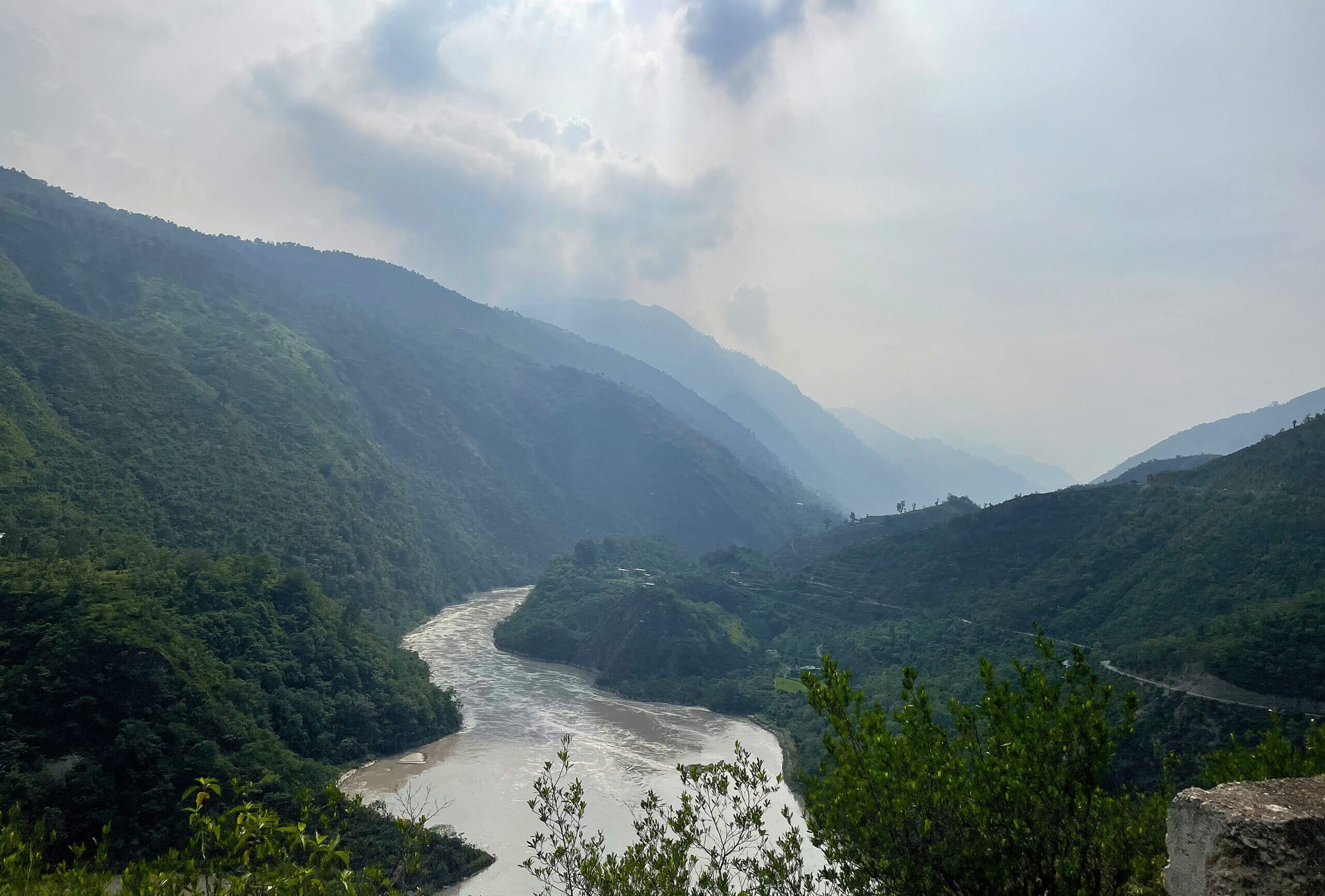
Banner image: Sub-tropical pine forests in Himachal Pradesh. Image by Meenakshi Kapoor.