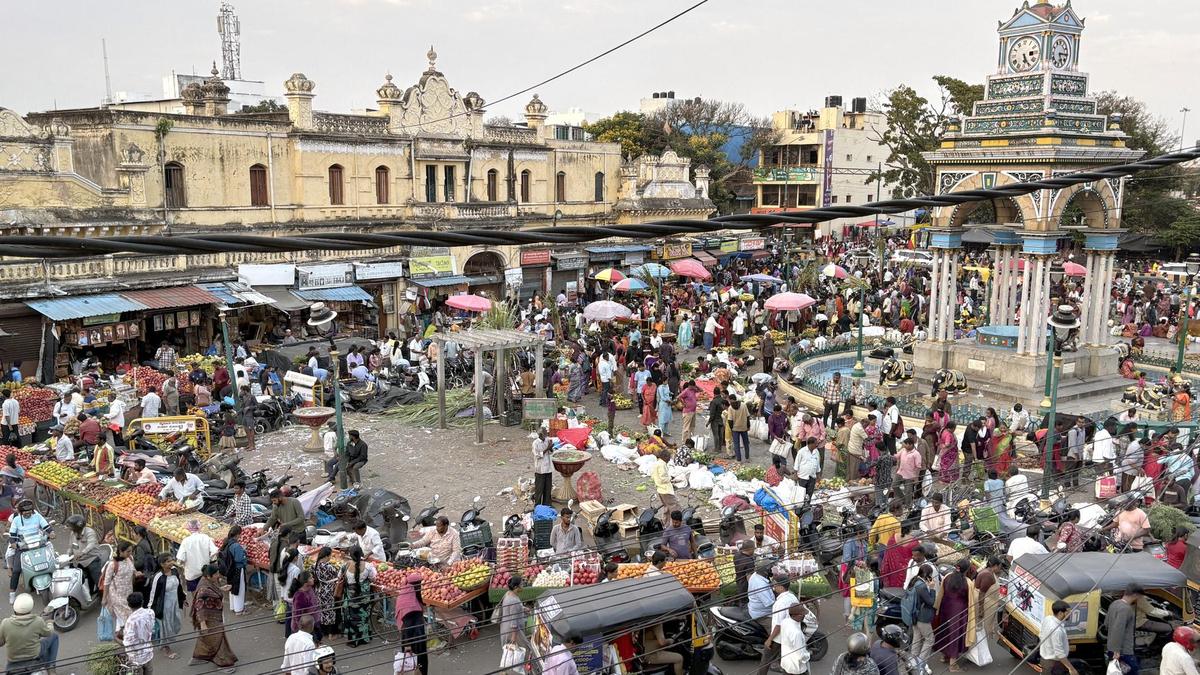
A view of the century-old Devaraja Market in Mysuru.
| Photo Credit: File Photo
The Supreme Court has held that the Devaraj Urs Market and the Lansdowne Building in Mysuru should be protected and directed authorities to prepare a comprehensive plan for their renovation and restoration.
The Supreme Court’s observations follow an evaluation report submitted by the IIT Roorkee on the assessment of the condition of the two heritage buildings of Mysuru, which the State government had proposed to demolish and rebuild.
During the hearing of a special leave petition filed by Gouri Satya and others earlier this week, the Supreme Court directed the Mysuru City Corporation (MCC) and Mysuru Development Authority (MDA) to prepare a comprehensive plan in line with IIT Roorkee’s evaluation report while also looking into the recommendations made by INTACH in this regard.
“Let the necessary exercise be undertaken at the earliest so as to ensure that no further damage is caused to the two structures,” the Supreme Court has observed.
Sharing a copy of the Apex Court’s observations, Mr. Satya told The Hindu that MCC and MDA are expected to be ready with the renovation and restoration plan for the two structures, before the next hearing scheduled for July 30.
In its report to the Supreme Court, IIT Roorkee noted that “approximately 70% of the vertical elements in both the buildings, including walls and columns, fall under mild to moderate categories of distress, indicating that these components are repairable with conservation measures. In contrast, the horizontal elements, primarily roofs and slabs, show a higher degree of deterioration, with nearly 70% of these elements in moderate to severe condition, necessitating comprehensive restoration or even reconstruction”.
Devaraja Market
In Devaraja Market, among the three types of roofing systems, the Madras-terrace and jack-arch roofs are in critical condition, with nearly 75% of the roofing area requiring urgent intervention. The brick barrel vault system, however, remains in a comparatively better condition due to its inherent structural form and load distribution. “The masonry walls and columns are generally in satisfactory structural condition, though localised cracks and dampness require minor to moderate repairs. The recent RCC extensions at the rear side of the east block show significant corrosion and spalling, calling for targeted rehabilitation,” the IIT Roorkee report has pointed out.
Lansdowne Building
“As for the Lansdowne Building, about 70% of the vertical elements are in mild condition, 20% in moderate, and 10% in severe condition. However, the horizontal systems are comparatively weaker. At the first-floor level, around 65% of slabs are moderately distressed, while 25% are severely deteriorated. At the terrace level, 80% of the slabs fall under the severe category, with visible cracking, sagging, and partial collapses. The passage slabs at both levels also show advanced deterioration, indicating a loss of stiffness and safety concerns,” the report said.
It has also been pointed out that the assessment highlights that past interventions to the building had “significantly contributed to its current state of distress.”
While pointing to the need for a scientifically sound evaluation and conservation plan for the structures, the Supreme Court has also observed that “many severely deteriorated or damaged elements of these structures would even need reconstruction as a part of this overall restoration work.”
The court noted that the buildings would not have deteriorated to this extent had proper maintenance and upkeep been undertaken in the past. “It is strongly recommended that all such alterations and additions, i.e. construction of mezzanine floors, closure of many arches, etc., should be removed at the time of execution of restoration works and these buildings should be brought to their original architectural and structural forms,” the court said.
Published – May 08, 2026 08:21 pm IST