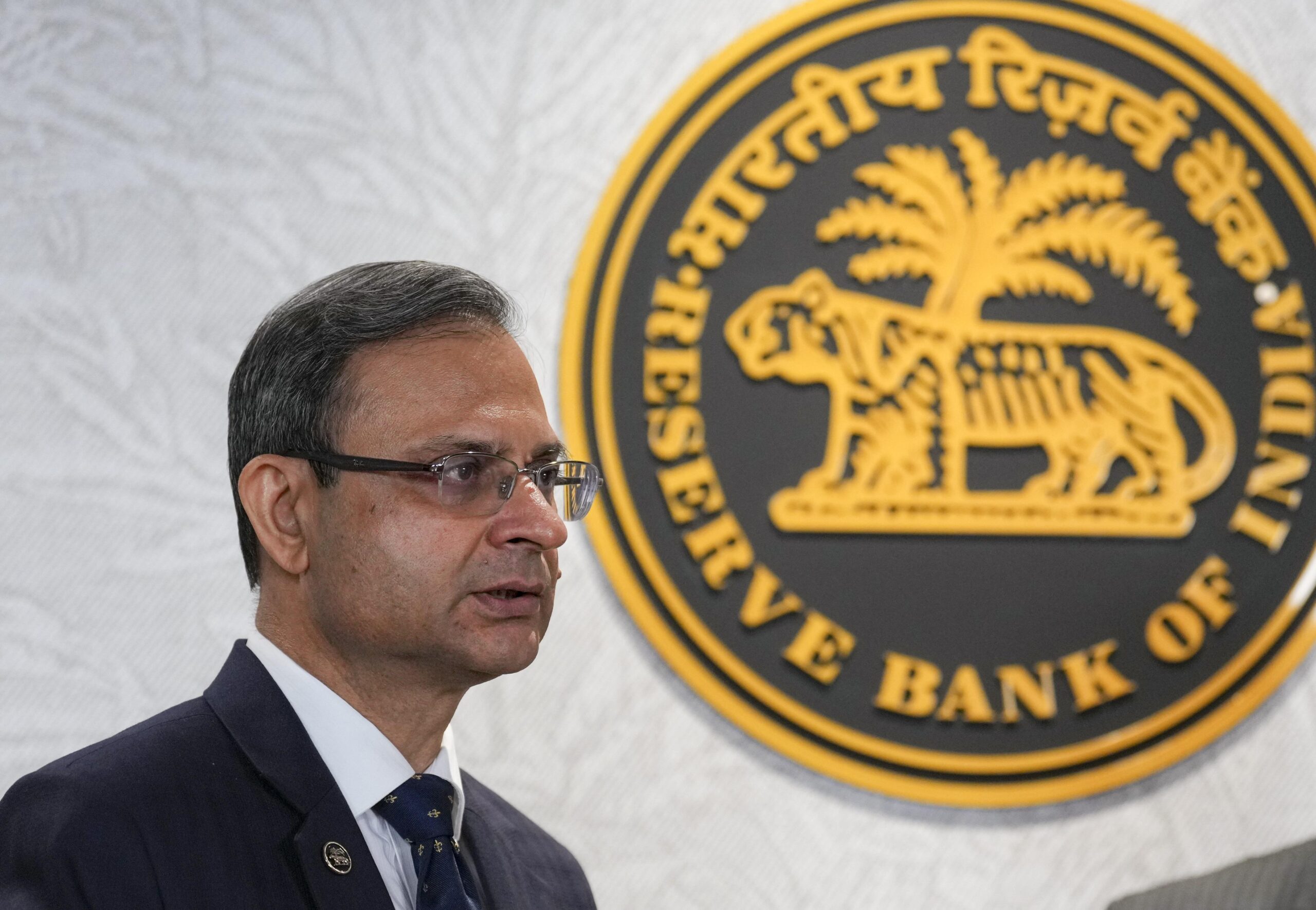
In a speech delivered at his alma mater, Princeton University, on Saturday, Reserve Bank of India (RBI) Governor Sanjay Malhotra said second-round effects of supply shocks are the real concern — when inflation expectations rise due to prolonged supply disruptions — and preventing such a situation is the primary role of monetary policy.
He said the central bank’s intervention in the foreign exchange (forex) market was as warranted and that it did not commit to an “indefensible peg”. The speech was uploaded on the RBI website on Monday.
“When intervention in the forex market was warranted, the RBI acted — but it did not commit to an indefensible peg,” he said.
The rupee came under pressure following the West Asia conflict in March, depreciating over 4 per cent, prompting the central bank to curb speculative trades. Some of those curbs were rolled back on Monday.
“India’s current account deficit was manageable and foreign currency exposure reasonable. The lesson is that, for a country at India’s stage of development, the sequencing of capital account liberalisation is not a technicality — it is a first-order question of macroeconomic sovereignty,” he said.
He added that the RBI has maintained controls on the capital account, particularly for residents, and that short-term external debt has been kept at levels well below what forex reserves can comfortably cover.
India’s forex reserves stand at $710 billion, providing cover for over 11 months of imports.
Malhotra said the present crisis — the conflict in West Asia — affects India, as the region accounts for about one-sixth of exports, one-fifth of imports, half of crude oil imports, two-fifths of fertiliser imports, and nearly two-fifths of inward remittances.
He said the appropriate monetary policy response to such a supply shock is to look through the first-round effects, as long as they do not feed into second-round dynamics.
“Second-round effects are the real concern. They can materialise if supply chain disruptions persist,” he said, explaining that what begins as a supply shock can become embedded in the general price level.
“Preventing this entrenchment is where monetary policy has a primary role through its influence on inflation expectations rather than through blunt demand compression,” he said.
He emphasised that in uncertain times, it is important to remain agile and nimble, maintain a broad policy stance, and avoid firm commitments on the future path of policy.
“In such circumstances, our broad approach has been to be even more data-dependent and to continuously reassess the balance of risks. We are therefore in a wait-and-watch mode now,” he said.
He said the monetary policy committee (MPC) has maintained a neutral stance over the last few policy cycles, preserving flexibility to respond as inflation-growth dynamics evolve.
The MPC, which cut the policy repo rate by 125 basis points (bps) since February 2025, has maintained a neutral stance since the June policy review meeting, when it reduced the rate by 50 bps. The last rate cut was in the December meeting; since then, the status quo has been maintained on both rate and stance.
He said fiscal policy has also played an important role in preserving price stability in India, where supply-side factors have a large influence on inflation.
“The central government’s fiscal deficit-to-gross domestic product (GDP) ratio has declined from 9.2 per cent in 2020–21 to 4.4 per cent in 2025–26 (Revised Estimates). India’s general government debt-to-GDP ratio, at 81.1 per cent in 2024–25, is reasonable, with most of the world’s top 10 economies (by nominal GDP in US dollar), except Germany and Russia, having higher debt ratios than India,” he said.
He said financial stability is the bedrock on which an economy grows sustainably. “We have been willing to sacrifice some short-term upside for long-term growth. While some regard this as conservatism, we believe it is prudence,” he said.
He added that the RBI — as a full-service central bank — also has a developmental role. He cited initiatives such as Jan-Dhan account openings, the development of Unified Payments Interface, and central bank digital currency (CBDC) efforts.
He said the RBI is currently building the Unified Lending Interface to give lenders instant digital access to data, enabling them to assess creditworthiness within minutes for small farmers and business owners who previously lacked documentation or had to spend considerable time at banks.
“We are also pushing the frontiers with our CBDC. It has the potential to make cross-border payments faster and cheaper,” he added.