- At the latest biodiversity conference in Brazil, governments agreed on stronger international protection for the striped hyena.
- Research from Rajasthan, Gujarat, Odisha and West Bengal shows the species survives in agricultural, coastal, industrial and other human-dominated landscapes, not only in protected areas.
- Experts recommend India improves surveys, protects denning sites and movement routes, and pays greater attention to fragmented habitats in places such as West Bengal and Jharkhand.
The striped hyena has been given stronger international protection under the Convention on the Conservation of Migratory Species of Wild Animals treaty (CMS), with its conservation requiring greater cooperation among range states. This decision was made at the 15th Meeting of the Conference of the Parties to the CMS Convention (CMS CoP15), held in Campo Grande, Brazil, at the end of March.
For India, the significance of this decision is that it puts fresh international pressure on the country to improve monitoring, protect habitats and movement corridors outside protected areas, and pay greater conservation attention to a species that is still poorly tracked across much of its range. The decision has been welcomed by conservation groups globally, which say it could help push stronger protection and cooperation for a species that has long received limited policy attention.
The striped hyena is listed as Near Threatened on the IUCN Red List, and Wildlife Conservation Society says its global population is estimated at fewer than 10,000 mature individuals and is in continuing decline.
In India, the species is found across much of the country outside the northeast and wetter southern regions, with records and studies from states including Rajasthan, Gujarat, Odisha, Karnataka and West Bengal showing it survives in agricultural, coastal, scrub and industrial landscapes.
Susan Lieberman, Vice President for International Policy at the Wildlife Conservation Society, told Mongabay-India that the decision to include the striped hyena in Appendix I (total protection of the species in the wild) and Appendix II (range states need to collaborate) of the treaty was an important step. “All range States for the species that are CMS Parties are now required to protect the species, and to collaborate in its conservation. Hopefully, this will stimulate action for this endangered species,” she said.
A species protected in law, but poorly tracked
In India, the striped hyena is protected under the Wild Life (Protection) Act. Following the 2022 amendment to the law, it is listed in Schedule I, which gives it the highest level of legal protection.
The latest government-backed assessment by the National Tiger Conservation Authority and Wildlife Institute of India records hyenas across multiple landscapes and uses occupancy rather than a national headcount as the main indicator of status. In that assessment, striped hyenas were recorded over 885 sq km in the Shivalik Hills and Gangetic Plains landscape and about 3,100 sq km in the Western Ghats landscape, with the report noting that this is likely an underestimation because the species often occurs outside forests in rural and semi-urban areas.
Lieberman said monitoring remains a major gap.
That lack of data runs through available research from India. Studies from Rajasthan, Gujarat, Odisha and West Bengal show that the species persists across a wide range of landscapes, from agricultural lands, coastal areas, industrial belts and other human-dominated spaces. They also point to patchy information and uneven conservation attention toward the species.
Shamshad Alam, a wildlife specialist known for his work on the striped hyena, including research on its status and distribution in Gujarat’s Gir landscape, said the lack of reliable information is especially serious outside protected areas, where most striped hyenas in India are likely to occur. He said populations within protected areas may be “relatively stable” based on limited scientific estimates, but outside them, understanding still depends largely on general observations by forest officials rather than systematic assessment.
Alam said this is a major concern because habitats used by hyenas beyond the protected-area network are rapidly shrinking or being heavily altered. He said India needs a national-level assessment of the species’ current status and distribution to support better conservation and management decisions.

Why eastern India matters
Manish Kumar Chattopadhyay, Vice President at the Wildlife Information and Nature Guide Society, working on the conservation of Indian striped hyena and Indian grey wolf in West Bengal, said the CMS CoP15 decision has “significant practical importance” for the species in India.
“In practical terms, this decision encourages greater transboundary cooperation, improved research, and data sharing on species movements and population status, especially in landscapes with fragmented habitats. It also provides policy support for integrating species-specific conservation measures into national and state-level management plans.”
He added, “For India, where striped hyenas persist largely outside protected areas in human-dominated and industrial landscapes, the CMS CoP15 outcome can help prioritise funding, monitoring, and mitigation of threats such as habitat fragmentation and human–wildlife conflict. Furthermore, it reinforces the need for landscape-level conservation approaches and enhances the global conservation profile of the species.”
Those concerns are directly relevant in West Bengal’s Asansol-Durgapur belt, where mining and industrial expansion have reshaped the landscape where hyenas would live.
Mining, roads and fragmented habitat
Chattopadhyay said, “In the Asansol and Durgapur landscape, the primary threats to hyenas stem from habitat loss, fragmentation, and disturbance due to extensive mining and associated infrastructure. Expanding open-cast mines, road networks, and human settlements have disrupted natural corridors that hyenas rely on for movement.”
He added that road mortality, occasional retaliatory killings, and the instability of denning sites in abandoned or reactivated mining areas pose significant risks. “Given the species’ low reproductive rate and biological constraints, even small increases in adult mortality can have serious population-level consequences.”

“In our landscape, a clear manifestation of island biogeography can be observed, where habitat patches within mining and industrial areas of West Bengal function as ecological ‘islands.’ It is likely that source populations from adjoining Jharkhand disperse into these fragmented patches, sustaining smaller, isolated hyena populations. However, increasing fragmentation and barriers such as mining infrastructure and linear developments can restrict movement, leading to reduced connectivity and potential genetic isolation.”
Chattopadhyay, who works r on the species in eastern India, said the international decision has strong potential to bring greater policy and conservation attention to striped hyena habitats in eastern India. “Recognition under global frameworks like the Convention on the Conservation of Migratory Species of Wild Animals elevates the conservation priority of the species and encourages alignment of national and state-level strategies with international commitments,” he said.
Threats across the range
Alam also said public perception of the species remains poorly understood in India. Because striped hyenas are strictly nocturnal and occur at low densities, many people are unaware of their presence, while in some areas they are regarded mainly as a threat to livestock, he said.
Lieberman also added on to the threats striped hyenas face across their range, including habitat loss and degradation due to urbanisation, infrastructure development, and agricultural expansion; prey depletion; human-wildlife conflict, direct persecution and illegal trade. Some of the trade is for magic purposes.
On immediate priorities in Bengal, Chattopadhyay said, “Immediate priorities should include strengthening baseline data through systematic surveys, such as camera trapping and movement studies; identifying and securing denning sites; and mapping critical corridors. It is equally important to reduce road mortality through measures such as speed regulation, signage, and wildlife crossings.”
Alam said India needs a detailed nationwide project to assess both the current and historical distribution of the species, identify threats across landscapes, and help central and state governments frame stronger conservation responses. He said forest departments, research institutions and conservation groups need to give the species greater attention.
Read more: Scavenging hyenas save carcass disposal costs
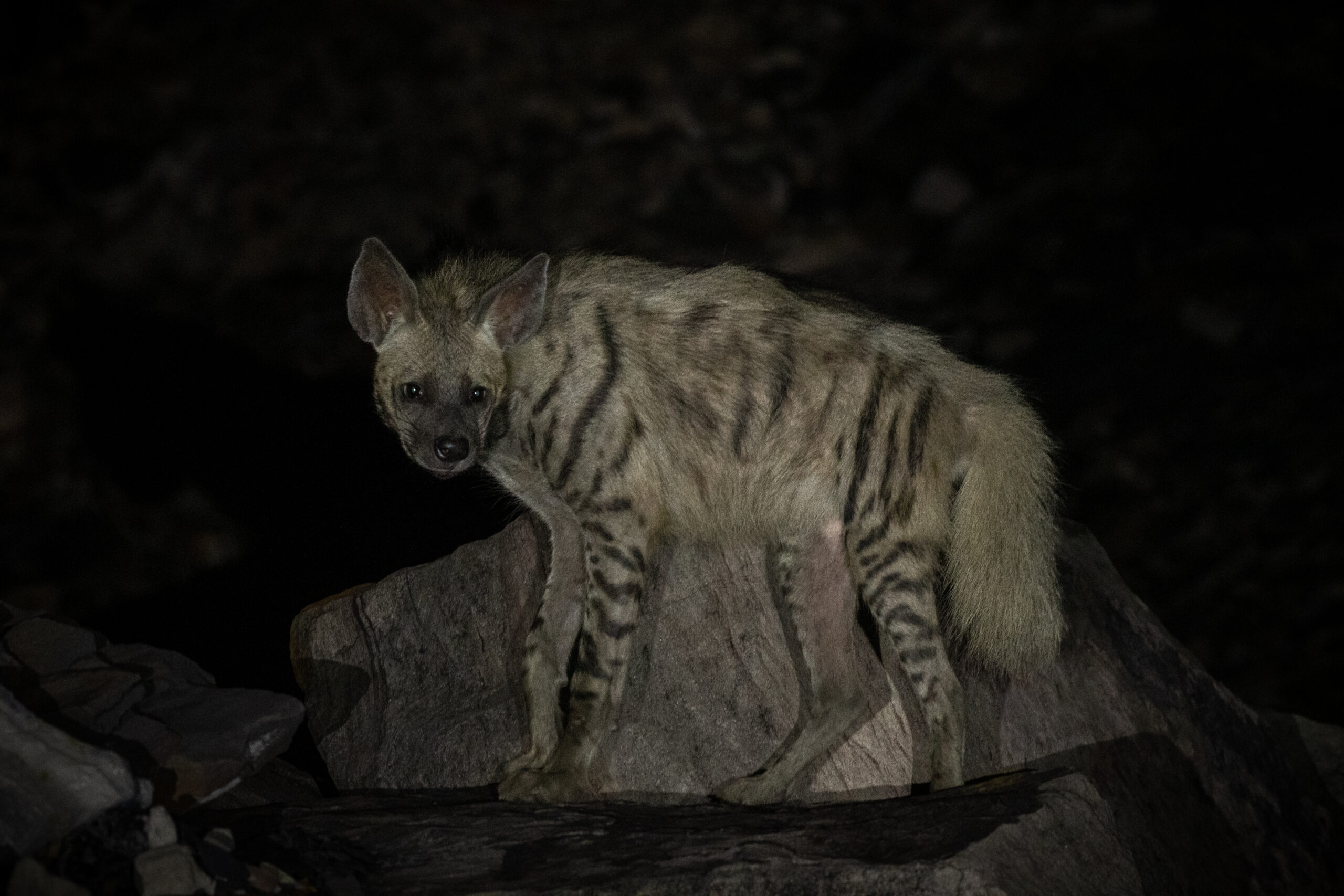
Banner image: Striped hyenas face threats like habitat loss and degradation, prey depletion, human-wildlife conflict, direct persecution and illegal trade. Image © Manish Kumar Chattopadhyay.