A study that explored the impacts of climate change on human migration patterns, specifically through the lens of climate-induced forced migration and internal displacement within rural India, shows that climate change does not directly cause migration. Instead, it acts through a chain of impacts — particularly by disrupting agriculture, depleting water resources, and weakening local economies. The environmental stresses become critical only when combined with existing socio-economic vulnerabilities and weak governance systems, according to the research.
The study, using secondary data, was based on the case of Meenakshipuram, a village in Tamil Nadu where the residents abandoned it, turning it into a ghost village. Meenakshipuram had grabbed headlines a few years ago because of its only resident Kandaswamy, now dead, who refused to leave the village even when his children decided to move out of it.
Declining rainfall, repeated droughts, and rising temperatures led to severe water shortage and agricultural collapse there. However, what ultimately drove people out was not climate stress alone but the absence of institutional support, poor infrastructure, limited livelihood alternatives, and social marginalisation, the study reports.
According to the lead author of the study Prasanta Moharaj, assistant professor of sociology at Dayananda Sagar University, Bengaluru, Kandaswamy continued to live in Meenakshipuram even when everyone left due to emotional attachment to his land, his home, and memories of his family. The study highlights that Kandaswamy’s story exemplifies that not everyone abandons climate-affected villages. The decision hinges on the adaptive capacity of the place — better infrastructure, policy support, and alternative livelihoods can alter the decision and encourage people to stay on. “The decision to migrate (by Meenakshipuram residents) or not was not just driven by environmental or economic factors; it was also shaped by social change and emotional factors,” Moharaj explains.
He draws parallels to his hometown in Odisha’s Kendrapara district, a coastal region in the spotlight for climate change-induced migration. “There is a cluster of seven island villages there, locally called ‘Satabhaya’ (meaning “seven brothers”). These villages were once inhabited, with people dependent on agriculture and fishing. Today, most of them have been evacuated, and the situation is quite similar to Meenakshipuram,” he says, adding, “Many of the residents have been displaced there, partly because the area is socio-politically complex, with a large number of long-settled migrants.”
Migration, therefore, emerges as a compelled response, not a voluntary choice. It represents the last available survival strategy when communities lose the ability to sustain livelihoods locally.
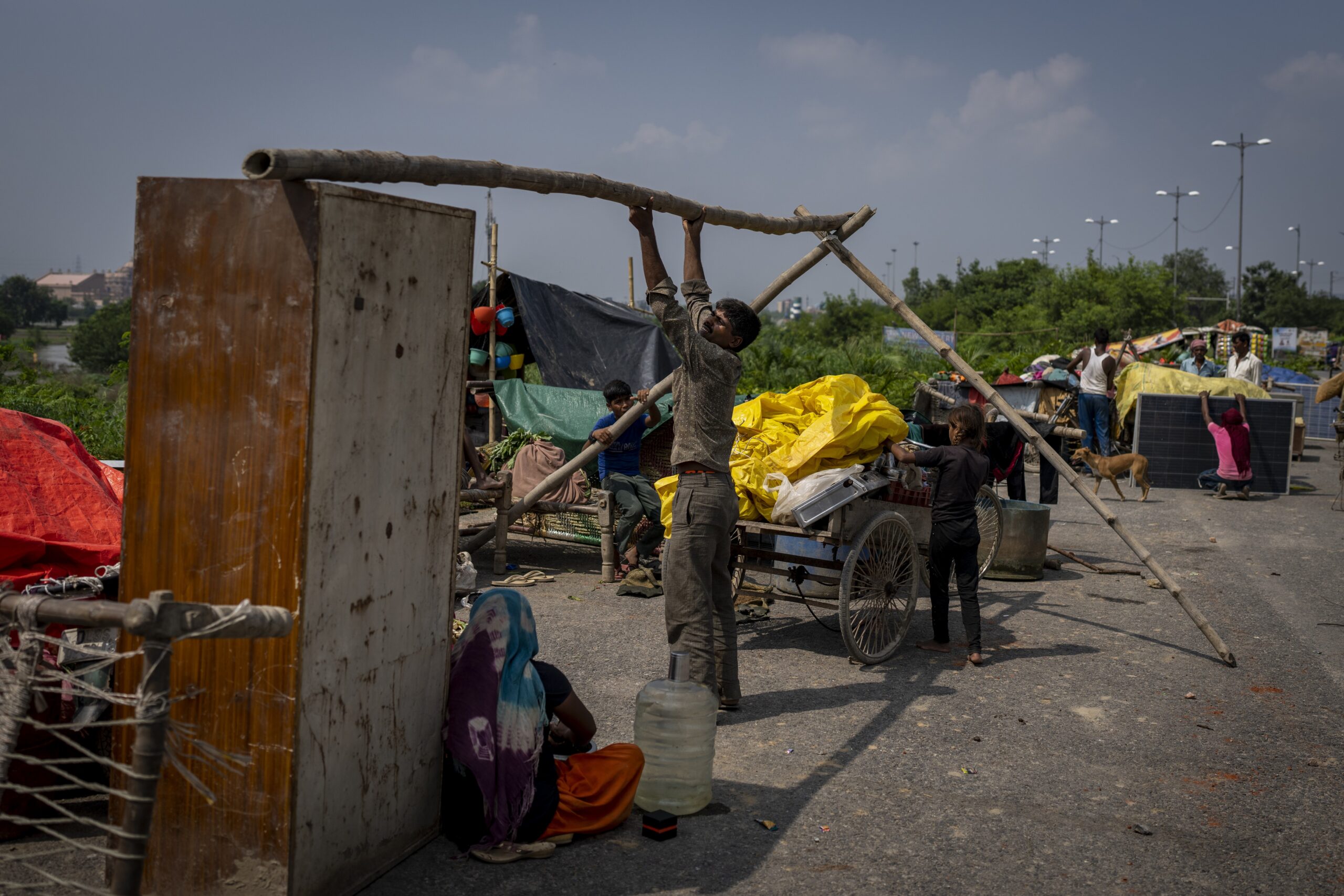
Banner image: A family prepares a makeshift tent on a road after evacuating the flooded banks of Yamuna River. Representative image. (AP Photo/Altaf Qadri)