On Saturday, the night before Election Day in Hungary, I had dinner in Budapest with a political philosopher named Zoltán Miklósi. “Rationally, I can see all the signs that the opposition is gaining ground, and I don’t see a way for Orbán to overcome it,” he said. “But, I have to confess, when I try to think of Orbán simply losing and walking away, I can’t quite imagine it.” Dozens of Hungarians had told me much the same thing. Viktor Orbán, the longest-serving Prime Minister in the European Union, had been in office since 2010, pioneering a system of legalized autocracy that became a model for aspiring strongmen all over the world, including President Donald Trump. In the past three years, though, the Hungarian economy faltered, and what was left of its independent media focussed relentlessly on the corruption and rot in the Orbán regime. Péter Magyar, a former official in Orbán’s party, became an ascendant opposition candidate, drawing unprecedented crowds at rallies across the country and eventually leading in most polls. Business élites started to signal dissatisfaction with Orbán. Whistle-blowers emerged from the military and the police. Orbán’s grip on power, unquestionable for a decade and a half, suddenly looked vulnerable. (Even he seemed to know it: at a joint press conference with Vice-President J. D. Vance, who’d come to Hungary to stump for him, Vance said, “Viktor Orbán is going to win the next election,” and Orbán made a tentative so-so hand gesture that immediately became a meme.)
Every Hungarian I spoke with could recite these facts, but still, on the eve of the election, no one seemed able to internalize them. In the previous election, the opposition had stirred up hope, only to endure a crushing defeat. Surely Orbán would find a way to triumph once again, even if no one could anticipate how. “I have friends who are worried about some sort of legal trickery, or last-minute intervention by the Russians,” Miklósi told me. “Others are worried about violence.” The only scenario that seemed impossible to contemplate was a clear win for Magyar, a quick concession from Orbán, and a moment of national catharsis.
The first time I interviewed Miklósi, last year, I asked him whether the U.S. was sleepwalking down the trail that Hungary had blazed a decade earlier, and, if so, whether American exceptionalism might make this harder for us to see. He validated this concern, but he also raised an inverse problem—not an exceptionalism that insists that a descent into authoritarianism is impossible, but a defeatism suggesting that, once authoritarianism takes hold, there’s no way out. “It’s understandable, after so many years of setbacks and humiliations, but it’s one of the biggest dangers, because it deprives you of political agency,” Miklosi told me. “Defeatism breeds defeat.”
The key fact about the autocratic regime that Orbán engineered in Hungary—the very thing that made it a useful prototype for Trump and other elected autocrats—is that it was a form of competitive authoritarianism, not totalitarianism. Orbán had used a supermajority in Parliament to rewrite the constitution, consolidating his power and tilting key institutions toward his interests. Still, Hungary was not North Korea, or Egypt, or Azerbaijan; it was more like India, or Turkey, or the United States. Elections were held every four years, and these elections remained competitive. Orbán used the tools of autocratic legalism (extreme gerrymandering, courts stacked with loyalists) to tilt the system in his favor, but he never cancelled elections, or ordered the police to shoot at protesters, or conjured votes out of thin air. Miklósi, in a recent journal article called “Perversity, futility, complicity: Should democrats participate in autocratic elections?,” considers a range of philosophical arguments against voting in a “normatively illegitimate” regime. And yet he keeps warning readers, and perhaps himself, against defeatism: “The outcome of autocratic elections, despite the immense advantages of the ruling party, is not entirely predetermined. Electoral autocracies are unique among autocracies in that their ruling party can, though rarely, be defeated by an opposition that plays within the autocrat’s own formal rules of the game.”
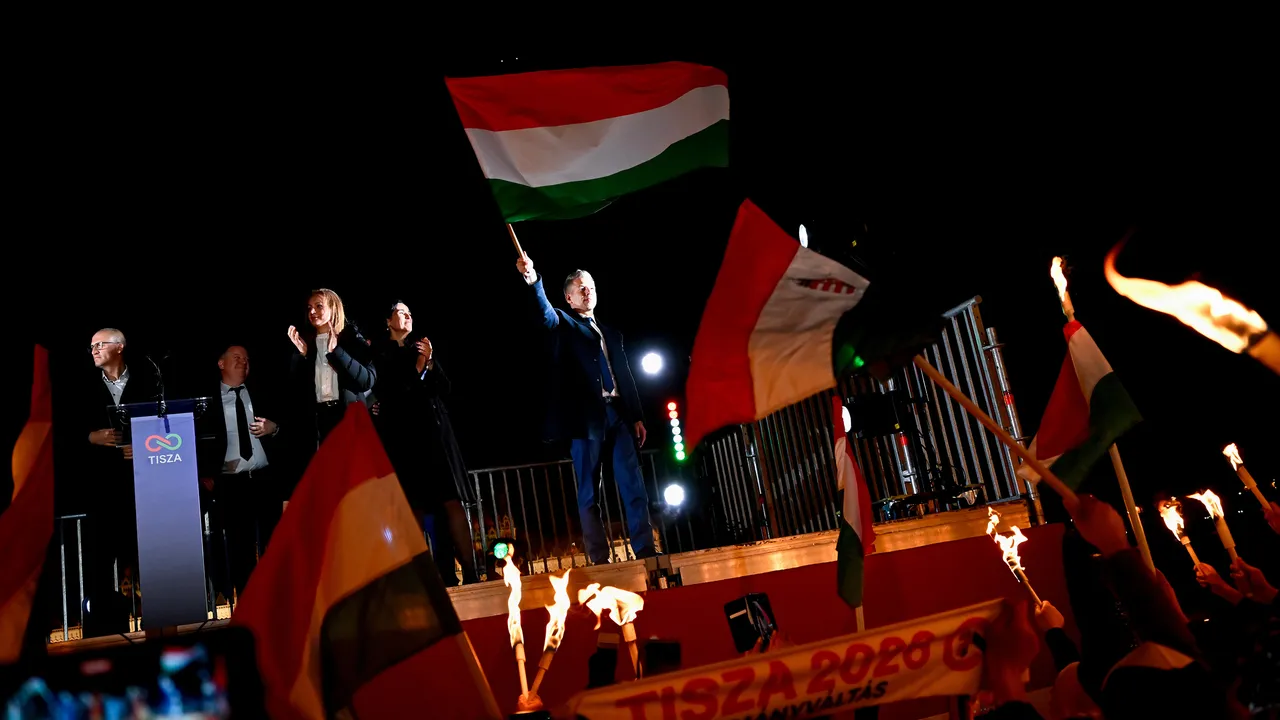
On Sunday, what the Hungarians got was precisely what they’d found hardest to imagine. Magyar won a clear majority, enough for his party to secure a two-thirds supermajority in Parliament. At around 10 P.M., Orbán called Magyar to concede; after that, the streets of Budapest erupted in what can only be described as catharsis. “We don’t do Carnival here, but this is our Hungarian Carnival,” Ákos Takács, an architect and a former progressive activist, said (or, really, shouted), passing around cups of champagne in a square in downtown Budapest. All around us, grown men hugged and cried; young parents hoisted children on their shoulders; a few police officers stood on a street corner, chatting amiably with passersby. One of Takács’s friends, speaking English for my benefit, kept shouting “Fuck, fuck, fucking fuck!” (“I have Tourette’s, but in the happy way,” she hastened to explain, unnecessarily.) People waved Hungarian flags and erupted in patriotic chants. “In this hip, lefty part of the city, you wouldn’t see this sort of patriotism, ever, except at this moment,” Takács said.