- Enchantingly written and filled with delightful anecdotes, Neha Sinha’s latest book on Delhi’s wild denizens is an ode to the capital city’s nonhuman residents.
- The book, Wild Capital, reflects the author’s joy in the biodiversity of the city she grew up in, and how it has persisted in the squeeze of urbanisation.
- Sinha brings her conservation lens as well as a journalist’s eye for detail as she walks through the city’s different landscapes with fellow nature enthusiasts preserving the city’s natural beauty.
For many Delhi residents, who, like me, have lived in India’s capital for 50 to 60 years and watched with consternation the desecration of the city — its green lungs and open spaces taken over by multi-storeyed buildings, its once elegant rivers turned into muddy cesspools, and garbage dumps replacing sprightly flowering and fruiting trees — it is difficult to believe that a “wild” capital still exists. But that is precisely what Neha Sinha, a journalist turned conservation biologist, sets out to showcase in her latest book, Wild Capital – Discovering Nature in Delhi.
It’s a deeply personal book as she takes you through the hidden wilderness of the bustling city. She weaves ecological history, wild creatures, trees that she loves, discovers centuries old sacred groves, bird songs and fire flies that still flash their lights in the dead of night in forgotten forest tracks.
Even as a young child, Sinha reflects that she did not like playing with “dead” dolls. She preferred living playmates: ants, bright-eyed birds, a mongoose, squirrels, millipedes and other wild creatures that lived in the garden of her home in North Delhi. She would talk to them and join in their game of hide-and-seek. She also loved and played with plants, the touch-me-not mimosa, whose leaves closed if she touched them. There were trees that she grew up with and learnt their value. The neem twigs were used to clean teeth and the concoction of crushed neem leaves and honey that her mother made served as a tonic. But the tree that she called ‘her tree’ was a 30-40-year- old bakain (Melia azedarach) , a cousin of the popular neem tree. She called it ‘Citri’ and shared it with birds, squirrels and insects. Plants and nature’s myriad creatures distracted her from the maths homework she hated. She looked at ‘her tree’ and her thoughts veered to the ecological relationship between trees and birds. Her book conveys how she felt she had found hope, joy and purpose in trees, insects and birds.
Publisher: HarperCollins
Print length: 320 pages
Publication date: February 8, 2026
Genre: Travel, Non-Fiction
Wild Capital – Discovering Nature in Delhi by Neha Sinha takes you on a journey through the hidden wilderness of the bustling capital city of India. The book introduces readers to the city’s trees, birds and other biodiversity while renewing hope for nature enthusiasts in a concrete jungle.
This book shares her manifesto of hope through the rediscovery of nature. Wild Capital is eminently readable combining Sinha’s academic skills as a conservation biologist with her writing talent. Her first book Wild and Wilful: Tales of 15 Iconic Indian Species, published in 2021, won her accolades and awards.
The Delhi Parks and Gardens Society has identified more than 18,000 public parks and gardens in the National Capital Region but this does not account for the fast disappearing private gardens, local green spots and avenues being swallowed by the city’s growth. Plants are the foundations of ecosystems and some 400 plant species are native to Delhi. “With water, land and native plants, we should try to recover the wilderness areas,” she pleads.
Sinha’s forays into little-known wild and green areas of the NCR are with fellow nature lovers like Pradip Krishen who wrote the book on the Trees of Delhi, Sohail Madan, an ecologist who restored the Asola Bhatti Sanctuary, Verhaen Khanna, founder of New Delhi Nature Society, Sunil Harsana, a warrior for the Mangar Bani, a sacred grove and maybe the last primary forest of the region. Other companions on her ecology ventures were Vellari Sheel who was completing her Ph.D. on the trees of Delhi and Col. Pankaj Sharma, whose interest on birds and wildlife of the mountainous regions of North India extended to the NCR. They shared as well as added to the author’s understanding of nature and took her to ecologically rich and new places. The book also gives readers an understanding of the Aravalli ecology and its importance, Sanjay Van and the value of rivers like the Yamuna, the Sahibi and even storm water drains where decades ago, hundreds of birds swirled above the waters searching for their breakfast of fish.

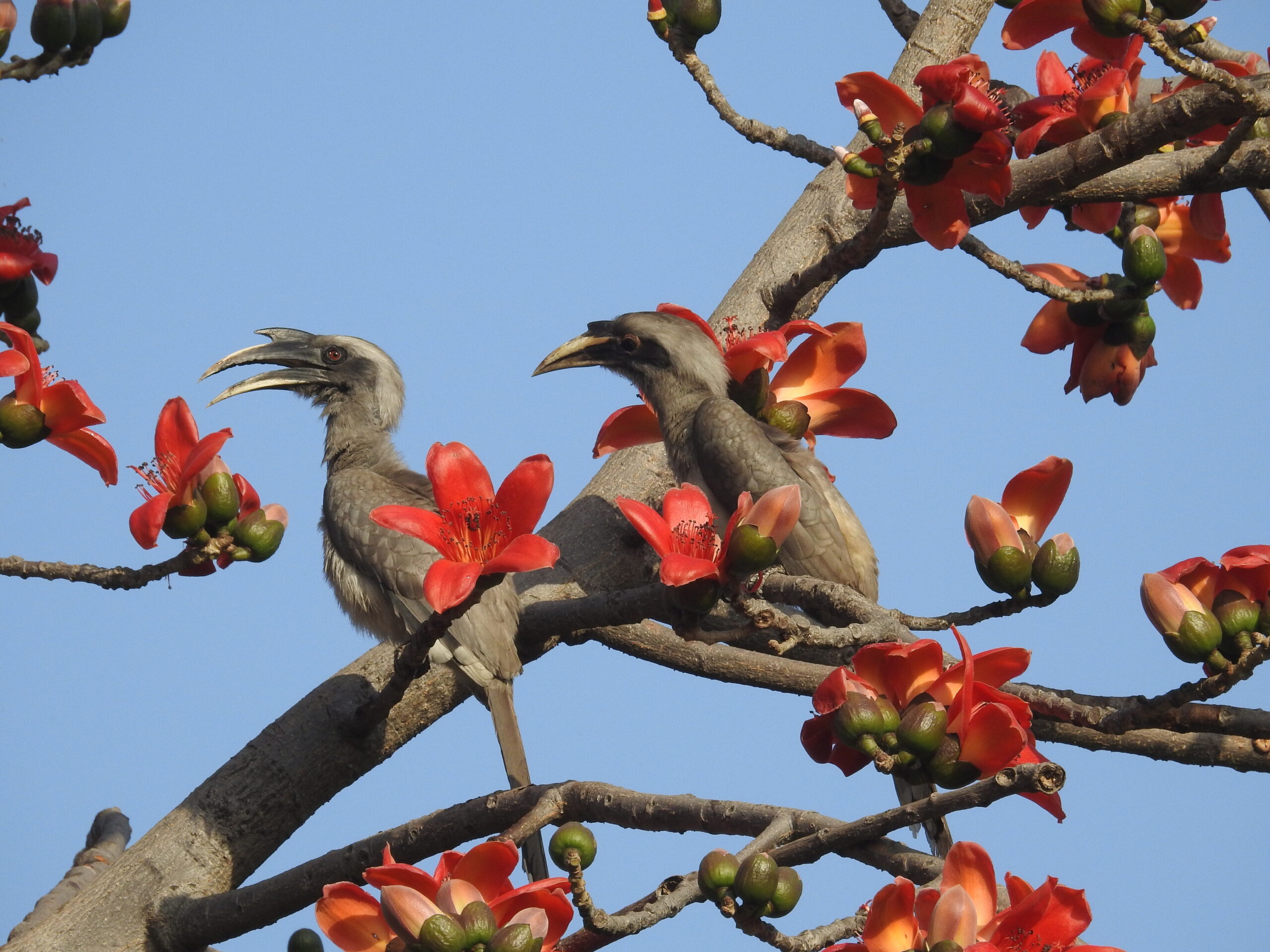
How does one look for joy in the fast changing Delhi landscape? In a small park in Malcha Marg, in Chanakyapuri, there is a full grown tree and sitting on it is a hornbill eyeing its fruits. It picks up a fruit and hops across to its partner and tenderly feeds her. This moving spectacle of the feeding is accompanied with information that the female hornbill is sealed inside a hole in the bark of the tree where she has her chicks and rears them till they are old enough to fly out. It is the male who provides for them through a post box like opening till they come out.
At the city forest of Mitraon, not far from Najafgarh, with Sohail Madan, Sinha spotted a 350-year-old jaal (Salvadora oleoides), a slow growing tree that looks like a stately monument. Also known as bada peelu, it’s a tree that can also be found in forest groves and the 1912 A Gazetteer of Delhi says “it brings life to waste.” The joy of seeing this venerable tree is diminished by seeing the vilayati kikar (Neltuma juliflora) clustered around it. These ‘invasives’ from Mexico compete with the local trees for sustenance and eventually kill them. For the survival of the jaal, the vilayati kikar has to be removed quickly. In fact, these trees have colonised forests and erased natural landscapes. Here again, it’s the sight and sound of birds like the barbet, woodpeckers, hornbills and yellow throated sparrows that brings joy and hope of saving the jaal.
Despite all the glitter and glow of city lights, you can still see fire flies at the Haus Khas Deer Park and the Haus Khas lake. Verhaen Khanna, founder of New Delhi Nature Society, takes people to secret spots lit with fairy lights that can fly. Next to the gate leading to the deer park is a pilkhan tree, one of Delhi’s eighteen designated ‘heritage trees.’ “Insects whine around the pilkhan, birds move on its boughs and there are gnats and green pigeons,” Sinha writes. As dusk deepens bats fly across the sky near the lake. They detach from trees growing on an island in the water and flap skywards. It is under the pilkhan that you see the first glow. Slowly more fireflies begin showing their light. Fireflies love the moisture clinging to soggy grass. Once they mate, they lay eggs in damp soil. At the Deer Park, Verhaen says, there are two towering semal trees that the fireflies favour and they become illuminated Christmas trees certain times of the year.

Fascinated by the fireflies, children want to take one home. Verhaen tells them patiently the fireflies will not flash their light in their homes. They will have nothing to eat and will die of loneliness and never light up again. Sinha’s writing skills are manifested in sentences such as, “You have learnt now that sometimes the darkness glitters with the malice of light pollution. But it can also glitter with the jewels of fireflies.” People who grew up in Delhi in the 1960s remember that their gardens would be full of fireflies after the rains. But now private gardens are disappearing and so are the fireflies.
The Central Ridge of Delhi and Mangar Bani, off the Faridabad-Gurgaon road, a sacred grove forest of a local spiritual leader, are two of Pradip Kishen’s favourite wilderness areas. The green belt of the Central Ridge girdles posh areas. It is home to the President’s horses and is opposite the Taj Palace and other luxury facilities. Bugs, dragon flies are among the smaller creatures on the Ridge and among the bigger ones are wild jackals. You can see the ronjh (kaim) trees that tower 60 feet tall and the beautiful semal trees with their red flowers. In Mangar, which falls in the Aravalli belt, Sinha is shown plants growing on thick layers of what looked like smashed rock particles. They are biological soil crusts — lichen, cyanobacteria and mosses. It is on the bio-crusts that plants bloom. In the Aravallis, the Roheda tree acts like a windbreak “catching howling desert looks in its arms like a goal keeper.” In India, Sinha says “human and animal paths cross, collide, or merge together. The jackal crosses the road, the hornbill flies overhead, the spider jumps away and the mongoose visits gardens.”
Unlike the dry deciduous forests of Delhi, the Mangar forest is green, moist and complex. While Kishen visits the area for plants, Sinha looks for birds, to hear the call of Barbets and nightjars and listen to the drumming of the woodpeckers. The summer migrants include the Indian pitta, Indian paradise flycatcher and the common cuckoo. In the rains, activity increases with the red velvet mites running amok and birds looping in to snap them up. Peacock calls rent the air and the green bee-eater is out hunting for tasty prey. Much of Mangar is a clonal forest (a forest of genetically identical trees) containing the dhau tree (Anogeissus pendula) . It’s a native forest and a good example of how far a single tree can expand if given the space to grow. The vilayati kikar has invaded the Ridge as well as Mangar but it is getting a good fight in Mangar from the dhau.

Bringing up disappearing wetlands, there is reference to the Basai wetlands, close to Chandu and Sultanpur, where in 2005, Pankaj Sharma, one of Sinha’s collaborators, had seen 10,000 bar-headed geese who came from Central Asia, China and Tibet crossing the world’s tallest mountain range. The area had stretches of shallow water and bushels of reeds and a variety of birds loved to frolic in the Basai wetlands. But in 2024, Basai is unrecognisable with 25-storey high-rise buildings all around and a construction waste and demolition plant right next to it. Now there are hardly any bar-headed geese to be seen. “The real flats where birds could run unhindered are getting carpeted with concrete,” writes Sinha.
But even today in the village ponds of Munda Khera and Khawaspur, Haryana, after every burst of rainfall the ponds are filled with water and scores of birds — grey pelican, knob-billed ducks, lesser whistling ducks and red-necked falcons.
In the Tughlaqabad Biodiversity Park, though the wolves have disappeared, you may still see a majestic nilgai and of course birds galore in its small wetland. There are pond herons, red-naped ibis and the red-wattled lapwings.
Wild Capital is full of wonderful stories of birds, beasts and trees — of survival in a fast changing competitive world, of forests and green areas and birds tugging at grass and spraying grass seeds to enhance the grass. From balconies and windows too, there is life waiting to be seen and treasured.
Read more: The future of Delhi’s green spaces [Commentary]
Banner image: A pair of grey hornbills rest on a flowering tree. Image by Neha Sinha.