Experts who monitor far-right extremism have tracked a resurgence in California in recent years.
There are nearly 100 “hate and anti-government” groups in the state, including anti-vaxxers, doomsday prepper militias and old-school neo-Nazi outfits, according to the latest publicly available data from the Southern Poverty Law Center.
For years, the Alabama-based nonprofit, also known as the SPLC, has been one of the few nongovernmental organizations paying close attention to California’s fringe. But now, after the Trump administration’s announcement of federal charges against the center for alleged fraud, it’s unclear how its work will continue.
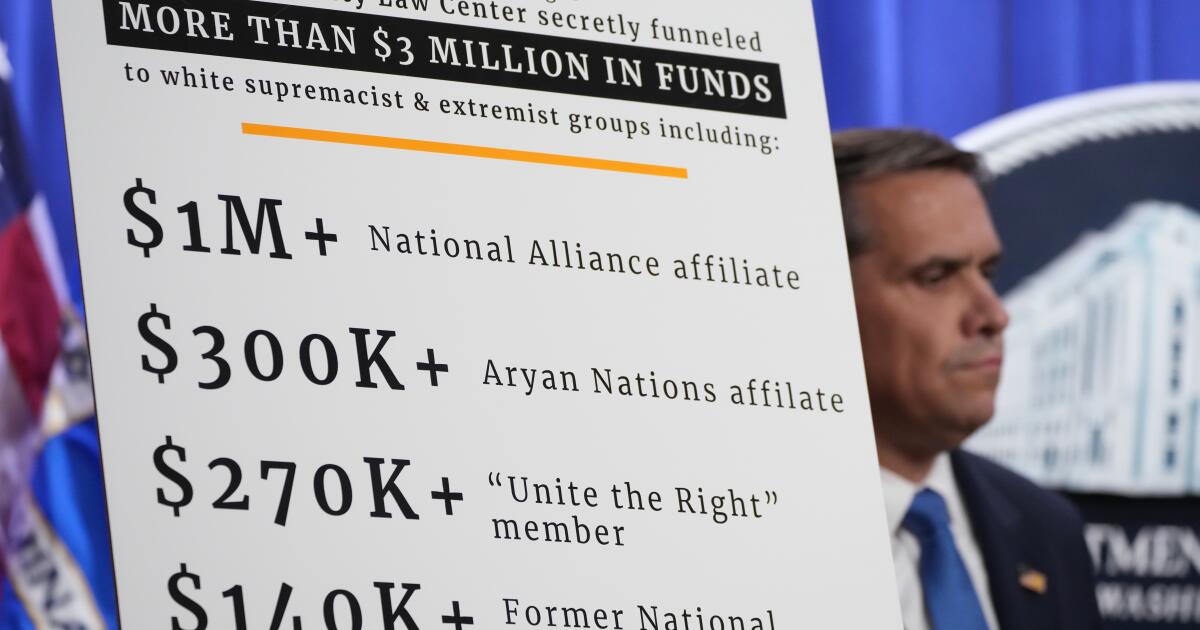
The Department of Justice claims the SPLC bilked donors by funneling cash to informants within hate groups.
An April 21 indictment alleges a raft of crimes including “wire fraud, making false statements to a federally insured banking institution, and conspiracy to commit money laundering.”
The case hinges on the Trump administration’s claim that the law center misled donors about where their money was going. The organization had long worked to gather intelligence about extremist groups, but federal prosecutors say the SPLC did not properly disclose that it was paying active members to leak information.
The indictment charges that “some of the donated funds were to be used by the SPLC to pay high-level leaders of violent extremist groups and others,” including payments that were allegedly “used in the commission of state and federal crimes.”
This week, the legal advocacy organization hit back, demanding the court unseal grand jury transcripts — a highly unusual move it says will show the Justice Department lied or failed to present exculpatory evidence, including records of direct cooperation with the FBI to report crimes that the paid sources helped uncover.
“The Department of Justice is well aware that the SPLC provided helpful information, through the use of its confidential informants, to law enforcement,” attorney Addy R. Schmitt wrote in a motion to unseal the transcripts. “The Department of Justice also knows that these confidential informants helped law enforcement put violent extremists in jail.”
Legal experts called the indictment “absurd.”
This is “just another example of a larger trend of this administration doing everything it can to help the far right, including hate groups,” said Eric J. Segall, a law professor at Georgia State University.
Segall called it “irresponsible and incredibly unlikely” to suggest the nonprofit was working to benefit hate groups rather than expose their activities.
Neither the Southern Poverty Law Center nor the Department of Justice responded to requests for comment.
The fight has already tied up the advocacy group’s finances: Financial firms Fidelity and Vanguard told investors they would not make grants to the organization while federal charges remain pending, according to the New York Times, and the indictment all but ensures an expensive court battle.
The case also arrives at a moment when other bulwarks against violent extremism have been attenuated, with federal investigative resources redirected elsewhere under the Trump administration.
“There used to be quite a few eyes on this,” said Kathleen Blee, a professor of sociology at the University of Pittsburgh. “It’s not being watched very much anymore, and that’s a really bad state of affairs.”
Some are particularly concerned about California, long a hothouse for extremist groups.
“These kinds of groups have deep tentacles in Southern California,” said Peter Simi, a professor of sociology at Chapman University and an expert on hate groups in the state. “You had a substantial presence of white supremacist philosophy that goes back as far as white settlement of the area — it was kind of viewed it as a white supremacist utopia in some respects.”
That animus appears resurgent. The California Civil Rights Department’s most recent annual hate report noted “record levels of hate crimes, targeted violence, and related aggression.”
The groups that the Southern Poverty Law Center has identified in the state include a mom-focused, pro-gun Mamalitia and an anti-Jewish group that calls itself the Committee for Open Debate on the Holocaust.
“None of these groups will say they’re white supremacist,” Simi said. “Everyone’s in the denial business, which makes monitoring and classifying [difficult].”
Efforts to track groups whose hate might turn violent are further complicated by the nebulous, ever-shifting nature of extremism on social media.
For decades, extremist groups recruited in part by offering mutual aid to their members, many of whom had grown up neglected or abused and may have struggled with addiction and untreated mental illness, Simi said. Traditional hate groups, he said, offered both community and an outlet for violence.
That profile doesn’t hold anymore, Simi said. Instead, hatred often arrives through a social media algorithm.
“A lot of the ideas that these groups have been promoting have really become mainstreamed and normalized,” the scholar said. “It’s so much more part of the air that we breathe.”
Said Blee: “You can find the most horrific, hardcore, far-right, extremist, racist, misogynist, antisemitic, Islamophobic ideas and conspiracy tales in the most casual glance at X, or most other social media. There’s all kinds of tantalizing ways that it appeals to people, but you can also just stumble into it.”
Just this week, many Californians opened their official state voter guide to find a page-length antisemitic screed by gubernatorial candidate Don J. Grundmann of Santa Clara. The missive included accusations that conservative activist Charlie Kirk was killed by an Israeli bomb and that Jews plan to enslave American Christians, a claim Grundmann tried to support by mistranslating the Hebrew word for “nations” as “cattle.”
“Antisemitism has been a very core part of far-right extremism as long and as far back as we think about far-right extremism as an organized movement in the U.S. — so the 1870s,” Blee said. “It creates a conspiratorial mentality that brings in other kinds of hatreds. Jews are like the quintessential conspirators.”
She and others worry that these ideologies are now spreading unchecked, with far-right memes and white nationalist messaging spreading across WhatsApp, Telelgram and other online forums.
“Who’s doing the monitoring now?” Simi said. “It’s not the federal government.”
Without an organization such as the SPLC to put a spotlight on hate groups that operate in the shadows, experts said they fear Californians will be left with a false sense of safety.
“People aren’t walking around with Klan hoods on and swastikas on their cheekbones, so people think it’s gone,” Blee said. “But it’s just morphed into something much harder to see and much more pervasive and more influential. It’s part of normal culture.”