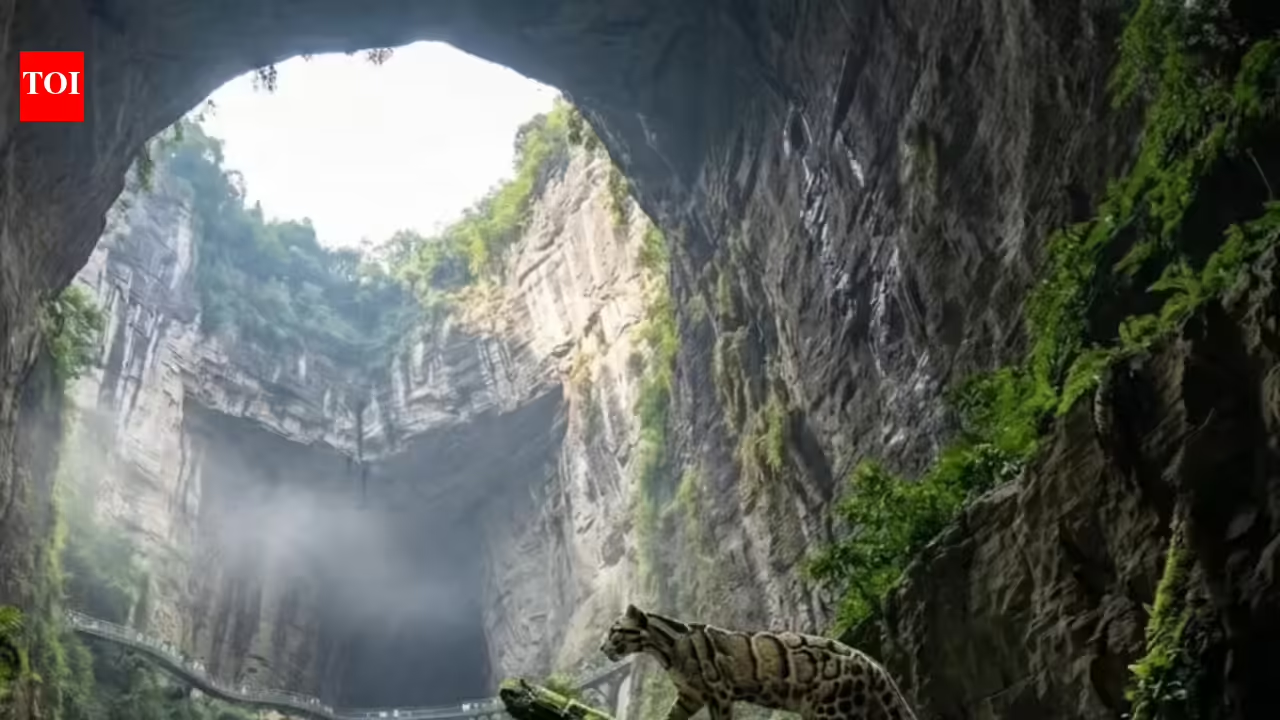
Unique geographical features continue to attract global attention due to their remarkable characteristics. In southern China, the vast Xiaozhai Tiankeng has drawn scientific interest for decades. Deeper than many skyscrapers, it contains a dense, relatively isolated forest ecosystem within its depths.Surprisingly, Xiaozhai Tiankeng is a colossal pit that has been isolated from the rest of the environment for millennia. This geological attraction is situated in the territory of Chongqing Municipality, China and can be viewed as a unique ecosystem. It is claimed to be the largest sinkhole on the planet, reaching a depth of up to 626 meters and a diameter of 527 meters. Compared with other incredible structures on Earth, this is much taller than many skyscrapers and could easily fit several football stadiums inside.Viewed from above, Xiaozhai Tiankeng resembles a vast cavity in the ground that opens like an entrance to an underground kingdom. Its walls fall down, forming the bottom that is usually covered by fog. However, what makes the attraction unique is the flora and fauna that inhabit the underground layers.The formation of the “heavenly pit” in ChinaThe term “Tiankeng” literally translates to “heavenly pit” and is widely used in China when referring to large sinkholes.Geological studies have revealed that the formation of Xiaozhai Tiankeng took several thousand years. Water seeped through the layers of porous limestone, widening fissures as it dissolved the rock. Concurrently, a subterranean stream had carved gigantic caverns beneath the earth’s surface. Ultimately, a massive sinkhole was created due to the collapse of the earth above it.Research findings indicate that the formation of Xiaozhai Tiankeng might be a multi-phase process. It has a larger upper chamber and a smaller lower one. This distinct formation pattern gives Xiaozhai Tiankeng its uniqueness compared to other sinkholes across the globe.According to the United States Geological Survey, sinkholes are most common in regions with karst topography. In such regions, water readily erodes soluble rocks such as limestone, leading to the formation of these structures.
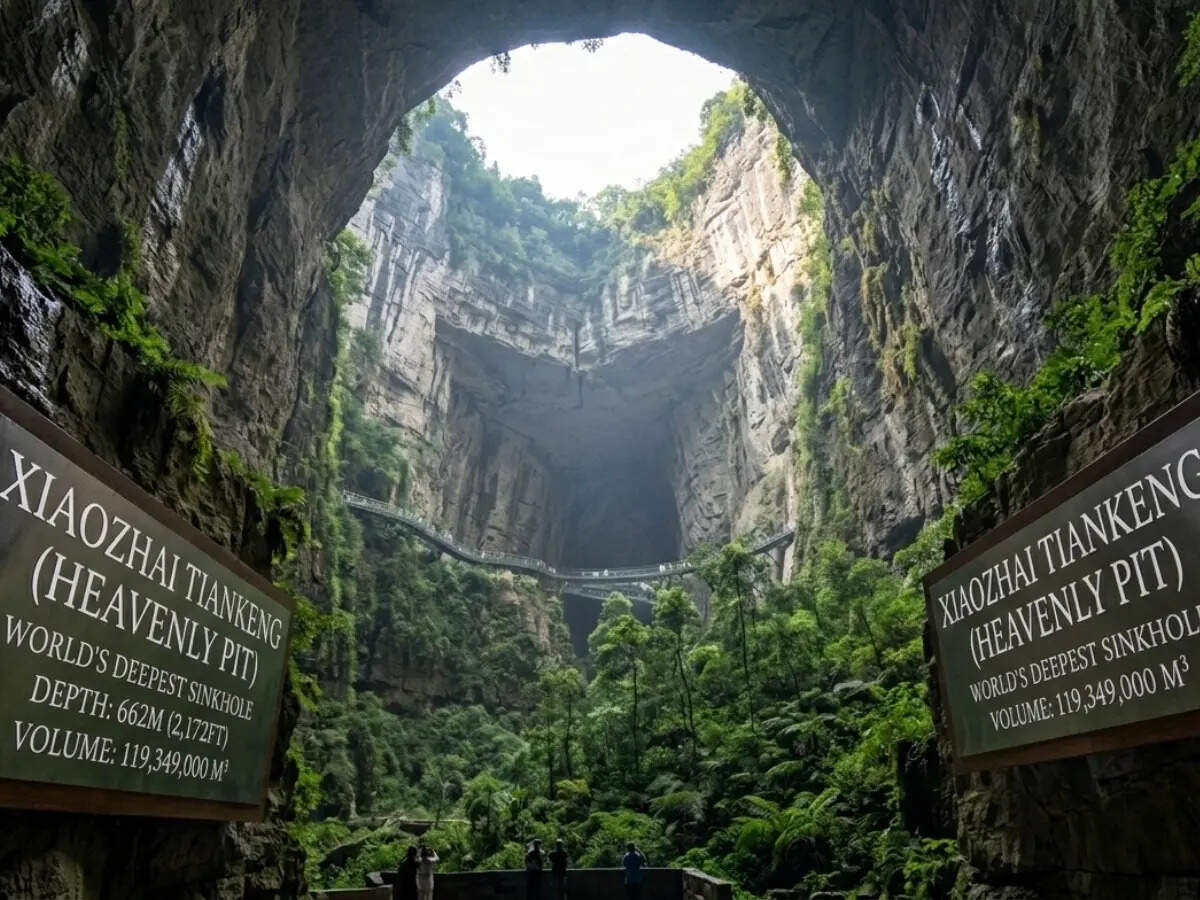
Scientists view this isolated ‘lost world’ as a crucial natural laboratory for studying biodiversity and climate change adaptations. Image Credits: Google Gemini
An ecosystem underground Xiaozhai TiankengThe bottom of the Xiaozhai Tiankeng has a thick layer of subtropical forest despite the scarcity of sunlight there. Over the years, the secluded habitat has evolved its unique microclimate. The humidity and coolness of the air have created ideal conditions for flora and fauna.Over 1,200 plant species have been identified in the sinkhole. Among them are ancient trees such as the ginkgo, as well as ferns, mosses, and other species that can tolerate shade. It is possible that some species could be unique to the area due to years of isolation from other plants.Various animals have adapted to living in this place. For instance, the endangered clouded leopard has been observed in this area, along with various birds and mammals. Experts believe that ecosystems like this can provide valuable information on biodiversity and evolution.According to a 2024 study conducted by Chinese scientists, plants in sinkholes like Xiaozhai are adapted to growing in dark conditions. Such plants have lower levels of carbon but larger amounts of nutrients, such as nitrogen and phosphorus.What makes scientists curious about the massive sinkholeThe discovery of a self-contained ecosystem within this enormous sinkhole raises new questions about adaptations to climate change and the survival of organisms. In particular, Xiaozhai Tiankeng is considered a natural lab by researchers.“This kind of environment allows researchers to observe how plants and animals adjust to limited light and unique climate conditions. This explains the significance of conserving fragile ecosystems, since the area, due to its remote location, has faced limited human interference. However, the emerging popularity might endanger this rare ecosystem.Environmentalists note that such ecosystems must be studied carefully, as their conservation may serve as examples of how ecosystems adjust to environmental changes and become fragmented as a result.Xiaozhai Tiankeng is a lost world on EarthThe hidden ecosystem seems to be disconnected from the outer world. Due to its isolation, the unique life within the sinkhole has had the chance to develop without being affected by any external factors.Thus, researchers refer to Xiaozhai Tiankeng as “a lost world” because of the amount of secrets that await discovery in the depths of this amazing place.