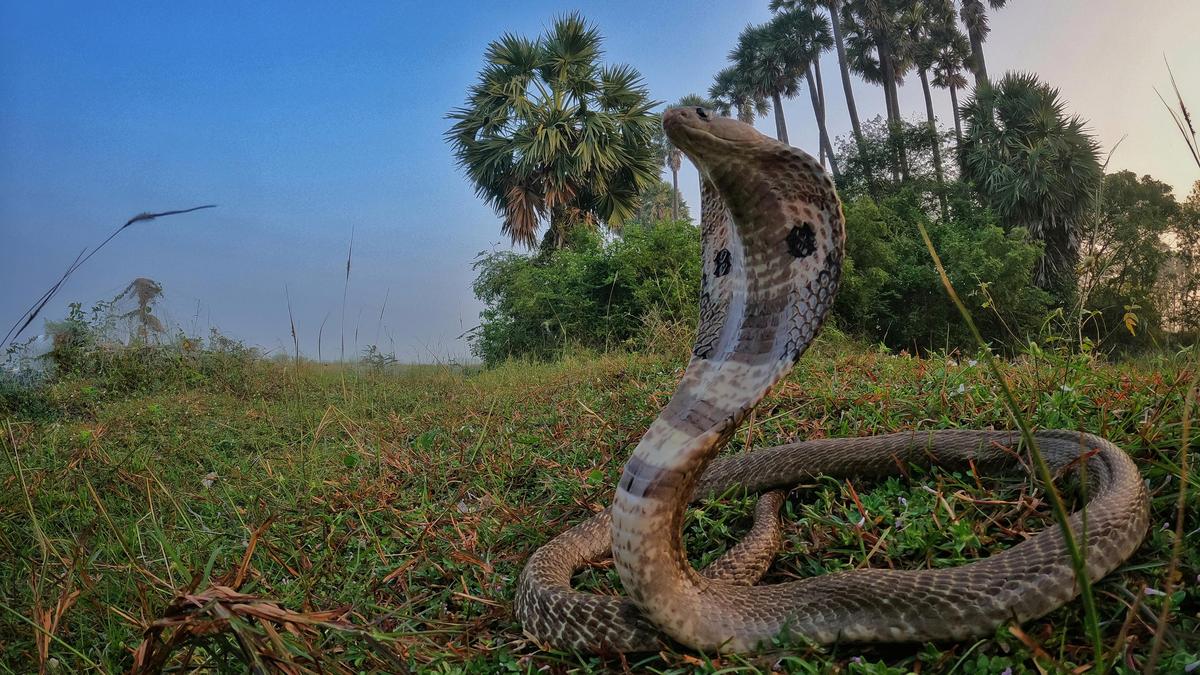
A spectacled cobra, one of India’s ‘Big Four’ species.
| Photo Credit: SPECIAL ARRANGEMENT/The Hindu
As India has progressed, the stereotyped image of the “land of snake charmers” has been left behind. We now have snake rescuers. However, in rural areas, snakebites still account for 58,000 deaths every year, affecting workers in paddy fields as much as subsistence farmers in dry landscapes.
Snake venoms generally cause three types of damage: blood disorders, muscle paralysis, and tissue death. Viper bites commonly cause blood-related disorders, while elapid snakes (like cobras) typically trigger nerve-related paralysis.
A standard antivenom has been designed against the venom of India’s ‘Big Four’ species: spectacled cobra, common krait, Russell’s viper, and saw-scaled viper. Venom from these snakes is needed for making this antivenom. Most of India’s requirement of snake venom is met by snakes captured in paddy fields and the scrublands of Tamil Nadu by tribals of the Irula Snake Catcher’s Industrial Co-operative Society.
A cocktail of venoms from the four species is injected into horses in non-lethal doses, and the animals are hyper-immunised by repeated injections. Horses are chosen because they are large animals and are easy to handle. Their immune system reacts, producing antibodies in large quantities. When ready, blood is drawn from the horses. Plasma containing the antibodies is processed to isolate toxin-binding antibody fragments, which are then tested, freeze-dried, and distributed in vials.
This method has been in practice since the 1950s, and has several limitations. India has over 60 venomous snake species. Snakes from different geographical regions have different toxin constituents in their venom, even within the same species. The ‘Big Four’ antivenom is not quite up to the task in many scenarios. This has driven research towards creating a therapy that is specific to a region or is universally effective.
Recent findings (Nature 647, 716, 2025) have taken us closer to a broad-spectrum treatment for snake bites. A Danish laboratory along with international collaborators focused on snakes in sub-Saharan Africa, where snakebites lead to 10,000 amputations every year. The researchers collected venom from the 18 snake species of the region that are medically important (including cobras and mambas) and injected the mix into an alpaca and a llama. These animals are related to camels and are native to South America. The camel family was chosen because it has unusual antibodies that yield small, stable fragments called nanobodies. A strong immune response is generated to the injected toxins, providing a potent source of highly effective neutralisers.
At this stage, B cells that produce antibodies are collected from the blood. The DNA that codes for the nanobodies is genetically engineered into the genome of bacteriophage viruses. The virus particles express nanobodies on their surface. The nanobodies that bind most strongly to snake venom toxins are selected. These nanobodies can now be mass-produced cheaply in bacteria, instead of in horses. In experiments performed on mice, strong antivenom activity was observed against 17 of the 18 snakes whose venoms were included in the study.
Coming to Indian snakes: researchers at the National Research Centre on Camel at Bikaner in Rajasthan have shown that antivenom generated in camels is able to neutralise the effects of venom from Sochurek’s saw-scaled viper, which is found in this region (Toxicon 134, 1, 2017). Expanding this to other medically important snake species will help in tackling what the World Health Organisation has classified as a neglected tropical disease.
The article was written in collaboration with Sushil Chandani.
Published – December 26, 2025 08:00 am IST