- The XVI Finance Commission expands funding for urban local bodies, making fiscal transfers more substantial, and shifts the allocation framework towards performance-based criteria.
- It introduces structural reforms to strengthen decentralisation, incentivise state commitment, improve transparency, and prioritise urban environmental services.
- Despite these advances, critical areas of concern remain, including undifferentiated revenue targets, weak participatory planning, and insufficient audit and data verification mechanisms.
- The views in the commentary are that of the author.
The finances of Urban Local Governments (ULGs) are constrained by multiple structural issues. Since the 74th Constitutional Amendment, the Central Finance Commission (FC) has been mandated to review urban finances and recommend devolution from the centre to ULGs through state governments. The funds and reforms proposed by successive FCs have shaped the evolution of municipal finance in India — sometimes producing unintended outcomes.
The XVI FC marks a decisive step toward strengthening ULG fiscal empowerment and accountability. Through systemic incentives — linking grants to own source revenue (OSR) performance, state co-financing, and transparent reporting — the Commission has internalised the logic of fiscal responsibility across tiers.
By raising the share of ULGs to 45% that includes 40% grant (60% to rural area) and also special grants of ₹661 billion to urban sector, XVI FC restores balance between tied and untied grants. It supports rural — urban transition, and prioritises environmental infrastructure and sets a new benchmark for cooperative urban federalism. However, it has missed some reforms that could have added depth and dynamism.
Enabling local bodies through incentives and reforms
A persistent issue across FCs, reiterated by the XVI FC, is the inadequacy of OSR and the underutilisation of property tax, the mainstay of OSR. The Commission noted that heavy dependence on higher levels of government weakens local autonomy and accountability. Among available local tax sources, property tax has the greatest potential but remains severely underexploited.
Building on this concern, the XVI FC introduced a major shift in the criteria for horizontal distribution of urban local body grants. While earlier commissions, especially the XIV and XV, relied on population (90% weightage) with a small weight for area (10%), the XVI FC reduced area’s weight for urban local bodies and adopted OSR index, with population at 90% and area at 10%. This change ensures that states with stronger own-source revenue performance receive higher grants, thereby incentivising revenue enhancement.
Further strengthening this approach, 20% of total urban local body grants have been made performance-linked, with 10% allocated to each state and ULB. They (ULBs) are required to demonstrate 5% annual growth in OSR to qualify for their share of performance grants. Thus, the FC embeds direct incentives for revenue augmentation and property tax efficiency.
At the same time, the commission highlighted, for the first time, the weak alignment between FC allocations and state-level transfers to urban local bodies. It observed that relying on FC grants as “gap-fillers” risks complacency in both state and local revenue efforts. It emphasised that the primary responsibility for financing urban local bodies lies with the states, and that FC grants should supplement rather than substitute for state transfers. Data analysis revealed wide disparities in how States fund local bodies — some providing substantial resources while others contribute minimally.
To address this, the XVI FC introduced a State Performance Grant component of ₹290.16 billion, which states can access only if they transfer at least 20% of the FC’s allocation for urban local bodies from their own resources. This links FC transfers to the state fiscal commitment toward local bodies.
Alongside fiscal reforms, the commission addressed the long-standing absence of a clear policy for transitioning rural areas, particularly census towns and peri-urban regions, into statutory urban local bodies. It stressed that timely and rule-based identification of urban areas, supported by proper planning and financing, is essential for efficient urbanisation. The FC recommended that states adopt clear, time-bound transition policies.
For the first time, the FC introduced a one-time grant of ₹100 billion for census towns or peri-urban areas merging with adjoining urban local bodies with a population above one lakh, with eligibility contingent on states framing a rural–urban transition policy. This grant is intended to support the augmentation of urban infrastructure and services in newly incorporated areas.
The commission also addressed the historical under-recognition of the urban population in grant allocations. Earlier FCs did not adequately reflect the urban share in India’s total population, which itself is often underestimated. While the XV FC made a partial correction, the XVI FC advanced this by allocating 40% of basic local body grants to urban local bodies, based on a projected urban population share of 40.73% by 203. In addition, it introduced a ₹561 billion Special Infrastructure Grant and the ₹100 billion Rural–Urban Transition Grant, increasing the overall share of urban local bodies in total local government grants to 45%.
Finally, the commission revisited the balance between tied and untied grants, a key indicator of fiscal decentralisation. While tied grants support priority services, an excessive bias undermines local autonomy. Earlier FCs, such as the XIII (75%) and XIV (80%), maintained a higher proportion of untied grants, whereas the XV FC reduced untied grants to 21% only. The XVI FC restored a more balanced approach by recommending that 50% of the basic grant component be tied to sectors such as sanitation, solid waste management, and water management, and the remaining 50% be untied, while keeping the entire performance component untied. As a result, about 60% of total local body grants will now be untied, allowing urban local bodies greater flexibility. ULGs retain flexibility even within the tied component to meet local operations and maintenance needs.

Fixing persistent gaps
The XVI FC marked a substantial shift in the scale and design of support to urban local bodies, recommending a 294% increase in allocations compared to the XV FC, or about 230% when the interim year is included. Though past increases appeared higher in percentage, they were on much smaller bases; the XVI FC increase is unprecedented in scale and substance.
Alongside this increase, the commission continued to prioritise urban environmental services, allocating 50% of the basic grant component to water supply, wastewater, and solid waste management. It also introduced a ₹561 billion Special Infrastructure Grant focused on wastewater management in 22 cities, with two cities per state identified, each with a population ranging from 1 to 4 million, as per the 2011 census. Funding caps have been set at ₹50 billion for cities with populations above 1.5 million and ₹35 billion for smaller cities, with a 60:40 cost-sharing arrangement between the union and states.
The commission retained and reinforced the institutional and accountability conditionalities introduced earlier, requiring the conduct of regular urban local body elections, the timely constitution of State FCs, the tabling of Action Taken Reports in state legislatures within six months of submission, and the publication of audited accounts of urban local bodies. These provisions aim to ensure adherence to constitutional mandates and strengthen fiscal discipline. In addition, to improve transparency and comparability of fiscal flows.
States are now required to disclose all transfers to local bodies separately for rural and urban entities, including transfers from Union FC recommendations, Centrally Sponsored Schemes, State FC grants, and State government resources.
Building on earlier reforms, the XVI FC also mandated that all urban local bodies publish Service Level Benchmark data. Recognising concerns around data quality, it directed the Ministry of Housing and Urban Affairs (MoHUA) to establish third-party assessment or audit mechanisms in consultation with states, urban local bodies, and the Comptroller and Auditor General of India to ensure reliability.
The commission further addressed delays in fund flows by recommending that grant disbursements no longer depend solely on statewide compliance. Instead, eligible ULGs that meet the prescribed criteria will receive funds directly. This reform enhances predictability and reduces penalisation due to state-level delays.
Unfinished agenda
The XVI FC commendably advanced India’s urban agenda, but it overlooked certain reforms that could have added further depth and dynamism. These gaps, though not addressed in the report, remain within the domain of the Union and State Governments to take forward.
One such area is the lack of a differentiated approach to OSR growth. The XV FC required property tax growth to match nominal state gross domestic product (GSDP), the total value of all goods and services produced within a state measured at current market prices, without adjusting for inflation). Most urban local bodies failed to meet the condition, leading to a decline in the number of eligible states receiving grants from 22 in 2023–24 to 16 in 2024–25. Smaller urban local bodies, particularly those with populations below one lakh, were disproportionately affected. While the XVI FC eased this requirement to a uniform 5% annual growth in OSR, it applied the same benchmark to all urban local bodies. Given the varying capacities of cities, a differentiated framework would have been more appropriate, with larger urban local bodies expected to match or exceed nominal GSDP growth, medium-sized cities targeting a proportion of such growth, and smaller urban local bodies continuing with a modest but achievable benchmark.
Read more: India’s updated climate plan targets 47% emissions cut and 60% clean power capacity by 2035
Another notable gap is the absence of a push for participatory capital investment planning. ULGs lack long-term infrastructure vision and citizen engagement, leading to poor prioritization and governance. XVI FC should have mandated participatory Capital Investment Plans or City Investment Development Plans (CIP/CIDP) preparation as a condition for performance grants or provided special grants for this purpose.
Concerns around transparency also persist. While the XVI FC retained XV FC’s condition of publishing audited accounts online, it acknowledged ongoing issues related to data quality. In practice, many urban local bodies upload financial statements without independent verification, omit auditor observations, and present data that is not always reliable for assessing performance. Stronger measures could have been introduced, including the timely publication of annual accounts, mandatory independent statutory audits with full disclosure of audit notes, and mechanisms under the supervision of the Comptroller and Auditor General of India to verify the availability, quality, and reliability of financial and performance data.
Beyond allocations, its real significance lies in transforming India’s municipal finance architecture — from dependence to performance, from ad hoc transfers to predictable, rules-based devolution. The challenge ahead will be maintaining the momentum of these reforms to realise the vision of financially empowered, accountable, and service-oriented urban governance.
The author is a freelance consultant and visiting professor in urban finance and governance.
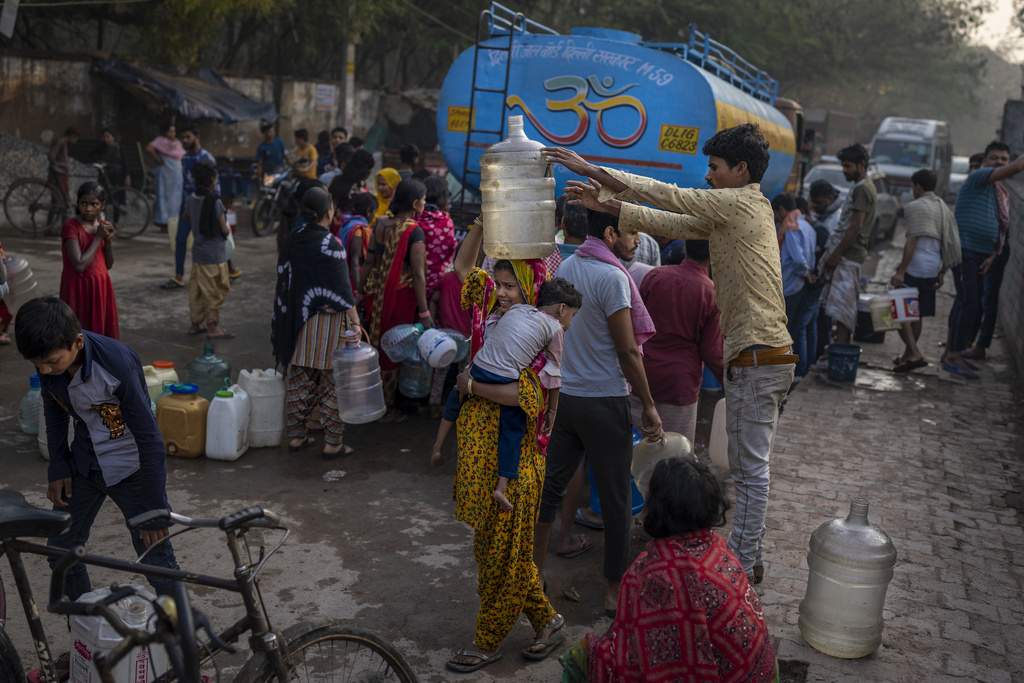
Banner image: A woman balances a water can on her head as people collect water from a mobile water tanker in drought-stressed New Delhi. (AP Photo/Altaf Qadri)