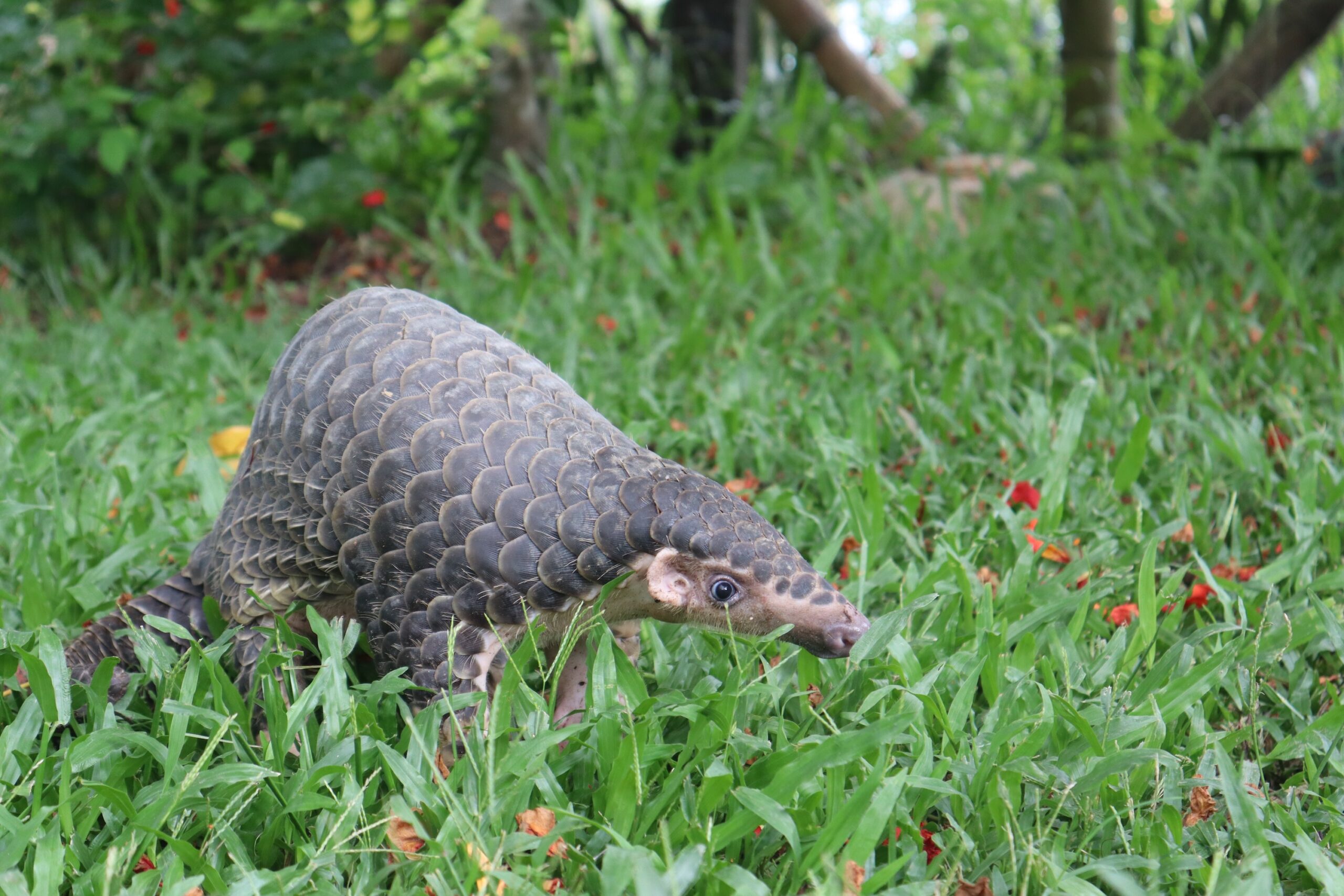
- The Sangtam Naga community has passed a resolution banning pangolin hunting to address wildlife trafficking along the India-Myanmar border.
- Nagaland is a critical wildlife corridor for the illegal trade, with pangolins being the world’s most trafficked mammal.
- While pangolin hunting is already banned under India’s wildlife law, enforcement in Nagaland’s districts, where governance is largely community-driven with customary laws, becomes difficult. A community-led ban has greater influence.
In Nagaland’s Kiphire district, along the porous Indo-Myanmar border, pangolins have been hunted for decades — once due to cultural beliefs, and increasingly for trade, in a region identified as a key wildlife trafficking route.
“Our forefathers would say that if a pangolin enters a house, it was considered a bad omen or curse,” says L. Kipitong Sangtam, 61, a resident of Amahator village in Kiphire district. “In the past, if someone encountered a pangolin, they would try to catch and kill it, sometimes by digging it out of its burrow.”
Now, conservationists in Nagaland are turning to village councils and customary courts, to protect the elusive mammal. Though pangolin hunting is banned under India’s Wildlife Protection Act, enforcement remains difficult. So, conservationists are working with local tribal bodies, that have a greater influence in the state, to push for a local ban and safeguard the species.
Earlier this year, the United Sangtam Likhum Pumji (USLP), the apex tribal body of the Sangtam Naga community, passed a resolution for a community-led ban on pangolin hunting in 42 villages of Kiphire district. The Sangtam Naga community is a major ethnic group in Nagaland, primarily inhabiting the Kiphire and Tuensang districts.
The move comes amid growing concerns over trafficking of the critically endangered Chinese pangolin (Manis pentadactyla) along the Indo-Myanmar border, as well as pangolins hunted for local consumption.
A biodiversity hotspot under pressure
Kiphire, located around 254 kilometres from Nagaland’s capital Kohima, lies within the Indo-Myanmar biodiversity hotspot. It is home to the Fakim Wildlife Sanctuary which lies at the foot hill of Mount Saramati, the highest peak in Nagaland. This peak forms a natural barrier between Nagaland and Myanmar.
The region’s rich biodiversity also makes it highly vulnerable to illegal wildlife trade, and subsistence hunting.
“Pangolins help farmers,” says Kipitong, who is part of USLP. “They eat insects that damage crops, so they are useful for agriculture. This is one of the reasons why we now believe they should be protected,” he adds.
Shifting cultivation forms a significant part of livelihood in villages around this region.
Testing the model from Manipur to Nagaland
The USLP resolution builds upon a similar initiative in neighbouring Manipur where the Tangkhul Naga Awunga Long (TNAL) imposed a ban on pangolin hunting across 252 Tangkhul Naga villages under Wildlife Trust of India’s (WTI) Countering Pangolin Trafficking Project.
“There was significant pangolin trafficking reported from Manipur between 2010 and 2015,” says Monesh Tomar, assistant manager and officer-in-charge at WTI. “The region is a known route connecting India to the Golden Triangle, making it a critical corridor for wildlife trafficking. Our aim was to counter this illegal trade,”
The Golden Triangle is a border area where Thailand, Laos and Myanmar meet.
According to WTI officials, the ban in Manipur gradually saw a favourable response after continuous community engagement.
In 2024, amid ongoing conflict in Manipur, WTI officials say they shifted focus to Nagaland, as trafficking routes moved to this state.

Demand, trade and changing patterns
The pangolin is the world’s most trafficked mammal, primarily targeted for their scales, meat and body parts. The species is protected under Schedule I of India’s Wildlife Protection Act, 1972. In 2016, all eight species of pangolins were moved to the Appendix I of CITES (Convention on International Trade in Endangered Species of Wild Fauna and Flora), which bans the international commercial trade of all pangolin species.
Between 2016 and 2024, globally, more than 530,000 pangolins were seized. In India, over 1,000 pangolins were found in the illegal wildlife trade from 2018-2022.
“While they [pangolins] have been hunted for local consumption for decades, the primary threat today comes from the global trade in their scales — falsely believed to have medicinal value — driven especially by demand in traditional Chinese and Vietnamese medicine,” says Araluen “Azza” Schunmann, director of the Pangolin Crisis Fund.
The population of pangolins in Nagaland or globally is unknown. Experts attribute this to limited studies and the species’ elusive nature. Pangolins have very low reproductive rates, usually giving birth to just one to three pups per year. The lack of baseline data makes it difficult to determine if conservation efforts are leading to recovery.
“Most available data is not about how many pangolins exist, but how many are being hunted, seized, or traded,” says Mukesh Thakur, wildlife forensic expert, Zoological Survey of India, Kolkata.
The nature of the trade may be shifting.
“Now, most cases we see are at the local level — people hunting pangolins for consumption or small-scale use,” Thakur says. “In many parts of Northeast India, hunting is driven by subsistence and local demand. People depend on bushmeat, and pangolins become part of that. Sometimes, the scales are also used locally to make ornaments.”
The complex political situation of the region makes it difficult to point at a particular cause for an increase in localised incidents.
“After COVID-19, pangolins were suspected as a possible intermediate host,” Thakur adds. “Stricter regulations and bans in countries like China may have contributed to reducing demand.”

A porous border and complex enforcement
Policing wildlife trade along the Indo-Myanmar border comes with multiple challenges. A Wildlife Crime Control Bureau (WCCB) official, on condition of anonymity, said that the social fabric is an important factor that poses a challenge in the Indo-Myanmar region.
“Many communities living along the border have relatives on both sides — India and Myanmar,” the official says. “So culturally and socially, these regions are deeply interconnected. Because of this, movement across borders has historically been common.”
The official adds that this makes enforcement more complicated, as they are not just dealing with geography or law enforcement, but also long-standing social ties. “So when we talk about restricting hunting, it is not just a legal issue but a social and cultural one,” the official says. “This makes enforcement alone insufficient. You need community engagement and behavioural change alongside it.”
Can community-led bans work?
In Nagaland’s districts, governance is largely community-driven with customary laws regulating land and resources.
“In such a setup, enforcing central laws like the Wildlife Protection Act becomes difficult,” says Tomar, adding that many communities are not fully aware of these laws, and enforcement is complicated because officials and community members often belong to the same social networks.
Instead of pushing for a complete ban on pangolin hunting immediately, villagers are being encouraged to provide temporary protection — five to ten years — to allow pangolin populations to recover.
It is estimated that an adult pangolin can eat more than 70 million insects a year and has a significant impact on forest termite population control. Since the villagers’ livelihoods depend heavily on wood, bamboo, and forest produce, termite infestations are a real concern for the Sangtam community.
“We explained how pangolins help control termite populations, consuming millions over their lifetime,” Tomar says. “We also highlighted that declining pangolin populations could lead to increased pesticide use, which would harm future generations.”
Tomar adds that their approach focuses on awareness and behavioural change rather than incentives.
“If communities themselves reject pangolin hunting and trade, it becomes much harder for external traders to operate,” he adds.
Under the USLP resolution, village councils are responsible for enforcing the ban, with violations handled through customary courts.
The way forward
Despite continuous challenges, conservationists remain optimistic.
“Pangolins are resilient,” says Schunmann. “So while the situation is serious, we remain optimistic that, given space and protection, pangolins have a real chance of recovery over time, even in high-pressure regions.”
Kipitong, too, is hopeful. The young people in the villages are returning home from big cities, aware of environmental and wildlife conservation, he says.
“We are confident that the ban will be successful because the villagers have understood and agreed to protect the species,” he adds.
Read more: Indigenous knowledge to track and save the Chinese pangolin
Banner image: A Chinese pangolin rescued and released by Wildlife Trust of India in Arunachal Pradesh. Image by Panjit Basumatary/WTI.