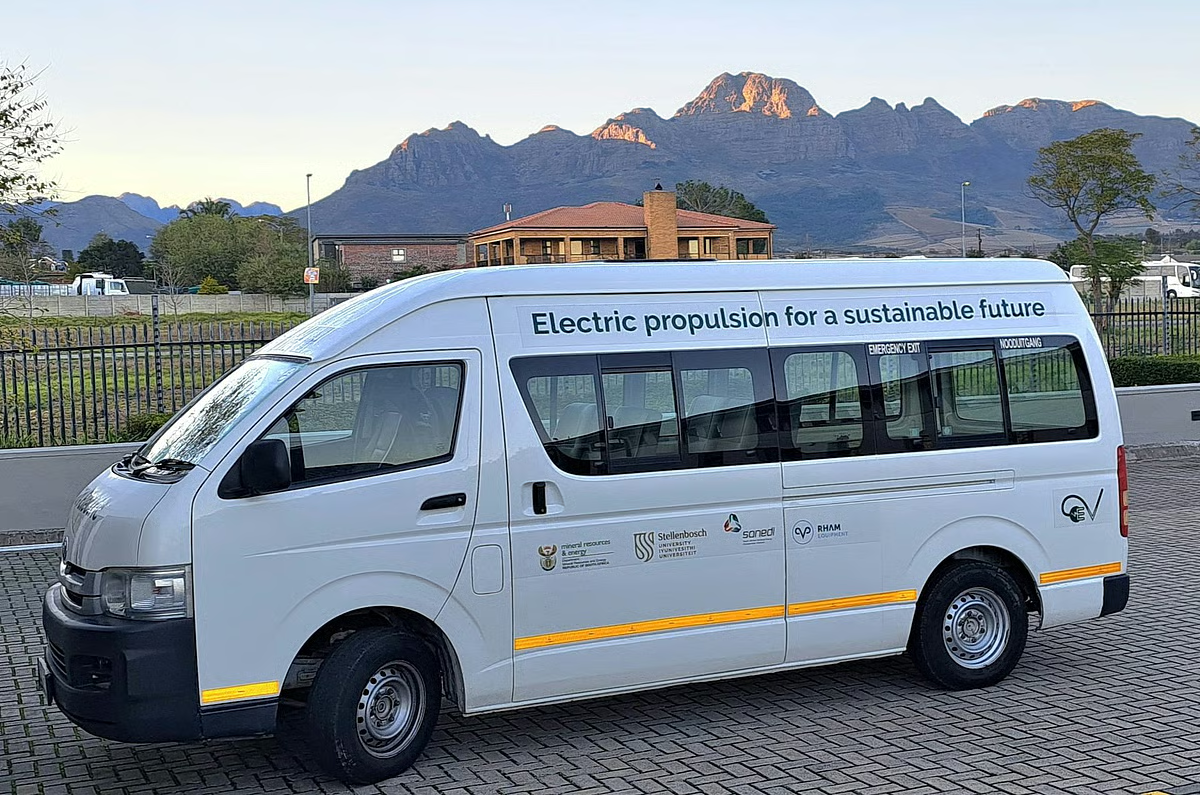
But because these vehicles run on petrol and diesel, they also contribute to greenhouse gas emissions, poor urban air quality and rising fuel costs.
The global shift away from internal combustion engines is accelerating, and public transport must be part of it. Bringing the electric vehicle transition to this sector, however, is not simply a matter of replacing one vehicle with another. In African paratransit systems, electrification raises a harder question: how do you change the vehicle without undermining the service on which so many people depend?
Electric minibuses would change how these vehicles operate, where and when they stop, how they interact with the grid, and driver decision making. They also require charging infrastructure that fits into the rhythms of taxi ranks, neighbourhoods and routes without disrupting service.
With Cape Town expected to launch its first few fully electric minibus taxi routes in Century City , electrification is no longer a distant possibility. It is now urgent to understand whether it can work in practice for operators, passengers and the electricity grid.
We are studying transport electrification in sub-Saharan Africa. In a series of studies, we have examined viability of electric vehicles under , including charger placement, access, and .
Our new research that electrifying minibus taxis is both necessary and possible. But it is also a complex challenge, with environmental trade-offs, grid constraints, operator costs and equity questions. Although our work focuses on Cape Town, the lessons are relevant to other African cities where paratransit dominates daily mobility.
Environmental perspective
The often assumes they are a simple win for the climate. But this does not hold everywhere, especially where electricity still comes largely from fossil fuels. In South Africa, coal accounts for approximately .
Using real minibus taxi mobility patterns in Cape Town, our research compared the energy use, emissions and costs of electric and conventional minibuses. It found a counter-intuitive result: under current grid conditions, an electric minibus taxi has about a than a standard diesel minibus. In other words, charging an electric taxi on a coal-heavy grid can currently produce more greenhouse gas emissions than running a diesel vehicle.
That is not the end of the story. Electric minibuses still offer major environmental and health benefits. They eliminate tailpipe particulate pollution, reduce brake wear, and cut noise. These local benefits matter in dense urban areas where people live close to busy roads. As South Africa’s electricity system shifts towards , the climate case for electric minibus taxis will strengthen too.
So the real conclusion is not that electric taxis are a bad idea. Rather, they are a long-term climate solution whose immediate value lies especially in cleaner air, lower noise and better urban health.
Energy perspective
Electrifying Cape Town’s minibus taxi fleet would add substantial new electricity demand. In , the typical vehicle required about 50.8 kWh per day, scaling to roughly 460 MWh a day across a fleet of about 9,000 vehicles, or the equivalent of about . The key issue is not just how much energy is needed but where and when vehicles charge.
Here, the newer work changes the story. It is tempting to think the answer is simply to install faster chargers at taxi ranks. But our modelling suggests that access to charging matters more than charging speed alone. Home or secure neighbourhood charging has the biggest effect on whether and on how well the system performs when .
A typical daily charge of around 50 kWh might take roughly two to three hours on a 22 kW charger, or just over an hour on a 50 kW charger, though real charging times vary. But faster charging does not solve the real problem: drivers still need reliable places and enough stationary time to charge without undermining service or losing income.
The that chargers should not be planned only for formal taxi ranks. Infrastructure stops and informal stops matter too, because that is how paratransit actually works.